Dispatch: Why Nurses Are Still on Strike at New York Presbyterian
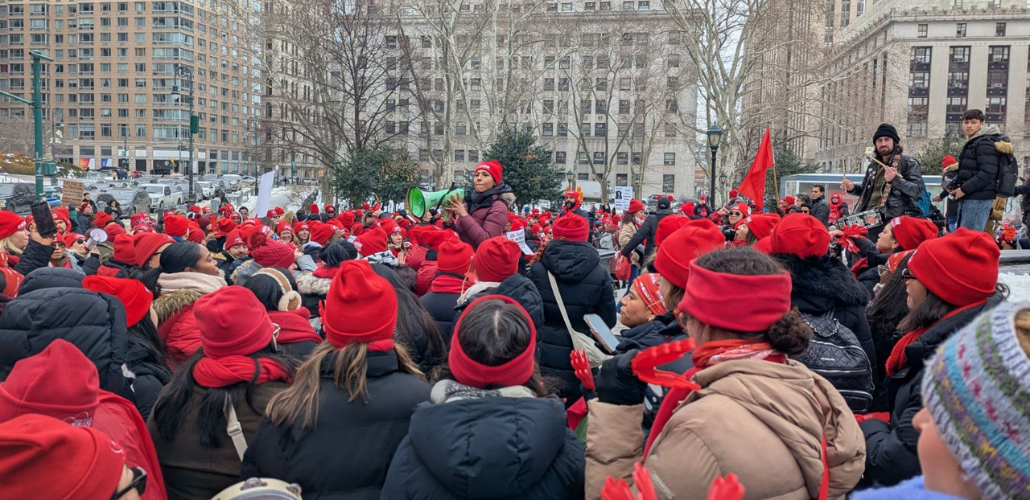
Nurses marched over the Brooklyn Bridge on February 3. While New York State Nurses Association members at Mount Sinai and Montefiore have gone to back to work after ratifying contracts, 4,200 nurses at New York Presbyterian remain on strike. Photo: A.J. Schumann
Editors’ note: As of today, 4,200 nurses at NewYork-Presbyterian are still on strike at hospitals in upper Manhattan. They first walked out more than a month ago, and they’ve kept strike lines open after voting down a tentative agreement 3,099 to 867 last week.
Nurses say NYP still hasn't met their demands for adequate staffing, job security protections, and proper enforcement mechanisms even for agreed-upon staffing ratios.
Sindhu Sundar spoke on February 13 with Sophie Boland, who is on the bargaining committee and is a pediatric ICU nurse at the NewYork-Presbyterian Morgan Stanley Children’s Hospital in Manhattan.
Enforcing staffing ratios is still a problem. We have units that went into staffing arbitration in 2023, and their cases still have not been heard in arbitration. The hospital just doesn’t agree to any dates, because they’re not bound to, in our contract.
A mechanism [to enforce staffing ratios] exists, but it’s broken. [Some cases have made it through arbitration. Earlier this week, an arbitrator awarded NYP nurses in a pediatric care unit $400,000 over understaffing, the third such type of award to the system's nurses. But NYP has so far appealed all the awards to federal court.]
We also really need improved staffing, in units like the Emergency Department—the ED at times has up to 15 patients per nurse. It’s totally unacceptable. There’s absolutely no way that a nurse can take care of 15 ED patients at one time.
We are also fighting for language for job security in our contract. Last spring, the hospital did sweeping layoffs—2 percent of the workforce, around 1,000 health care workers, not all of them nurses.

They ended up closing down less-lucrative units—they closed the palliative care unit, because dying patients don’t make them that much money. And this was a unit of incredibly specialized palliative care nurses, who spent their careers caring for dying patients.
They closed down the pediatric specialty infusion clinic. They closed an entire division of specialty nurse practitioners, some of whom have been in this hospital with years or decades of institutional experience.
So they’ve been doing this effort to union-bust by eroding the bargaining unit.
From the very beginning, we’ve been intentional about transparency and establishing trust with our members. And that’s been priority one from the very beginning of this fight. So when word got out that NYSNA was looking to ratify this contract over our heads, we were quickly able to get that message out and mobilize people and tell them that this wasn’t coming from us.
Our executive committee president got on Instagram live, and was telling our members what we knew and what was going on. We sent out messages saying “The strike lines remain open,” that people should still come to the strike lines.
Ultimately, the membership voted no on the ratification. And many who voted yes have said, “I’m so happy that the ‘No’ vote went through, and I’m definitely not crossing that line.”
For information on picket line locations, visit nysna.org/strike.