
In the Twin Cities, a Massive Strike Against ICE
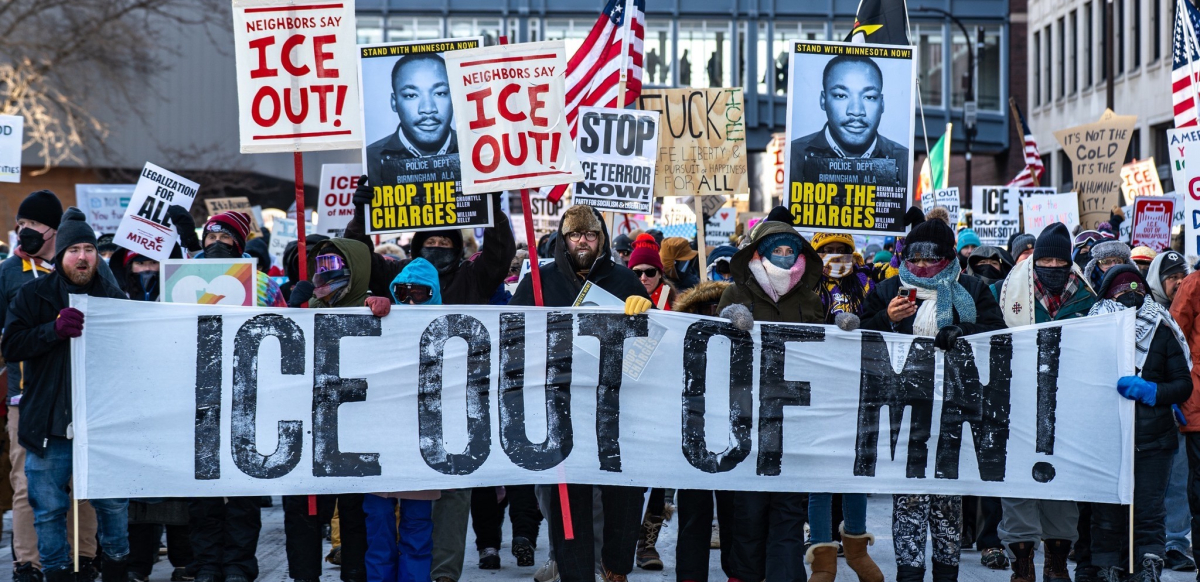
Union workers led the enormous protests of ICE on January 23 in Minnesota. Dozens of unions and the Minnesota Federation of Labor signed on. Photo: Brad Sigal
Icicles hung from the beards of men in union beanies. The lobbies of large commercial buildings in downtown Minneapolis opened to the public for respite filled with people rubbing each other’s sore feet, peeling the sticky adhesive off foot warmers to place them under their socks, and jamming their feet into thickly insulated boots.
On January 23, what looked like at least 100,000 people marched in downtown Minneapolis in a protest dubbed “ICE Out of Minnesota: Day of Truth and Freedom.” They braved temperatures as low as -20°F, with their glasses fogging over, the frost crusting into a thin film. They were demanding that Immigration and Customs Enforcement and its thousands of masked agents wielding war-style weaponry leave the metropolitan area. They also demanded the prosecution of the agent who killed legal observer Renee Good, and that Congress reject additional funding for ICE.
The first major event began around 10 a.m., a protest at Minneapolis–Saint Paul International Airport organized by clergy and community groups. They called on Delta Airlines and Signature Aviation to stop facilitating deportation flights through the airport.
One hundred clergy sang and kneeled on the road in an act of civil disobedience, heads bowed in prayer for the immigrants abducted by ICE. The faces and names of abducted UNITE HERE Local 17 members graced oversized posters. Almost 1,000 other protesters joined the action.
The largest mobilization came in the late afternoon, when workers and community groups marched through downtown for a rally at the Target Center sports arena, home of the state’s two professional basketball teams, the men’s Minnesota Timberwolves and the women’s Minnesota Lynx. The rally, which featured the presidents of the Service Employees Union (SEIU), the American Federation of Teachers (AFT), and the Communications Workers of America (CWA), filled almost all of the 20,000 seats.
Up one flight in a commercial building and across a passageway leading to a dining area, workers found the metal grates of restaurants pulled down, their chairs on top of tables. It was a brief moment of basking in the exuberance of what they had pulled off: a citywide shutdown that echoed the Minneapolis general strike of 1934 and the national “Day Without Immigrants” political strike of 2006.
At the AT&T call center where she works, “they only have about 20-30 people, out of over 100, who are still working,” said Lori Wolf, a CWA Local 7250 member. At “any of the local retail stores, they were offered to stay home or leave work with no pay without any consequences.”
BUSINESS CALLS FOR ‘DE-ESCALATION’
While workers shook from the frigid weather outside, the chief executives of Minnesota’s biggest employers shook with frightful thoughts about what was in store if mass action continues to surge nationwide.
CEOs from 60 of them, including Target, U.S. Bancorp, the Mayo Clinic, and 3M, issued a mealy-mouthed open letter on January 25 calling for “de-escalation of tensions,” without explicitly demanding that ICE leave the state.
But hundreds of smaller businesses had closed on Jan. 23, posting signs on their doors in solidarity. “I’m driving down Lake Street, which is usually bustling, and lots of businesses are empty,” said Kip Hedges, a former Minneapolis airport baggage handler and Machinist.
Members of the United Food and Commercial Workers (UFCW) Local 663 at Half Price Books’ locations in the Twin Cities and Peace Coffee pressured their employer into closing. “They had lots of conversations with their individual store managers on why it was important to close up shop that day, and the store managers put pressure on the company,” said Local 663 executive board member Paul Kirk-Davidoff, a sausage-maker for Seward Community Co-op. All of the UFCW union-shop grocery co-ops, which employ hundreds of workers, closed down. Members and leaders joined the march with their union banner.
Employers of members of UNITE HERE Local 17, OPEIU Local 12, IATSE Local 13, SEIU Local 26, and AFSCME Council 5 closed for the day. These included cultural institutions, clubs, and restaurants, among them the Minneapolis Institute of Art, the Minnesota Science Museum, the Guthrie Theater, the American Swedish Institute, Bichota Coffee, and seven First Avenue music venues. Others operated with minimal staffing.
Many immigrant-owned businesses closed, including those in Karmel Mall and Hmongtown Marketplace. Others had closed before the day of action, whether because workers were too scared of ICE to come in, or because owners decided they’d close until the chaos unleashed by federal agents abated. Some businesses may have closed due to the weather, as the day’s high of -9°F was one of the coldest days of the 21st century.
It’s not possible say how many workers withheld their labor or shut down their employers. But from the large windows of a skyway between buildings in downtown Minneapolis, it looked like some 50,000 to 100,000 demonstrators were in the streets, snarling traffic, lifting banners, and waving handmade signs in gloved hands.
THREE SHOT
The strike came after federal agents faced off against Minnesotans defending their neighbors from abductions in Minneapolis and St. Paul. Federal agents have arrested an estimated 3,000 people.
They have shot three people and killed two American citizens, Renee Nicole Good and Alex Pretti, who was an intensive-care nurse at a Veterans Affairs hospital and a member of the American Federation of Government Employees Local 3669. He was executed the day after the march. They shot and wounded Julio Sosa-Celis. They also abducted 5-year-old Liam Ramos along with his father.
A Department of Homeland Security official called the Jan. 23 strike “beyond insane,” adding, “Why would these labor bosses not want these public safety threats out of their communities?”
Minnesotans have also organized peaceful protests and sit-ins at Target and D.R. Horton, the country’s largest developer of single-family homes, to demand that the companies stop collaborating with ICE. Postal workers and airport workers have also rallied to get ICE agents kicked off postal property and bar federal immigration agents from the Minneapolis-St. Paul airport (MSP).
“What keeps me going is seeing people being organized and being out here,” said Feben Ghilagaber, an airport-food service worker from Eritrea and a steward with UNITE HERE Local 17, at the airport rally on January 23. “I’m not scared of the cold. I’m more scared of ICE right now. They've been abducting a lot of my co-workers. But also my co-workers haven't been working. They are staying home hiding.” In total, 36 union members from UNITE HERE Local 17 and SEIU Local 26 have been abducted by ICE from the Twin Cities since last year.
Hamsa Hussein, a Somali Uber driver organizing a union with SEIU Local 26, said he has seen a 30 percent drop in his income, because “nobody goes out. People are scared to go to grocery stores, school.”
ICE agents harass him even in the lot where cabs wait to pick up passengers at the airport, he added. “They ask you, ‘Are you a citizen?’ If you say, ‘Yes, I am a citizen,’ they ask you, ‘Where were you born?’ And it is an illegal question. I've been here for almost 17 years. So I am not afraid to come out for my rights. They stop me every day, two, three times to ask silly questions that I cannot accept. If you say, ‘I'm a U.S. citizen,’ they look at your accent. They say, ‘Oh, your accent is different.’”
That intimidation has stiffened the drivers’ resolve. Three years ago, says Hussein, the organizing committee had a few hundred members. Now, it has 3,000. “When they see what the union is doing, they get energized and they get confidence,” he said.
AIRPORT ARRESTS
Some 2,000 people have been deported through the airport. “We want to make the point that we want ICE out, and we want MSP to do something about it,” said Renee, a retired associate teacher, who taught all grades and subjects. “Our children in our schools, where I used to work, where I volunteer now, they're afraid to come to school, the children of color.”
At the airport, police outfitted in riot gear lined up behind the clergy, zip-ties clasped to their uniforms, issuing warnings to stop blocking the road.
“Everybody’s got a right to live,” the clergy sang, clad in snow suits, heavy winter coats, ski goggles, and insulated boots. “Before this campaign fails, we’ll all go down to jail.”
Then cops picked them off the road one by one, binding their hands, and loading them onto school buses.
The rules governing airports are stringent. If flight attendants get arrested at the airport, they can lose their SIDA (Security Identification Display Area) badge, which is required to work in the secured parts. But one flight attendant came to the MSP protest anyway. She said that she’s concerned about the Department of Homeland Security using the airport for deportation flights because of the inhuman treatment of immigrants “boarding planes in shackles.”
She also recounted an incident where DHS agents in civilian clothes pressured a flight attendant to page a passenger. “Mind you, these DHS agents were in civilian clothes, just jeans and sweatshirts,” she said, asking for anonymity to protect herself from retaliation.
“Turns out those agents wanted an apology from this passenger, because the passenger said in the gatehouse what they were doing was shameful,” she said. The agents made it clear that they wanted to remove him and put him on another flight the next day, she said, but the passenger, a U.S. citizen, was ultimately able to board “after a ten-minute shouting match.”

The flight attendant suspected that the agents most likely got the passenger’s name from the gate agent, “if they were doing facial-recognition boarding.”
“There has been no guidance from our airline, or from what I gather, from any other major airline on what our rights are and what we are expected to do in those situations,” she added.
But Minnesota has known many tough situations. “I was in the streets in 2016 when [Trump] first got elected. I was in the streets in 2020 getting pepper sprayed after George Floyd's murder,” she said. “Minneapolis stands strong every time. We've been through so much here, but we always persevere, and you can see it every day the community comes together.”
THOUSANDS CALLED IN SICK
The St. Paul educators pressured the district into shutting down. “In 1946, our predecessors went on the first organized teachers’ strike in U.S. history. They went on strike for toilet paper and books, two pressing needs at the time,” SPFE Local 28’s executive board wrote in a message to members on January 13. “Their strike was illegal. This decision was not made lightly, and educators did what was necessary to meet the needs of their students.”
“We are at a time where people must choose what side they are on. And just like in 1946, SPFE chooses to be on the side of our students and our St. Paul community,” the board said, adding a caveat that “SPFE is asking each member to decide for themselves how they will answer the call to this Day of Action, and to this moment at large.”
That approach worked. On January 22, educators organized an action, wearing stickers in support of their students and the community. Thousands called in sick ahead of Jan. 23, overwhelming the substitute teacher system. The district closed schools because of the frigid weather.
The Minneapolis Federation of Educators had a grading day, meaning teachers could opt to grade at school or remotely. But a sea of blue MFE hats were visible at the colossal march, though no official figures are available for member participation.
WORKING AROUND NO-STRIKE CLAUSES
The unions involved in organizing the day’s walkout included Service Employees Local 26, hospitality workers (UNITE HERE Local 17), telecom workers (CWA Local 7250), grad workers (GLU UE Local 1105), bus drivers and mechanics (ATU Local 1005), stagehands (IATSE Local 13), office workers (OPEIU Local 12), municipal workers (AFSCME Council 65), doctors (SEIU-CIR), and the Minneapolis and St. Paul educators’ unions.
The statewide AFL-CIO, the Minnesota Federation of Labor, also signed on after five of its regional bodies did. Other endorsers included houses of worship and an array of immigrant rights, women’s, tenant, and racial-justice groups, along with the workers center Centro de Trabajadores Unidos en Lucha (CTUL).
Multiple union sources confirmed that they were giving members a nod-and-wink to skip work by raising safety concerns, using sick days or personal days to work around no-strike clauses. The St. Paul Federation of Educators Local 28 and SEIU Local 26 committed to the fight before they had the legal coverage to do so, creating workarounds to ensure a mass walkout would succeed without resulting in a lockout or retaliation.
UNITE HERE Local 17 members marched on the boss to demand businesses close and ran petitions asking for workers taking the day off to return to work without discipline. They had strong protection in pressing these demands, because Minnesota’s Earned Sick and Safe Time law requires most employers to provide paid leave for illness, injury, preventative care, and caring for children missing school due to a snow day.
The decision to close the school districts gave workers an extra layer of protection, said Sheigh Freeberg, secretary-treasurer of UNITE HERE Local 17. He estimates about 500 members participated from restaurants and other venues.
Starbucks Workers United, still fighting for a first contract, took six stores out on an unfair-labor-practice strike and called for ICE to leave the state.
At the University of Minnesota, union members and student groups reduced operations. The university’s management attributed it to the extreme cold, and allowed faculty and grad workers to work remotely. But it also issued a stark warning against using sick time, saying workers could only use vacation or personal time with supervisors' advance approval.
Graduate workers maneuvered around those restrictions. “I didn’t have direct discussion with my department but my chair is really pro-labor,” said one in the humanities department who asked to be anonymous. “He sent out an email after the university's email, about how to take time off without violating your contract.”
A worker in another department said supervisors weren’t sticklers for filling out time sheets. “In my case, we were able to flex our time—meaning we did a little more of our work earlier in the week in order to take the day off partially or entirely.”
While the Minnesota Nurses Association and Amalgamated Transit Union Local 1005 endorsed the call, their members continued to work. “I know some called out but, yeah, it must have been low,” said Ryan Timlin, a bus driver and Local 1005 steward. “From what I could tell, light-rail service had minor disruption.” The main disruption to buses was the size of the march in downtown Minneapolis.
The ATU would have had the most leverage to shut the city down. Another point of leverage was large employers in the suburbs. “A shutdown of the massive UNFI warehouse in Hopkins, for instance, would have shut down grocery deliveries to pretty much the whole state,” UFCW Local 663’s Kirk-Davidoff wrote in his Substack, Twin Cities Labor Report.
ICE GOING DOOR-TO-DOOR
General contractors have been struggling to find construction workers. Rumors are flying about jobsites where as many as 80 percent of workers aren’t coming in. A local organizer showed me a screenshot from a Ring camera showing ICE agents going door-to-door in a Latino neighborhood in Minneapolis. The workers in the home shared it with a rapid-response network, so someone could scout the area to tell when the federal agents had left.
“Because of the presence of immigration enforcement, we haven't been working these past few days,” said Alexander, a siding and roofing worker who asked to only use his first name, in Spanish. “My boss made the decision for us to take a break from work due to the risk, and we've already been without work for four weeks.” During those four weeks, he said, “we've relied on the support of CTUL and also the support of some brothers from my church.”
The fear is also on school playgrounds. “In my classroom, we have kids learning at home, and we can’t go outside to recess because we are fearful of our kids being snatched up. We’re also fearful for our staff being snatched up,” said Ashley Penney, a first-grade teacher at Pillsbury Elementary in Minneapolis and a member of MFE Local 59. Many parents, she added, were afraid to protest “because they have children at home, and we don’t know how ICE is going to behave, if they’re going to come here and be a threat to those kids.”
“There are people who are scared for their safety just because they’re Black or brown, even if they are a U.S. citizen,” said Penney. About the protests, she said, “Everyone is participating, but it’s just a matter in what way safety would allow them to participate.”
WHAT WOULD I HAVE DONE?
Last summer, Josh Musikantow, a security guard at RSM Plaza and a member of SEIU Local 26, traveled to Louisiana as part of a cross-country bus tour called “Justice Journeys” to visit detainees there, including Rümeysa Öztürk, a member of SEIU Local 509, and United Auto Workers Local 2710 member Mahmoud Khalil, who had been abducted by federal agents for their free speech and political activities to demand an end to the genocide in Gaza.
“They thought they would never have protesters there, but we did go there,” he said. “I saw some of the detainees there, and we made sure that they knew that the world was watching. And we marched there, on one of the hottest days in the summer, and now today, we marched in Minnesota, on one of the coldest days in the winter.
“We're going to keep fighting. If they think they're going to ship people out in the middle of nowhere, we’re still going to go there and fight for them,” said Musikantow. “We're going to show [ICE] that we don't want them here. We're going to do whatever we have to do.”
“Everyone asked themselves, if I was alive during the Holocaust, what would I have done? And if you think honestly, I think we know, because what we’re doing now, that's what you would have done,” said Musikantow.
“I really believe that never again is now, and that it applies to everybody. I am a Jew. If I see something happening to other people that happened to us, I'm going to fight against it.”
Diana Varenik contributed reporting.


You must log in or register to post a comment.