In 57 Languages, Meatpackers Strike for the First Time in 40 Years
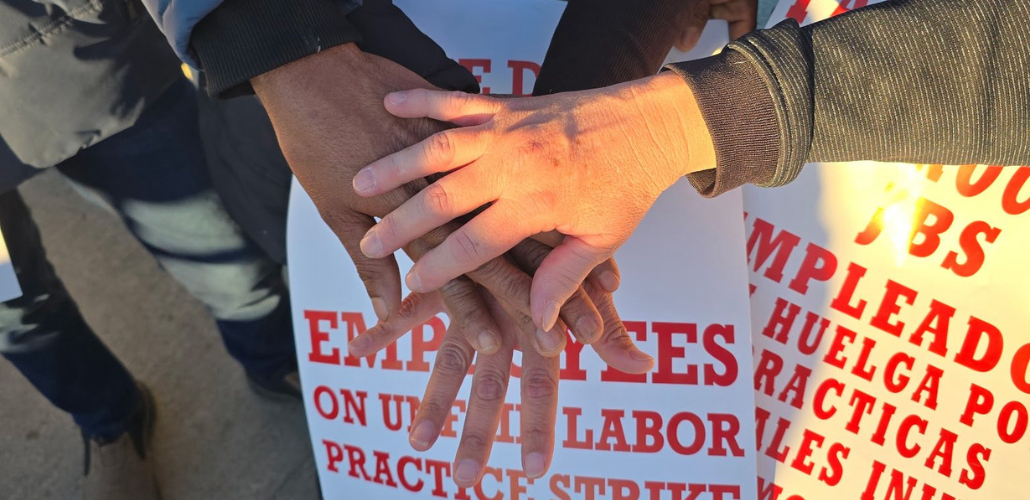
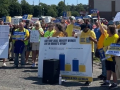
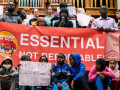
Immigrant workers from around the world are on strike at one of the nation's largest beef plants. Photo: Essential Workers for Democracy
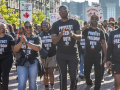
In less than a quarter-mile stretch of sidewalk, chatter in 57 languages overlaps with the sound of dancehall, bachata, Thai pop, Haitian kompa, and Micronesian hip-hop. At sunset, dozens gather for iftar, breaking their Ramadan fast; the music, pulsing from boomboxes and cell phones held up to megaphones, swells into one shared hum.
In this sliver of land across from the sprawling JBS beef processing plant—among the largest in the country—workers from around the world have united in the largest U.S. meatpacking strike in 40 years.
The 3,800 workers at the JBS beef processing plant in Greeley, Colorado, walked off the job on Monday, March 16, launching a two-week unfair labor practice strike.
This is the company’s flagship beef plant in the U.S. Its previous contract with Food and Commercial Workers (UFCW) Local 7 expired last July.
Strikers say JBS has been increasing the speed of the production line while cutting work hours from 40 a week to 35, squeezing out more work for less money. A thousand Haitian workers at the Greeley plant have filed a class action lawsuit against JBS for discriminatory practices that push them to work at dangerously fast line speeds.
Line speed is a major issue in the meatpacking industry. The UFCW International recently spoke out against a new proposal from the U.S. Department of Agriculture to remove federal limits on line speeds entirely.
“We’re demanding our rights, both in terms of wages and working conditions, because before the strike, they really took advantage of us,” said a worker in the brisket trim department, who spoke in Spanish and asked to remain anonymous. “They want the same output, but fewer hours and fewer people.”
After 18 years working at JBS, he said, “everything is so expensive. Everything has gone up, except our wages.”
‘ONE WRONG MOVE CAN TAKE YOUR LIFE’
Workers are also demanding that the company stop charging them out-of-pocket costs for personal protective equipment like mesh vests and arm guards—essential because they work with knives, saws, and other sharp, dangerous equipment.
JBS garnishes workers’ wages when equipment needs to be replaced due to daily wear and tear, damage, or theft. This gear can cost workers up to $1,100, taken directly from their paychecks without their consent.
“I have never experienced anything harder than this in my life,” said Teshale Dadi, who works on the chuck line. JBS was his first job after moving to the U.S. from Addis Ababa, Ethiopia. “One wrong move can take your life away.”
The various jobs mentioned in this article are all similar: cow carcasses are moving along on a conveyor belt, and workers are very quickly cutting them into smaller pieces and trimming off fat with knives.
“Access to the equipment is essential for us,” said Brett Tanner, who moved here from Arkansas and has worked as a ribber at JBS since 2024. “Personally, I love my job. I really do. We feed America. But it’s stressful sometimes, the hours we work and the physical toll the job does take on your body.”
Meatpacking jobs are among the most dangerous in the country. Workers on the picket line showed cuts, deep callouses, and chemical burns on their hands from years at the plant. Repetitive motion injuries are also common. Slips, falls, and machinery crushes can even be fatal; in 2021, a worker at the Greeley plant died after falling into a vat of chemicals.
“Our hard work makes JBS a profitable company, the biggest [meatpacking] company [in the world],” Dadi said. “Doing this hard work, everyone deserves the highest respect. Our pay is generally good, relative to [the rest of] the country, but for this specific job, I don’t think it’s even close to what we deserve.”
“It feels empowering that we have so many people standing together to send a message that we want better pay, we want more access to equipment,” Tanner said.
FACING DOWN A CORPORATE GIANT
Organizing across many languages and cultures has been a historical constant in the meatpacking sector. Union drives in the 1930s brought together Black, Mexican, and Eastern European immigrant workers to build some of the earliest meatpacking unions in the U.S.

This is the first strike ever at the Greeley plant, and the first major U.S. meatpacking strike since the 1985-6 strike at the Hormel plant in Austin, Minnesota. (There were wildcat walkouts at Smithfield Foods in Tarheel, North Carolina, in 2006 and 2007.) At Hormel, 1,500 members of UFCW Local P-9 struck for 13 months, refusing concessions that their international union was pressing them to accept. The Hormel strike galvanized grassroots support from around the country, though ultimately the workers were defeated by the powerful forces arrayed against them.
Over the last few years, UFCW Local 7 has built up a fighting reputation, with some of the largest strikes in the union. Last year 10,000 Kroger grocery workers in Local 7 went on strike for two weeks in February, followed by another 7,000 grocery workers at Safeway in June.
But meatpacking workers face a steep uphill battle as they fight for better conditions. Union density in the industry has fallen precipitously. Up to 90 percent of meatpacking workers belonged to unions in the postwar era, but only 15 percent did by 2019, as the industry consolidated and shuttered unionized plants, only to restart production in non-union plants.
The meatpacking industry is now so concentrated that the “Big Four” companies—JBS, Tyson, Cargill, and National Beef— control 85 percent of beef processing in the U.S. JBS acquired the Greeley plant when it bought Swift & Co. in 2007, one of many acquisitions and mergers on its road to becoming the world’s largest meatpacker.
Meatpacking companies have been reaping record profits since the Covid pandemic (notwithstanding fines for price fixing), even as communities suffer from plant closures and beef prices soar for consumers.
JBS, a multinational based in Brazil, is the U.S.’s largest beef processor, and also owns the second-largest chicken processor, Pilgrim’s Pride. It provides meat products for fast food chains like McDonald's and Burger King, as well as wholesalers and grocers like Costco and Kroger.
Even in an industry known for greed and lawbreaking, JBS has a notorious reputation. The company paid a $4 million fine last year after the Department of Labor found that cleaning contractors at the Greeley plant were using child labor. It also paid $55 million in a $200 million meatpacking industry settlement over collusion to repress wages.
For a long time, the company’s effort to get listed on the New York Stock Exchange was held up by the U.S. Securities and Exchange Commission due to extensive corruption scandals and the company’s role in deforesting the Amazon rainforest.
In January 2025, Pilgrim’s Pride made the single largest donation to Trump’s inauguration committee, $5 million, leading to allegations of a quid pro quo. A few months later, the SEC approved the stock exchange listing.
NATIONAL NEGOTIATIONS
The Greeley plant is one of dozens of JBS plants represented by the UFCW. Fourteen of these plants, including 26,000 workers in 12 locals, are now covered by a national contract that was settled for the first time last May. Local 7, which opted out of national negotiations, is pushing beyond this agreement, citing higher costs of living in Colorado.
The national contract included wins on regulating line speeds, including steward training and provisions for walking stewards (who are empowered to move around the plant to proactively enforce the contract, and who are paid by the company rather than the union), and improvements to wages and sick leave.
A particular triumph was the establishment of a new Taft-Hartley pension plan. Pensions used to be standard within meatpacking; the UFCW touted this one as the first to be offered by a meatpacking employer since 1986. (At least one news report speculated that JBS agreed to a pension as an optics move to get its stock listing approved by the SEC.)
That said, the national JBS pension plan is relatively modest, starting at contributions of 10 cents per hour worked in the first year of the contract, and increasing by 10 cents per hour each additional year. Local 663 and Local 1846 negotiated separate language to give individual members the choice whether to continue with their previous 401k or opt into the pension.
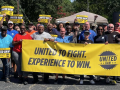
Nearly a dozen UFCW locals have been showing up in solidarity at the picket lines in Local 7, including Local 663 from Minnesota and Local 431 from Iowa, which were part of national negotiations.
Local 7 announced at the outset that this would be a limited-duration, two-week strike. It could be shorter, the local has stated, if JBS agrees to come back to the bargaining table and negotiate in good faith.
“I hope that we get justice, and that other meat processing plants stand up and get justice too,” said the anonymous worker, who is originally from Mexico, “for the good of the Latino community, and for the workers above all.”
Caitlyn Clark is a national organizer at Essential Workers for Democracy, an organization dedicated to rank-and-file member education and empowerment for workers in grocery, meatpacking, and retail. Lisa Xu is a staff writer and organizer at Labor Notes.