After Three-Week Strike, JBS Concedes to Meatpacking Workers
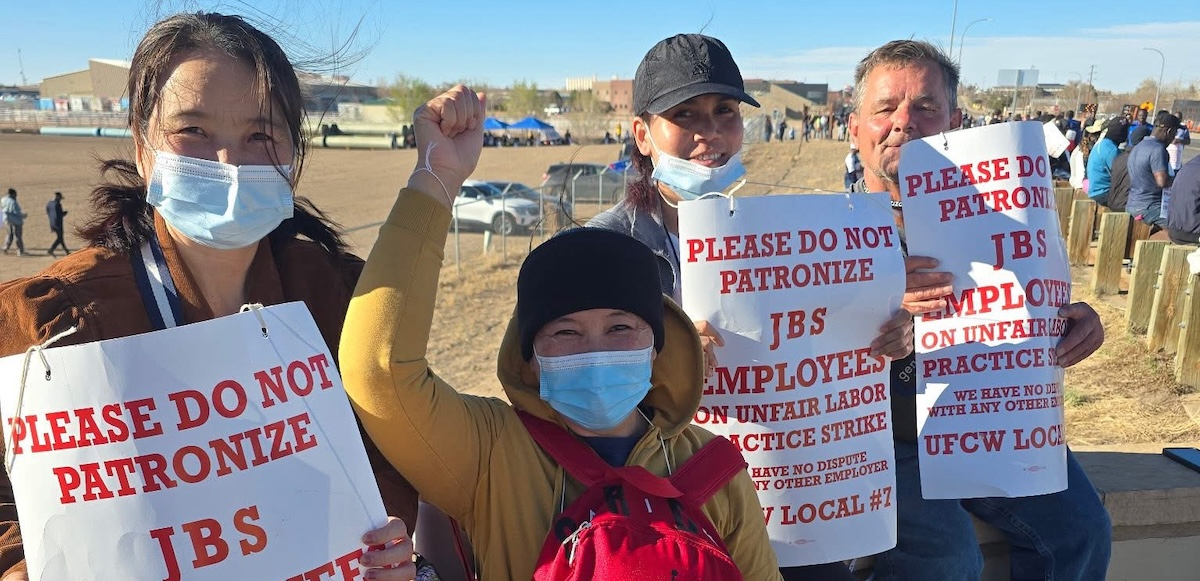
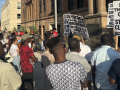
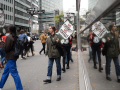
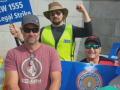
JBS workers won wages and protections after three weeks on strike. The Greeley, Colorado, plant’s largely immigrant workforce took on the biggest meatpacking company in the world. Photo: Essential Workers for Democracy.
Last month, 3,800 meatpacking workers in UFCW Local 7 in Greeley, Colorado launched the industry’s first major strike in 40 years.
The three-week unfair labor practice strike was the first time workers had ever struck the JBS Greeley beef packing plant, one of the company’s largest. ULP charges against JBS included the illegal termination of a member of the bargaining committee and surveillance and intimidation of workers for participation in union activity.
With 57 languages spoken under one roof, the strike united the plant’s largely immigrant workforce to take on the biggest meatpacking company in the world.
The local had spent nearly a year in negotiations following the contract’s expiration last July. JBS returned to the bargaining table after the strike—and when the dust settled, the company had conceded to almost every demand.
WON PROTECTION
In addition to $1.50 an hour in wage increases over the short two-year agreement, workers won a groundbreaking policy on personal protective equipment, challenging JBS’s previous system of garnishing wages to replace necessary PPE when it was lost, damaged, or stolen. JBS was charging workers up to $1,100 to pay for mesh vests, gloves, arm guards, and knife sharpeners.
“My mesh apron had a hole in it. I had to go two months wearing the same apron,” said Chris Ready, who has worked in the slaughter department at the plant for one year.
“I’ve had my equipment stolen,” Ready said. “I borrowed knives until I had to buy my own… I’ve had to buy two mesh gloves so far, that’s $200. It was annoying, but it felt like there wasn’t anything I could do. I needed that equipment to work, so I had to pay for it.”
“It makes your job more dangerous if you’re not ready to pay for new equipment,” said Noah, who has also worked at the plant for one year. He declined to give his last name.
Now, workers will be reimbursed for all out of pocket PPE expenses they paid over the past year. A new policy will establish a better tracking system for replacing PPE; until that system is set up, members won’t be charged for any needed replacements.
“The strike was about showing the company that the workers were strong in that plant, and showing the whole world who runs the plant: the workers,” said Local 7 President Kim Cordova.
The Greeley workers have struck a blow to the heart of the modern jungle: oligopoly control by the "Big Four" meat processors who have colluded for years to suppress worker wages, depress the livelihoods of cattle ranchers, and raise prices for consumers. JBS is the largest and arguably the most predatory of these companies; the others are Tyson, Cargill, and National Beef.
THROWING A WRENCH
Organizing 3,800 workers across dozens of languages was no small feat. Building up to the strike, a system of union representatives, walking stewards (shop stewards who are paid full-time by the employer to carry out steward duties), and 90 picket captains laid the foundation for a united picket line. A communication system via text, email, and social media, translated into the most commonly spoken languages—Spanish, Burmese, French, and Haitian Creole—kept members informed. Pre-strike meetings were held to register members for strike benefits, while also informing members of their rights to picket.
Unity around demands, plus widely and deeply felt grievances against the company kept members steadfast during the strike. The picket line was filled with joyful chanting, singing and dancing to music from around the world, buoyed by the support that flowed in from the community, other unions, and supporters from afar. UFCW members and staff from as far away as Boston, Minneapolis, and Seattle came to support the picket line.
Industry insiders held that it was not the optimal time to strike in beef processing, because of excess capacity in plants due to a national cattle shortage. That is due in turn to collusion among the Big Four to depress cattle prices, driving farmers out of business. “The producers are not breeding cattle because the prices are so low,” said Cordova.
Some thought that JBS would welcome the opportunity to take some production offline, divert cattle to other plants, and patiently wait out the strike. However, cattle cannot be costlessly diverted. In this case it involved shipping thousands of animals across the Great Plains. Cattle are purchased in advance, and then must be slaughtered quickly once they are transported, according to USDA regulations.
JBS was only able to divert roughly 40 percent of cattle to other JBS facilities hundreds of miles away in Utah, Texas, and Nebraska. Then JBS had to pay workers overtime to process the additional cattle. The other 60 percent of cattle were sent to competitors.
With the Greeley plant essentially idle, and the costs of diverting cattle, JBS lost substantial revenue during the strike. The plant typically processes 5,000-6,000 cattle per day, earning the company daily revenue of $20-$30 million.
The company flew in management to try to run the plant, but they were only able to kill a small fraction of the cattle. Fabrication—the plant’s main department, where workers cut beef into smaller, sellable pieces—couldn’t run at all. Workers estimated it takes hundreds of workers to keep the fabrication chain going.
JBS struggled to use scab labor, because it was difficult to recruit, and training meatpacking workers takes over a week before they can set foot on the production floor.
Weeks after the strike ended, JBS was still feeling the effects of the work stoppage, as production in beef processing requires time to ramp back up.
JBS also didn’t know if the workers would go back on strike at some point. "We hurt them big time," Cordova said.
The strike was originally planned for two weeks, and subsequently extended into a third week. Why not an open-ended strike?

Cordova argued that by depressing the price of cattle, a longer strike would play into the hands of the Big Four, who profit from the difference between what they pay for livestock and what they ultimately charge consumers for processed meat.
“Prices are at a 70-year low and there’s a cattle shortage, because of the Big Four’s oligopoly power,” said Cordova. “It’s hard to hurt JBS because of excess capacity, but a shorter strike was actually more damaging because you cannot shift cattle.”
NATIONAL NEGOTIATIONS
Last year, Local 7 broke away from national negotiations between JBS and the UFCW International, which covered beef and pork plants in 12 other locals across the country. The national agreement was ratified last May. It marked a step towards greater contract coordination in the union’s meatpacking division.
In breaking away, Local 7 cited the higher cost of living in Colorado and different contract priorities, such as protective equipment. But Local 7 has also traditionally set the pattern among JBS locals, with stronger protections in its contract.
The gains from the strike further cemented this, for the most part. In addition to the new standard-setting on protective equipment, the Local 7 agreement includes higher wage increases ($1.50 an hour over two years versus $0.90 an hour over two years in the national agreement), lower healthcare costs, and more generous sick leave and vacation policies.
JBS attempted to polarize the local’s decision to retain a 401(k) plan rather than join the nationally negotiated pension plan. After the strike, JBS claimed in a press release that Local 7 “chose to eliminate the historic pension benefit.”
National negotiations in 2025 did establish a new Taft-Hartley pension plan, a Variable Annuity Pension Plan (VAPP), the first in many decades in meatpacking. As part of the agreement, JBS eliminated the 401(k) plan in most locals, with the exception of two locals which gave current members the option of sticking with the 401(k) if desired.
While Local 7 did choose to retain the existing 401(k) plan with a 50 percent match on the first four percent rather than join the national pension plan, Local 7 also did not previously have a pension benefit to “eliminate.”
A 401(k) plan is generally inferior to a VAPP, which is in turn inferior to a traditional defined benefit plan—although it depends on how much money the employer puts in. The JBS VAPP features low employer contributions, starting at $0.10 per hour worked in the first year of the agreement and increasing $0.10 per year after that. Eligible hours are capped at 40 hours per week, although some workers work more.
Under the VAPP, assuming employer contributions of $0.40 per hour (theoretically reached in 2029 under the current contract) a full-time worker working 36 hours a week (the average for a production worker) for 20 years would earn a monthly retirement benefit of $262.50. However, locals could fight for more pension contribution increases in future contracts.
The UFCW had unique leverage during national negotiations, while JBS was struggling to make its debut on the New York Stock Exchange as a publicly traded company. Some speculated that the public scrutiny of JBS’s labor practices in advance of its initial public offering pushed JBS to agree to the pension. The IPO had long been held up by SEC concerns about corruption, although watchdogs questioned whether the company’s $5 million contribution to Trump’s inauguration fund greased the way to approval.
National negotiations at JBS were led by the head of the UFCW’s meatpacking and food processing division, Mark Lauritsen, who was narrowly defeated in his bid for president of the UFCW during closed-doors elections by the International Executive Board last May. This month, Lauritsen announced his retirement.
Local 7’s contract expires on April 30, 2028. The 12 locals who took part in national negotiations still have varying contract expiration dates, ranging from 2026 to 2029.
FIGHTING THE BIG FOUR
Both Local 7 and the UFCW International are now fighting for better legal protections for meatpacking workers across the industry.
A Congressional hearing headed by the Monopoly Busters Caucus is set to be held in Greeley in May to call attention to the national crisis created by the Big Four for consumers, meatpacking workers, and cattle ranchers.
The UFCW International has also recently launched a letter writing campaign, sending 42,000 public comments to urge the USDA to resist a deregulation push that would increase line speeds in pork and poultry processing.
Additionally, Local 7 is calling on Colorado state lawmakers to pass a law requiring meatpacking employers with more than 500 employees to guarantee reasonable bathroom breaks.
At the JBS Greeley plant, workers say bathroom breaks have always been an issue.
“They don’t like sending people to the bathrooms—they’ll keep you on the line until your break,” Ready said. But using the bathroom during your break turns what is supposed to be rest time into a race against the clock. “Our first break is supposed to be 15 minutes, but it’s more like seven or eight. You have to take off all your equipment, that’s two or three minutes. Then you have to put your equipment back on, another two or three minutes.”
In the next few years, several locals will return to the bargaining table with JBS, opening up the potential for future coordination. In 2028, Local 7 and Minnesota Local 663 will both negotiate new agreements.
Caitlyn Clark is a national organizer at Essential Workers for Democracy (www.ew4d.org). Lisa Xu is a Labor Notes staff writer and organizer.