Green Shoots of Hope in the Labor Movement
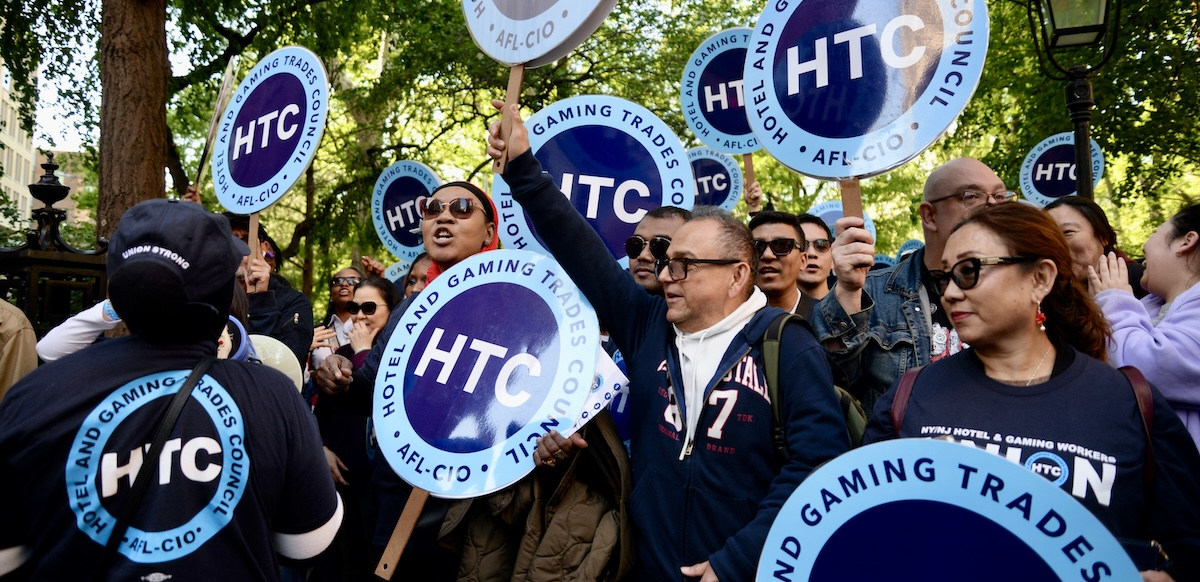
Hotel workers in New York were among the cases of unions using their leverage to win gains for workers. Photo: Jenny Brown
Gardeners have a saying about newly planted perennials: “They sleep, then creep, then leap.”
Last summer I pulled a lot of grass out of my yard (hard work!) and planted a garden. The new plants stayed small through the winter, gathering strength. Now suddenly my garden is teeming with new leaves.
Spring has brought green shoots in the labor movement too. Here are some causes for hope:
Workers using their leverage. It only took three days for strikers on the Long Island Railroad, which carries 300,000 commuters a day, to win needed raises. “Solidarity Forever” still has it right: Without our brain and muscle not a single wheel can turn.
The mere threat of striking 250 New York City hotels and interrupting a World Cup and “America 250” tourist frenzy was enough to score 27,000 housekeepers a big raise: 50 percent over eight years. Philadelphia hotel workers are threatening the same.
The hyper-exploitative meatpacking industry saw its first big strike in 40 years. Strikers speaking 57 languages cost Colorado’s JBS beef plant millions each day. In three weeks, workers won their raise and safety gear.
New organizing victories. Penn State faculty scored Pennsylvania’s biggest public sector unionization in decades. Faculty at Tulane ratified Louisiana’s first higher ed union contract.
JetBlue air dispatchers joined the Transport Workers. Doctors at Allina in the Twin Cities won an SEIU contract—as health care gets corporatized and doctors become employees, unions are gaining ground. It says something about the public mood that professionalized workers keep throwing in their lot with the working class—see also tech workers, art museum workers, “Sesame Street” workers, and the video game developers who make “Magic: The Gathering.”
And despite stiff headwinds in their contract fight, Starbucks baristas just won their 700th store. Whatever else it achieves, the campaign is producing thousands of organizers.

Unions defending immigrants. The most inspiring development, by miles, was Twin Cities workers rising to defend their neighbors and resist a federal occupation.
Seattle Machinists struggled last year to free a union brother taken by ICE—then kept fighting for detainees, union or not. The Progressive reported that airline workers used their insider knowledge to help the Filipino group Tanggol Migrante get a sick man who was being deported pulled off the plane. A Tanggol Migrante activist said labor’s funds, numbers, and legitimacy have given them a major boost.
Union reform catches on. Scratch a powerful strike story and you’ll often find a backstory of rank and filers who revived their union from the bottom up. Labor Notes has always been a hub for reformers, but a few years ago the active caucuses were pretty sparse, mostly Teamsters and teachers.
At this year’s Labor Notes Conference, I see reformers from at least a dozen industries who are seriously pushing to transform their unions, sowing the seeds of our next banner struggles. Among them are…
Federal workers getting organized, not a moment too soon. The Federal Unionists Network, once a gleam in someone’s eye, is now a thriving organization. Hundreds of government workers are joining our conference this year, including many state and local workers facing federal budget cuts, which brings me to…
Taxing the rich. In my home state of Washington, my whole life I’ve heard an income tax would be impossible. But this spring, after a sustained campaign led by state workers, the governor reluctantly signed a Millionaires Tax.
Blaming the billionaires is back in style. The world’s richest person is among its most hated, while New York’s socialist mayor is the apotheosis of cool. That’s gotta be a good sign.
The first year of the Trump administration was rough—including the biggest union-busting push in U.S. history. It took time to get our bearings. First we sleep, then creep… now let’s leap.