Letter Carriers Set to Deliver Change in Upcoming Union Election
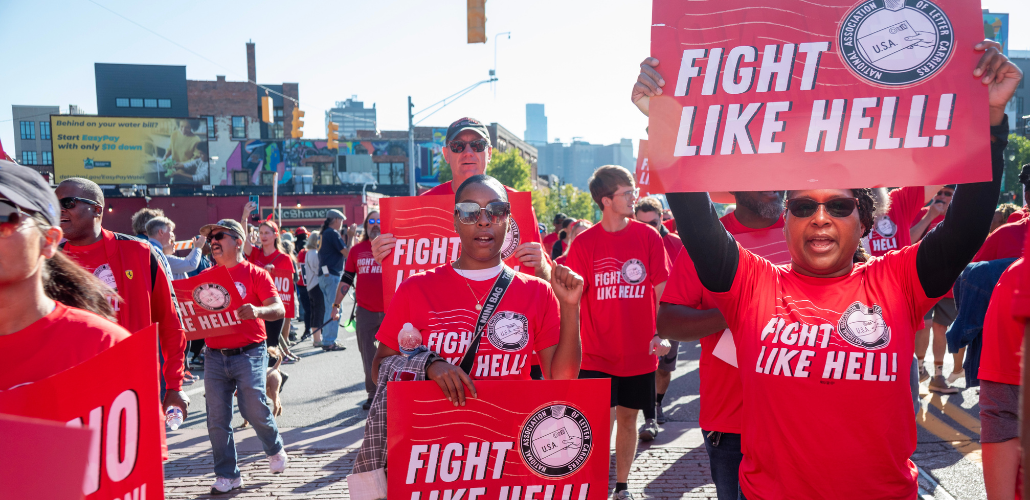
Letter carriers in Detroit marched on Labor Day last year. After members voted down a contract, President Renfroe started calling "Fight Like Hell" days of action. It was a step towards more engagement and transparency, but members are still pressing for much more, and Renfroe appears to be on his way out. Photo: Jim West/jimwestphoto.com
A leadership change looks likely in the Letter Carriers (NALC) this fall. Members are mad about low pay and forced overtime, dangerous heat and robberies, the rejected contract imposed last year, the backlog of tens of thousands of grievances, and the president’s secretive approach to bargaining.
There’s not just one group pushing for change, but a whole ecosystem of reform groups, slates, and podcasters among the 5,000-plus delegates coming to Los Angeles for the union convention August 3-7. They’ll rub elbows and hopefully build unity at a “Reformers Rum Party” on Sunday night, the eve of the convention.
Days before the August 5 nominations, it looks like a three-way race for president. The 200,000 members will get the chance to vote this fall—by mail ballot, of course—for 10 officers, three trustees, and 15 regional business agents.
Two reform tickets have been campaigning for two years. One is the Concerned Letter Carriers (CLC) slate, headlined by current Vice President James Henry and including a number of branch (local) presidents. The other is Mike Caref, business agent for Illinois, running solo for president.
Despite months of speculation about whether President Brian Renfroe would run again, he still hasn’t made any announcment. But a third slate announced July 17 includes many other incumbents, led by Eddie Davidson, current business agent for Florida, Georgia, and the Carolinas.
DOOMSDAY CLOCK
The backdrop is ongoing existential threats to USPS. Since Trump returned to office, the postal doomsday clock has been minutes from midnight.
Though Trump hasn’t acted on his threat to move the Postal Service under the Department of Commerce, his new batch of nominees for the Board of Governors aren’t even from private sector logistics, but from finance—so maybe less interested in rationalizing the service than in selling it for parts.
Postmaster General David Steiner, who somehow makes his predecessor Louis DeJoy look good, is going along with Trump’s extreme attacks on vote by mail. He says USPS won’t deliver ballots in states that won’t hand over voter lists to the government.
Steiner has also been claiming USPS could run out of money within the year, and threatening to close post offices and cut delivery days if its finances aren’t fixed.
The next-biggest union, the Postal Workers (APWU), organized rallies July 28 for three reforms that would help in the short term—raise the debt limit, modify the investment strategy for retiree benefit funds (they’re all in treasury bonds), and change how the retirement obligation is calculated.
Longer-term, USPS needs to adapt to fewer letters and more packages. Management’s approach has been to cut costs by degrading service. The unions argue it should instead expand revenue by adding services like banking, Internet access, hunting licenses, electric vehicle charging, and checking in on seniors.
In addition, retired letter carrier and longtime activist Jamie Partridge argues, the government should subsidize rural delivery, as many other countries do.
OVERLAPPING GROUPS
A vote-no movement on the 2024 contract was organized by a coalition of forces including Caref, the CLC, the Build a Fighting NALC (BFN) caucus, and influential podcaster Corey Walton, number two on the CLC ticket.
Podcasts are big with letter carriers—you can listen while you slog through the workday. One called “Next Generation Carriers” has interviewed activists from all the vying groups and even Renfroe himself (Labor Notes staffers have also been guests). Co-host Margo O’Neill, a steward of Branch 352 in Des Moines, is also the treasurer for BFN. Her main goals at the convention, she said, are to grow the reach of the reform movement and to build unity across the various existing groups.
The Next Gen hosts have been agitating for a contract demand of “30 for 30”: a starting wage of $30 and no more than one manager per 30 carriers, to save money and alleviate micromanagement. New carriers start at about $21, in an entry-level job called “city carrier assistant” where they’re often made to work Sundays delivering Amazon packages. It can take two years to convert to a career position, and even then, everyone hired since 2013 is on second-tier Table 2 pay.
In the Massachusetts chapter of BFN, “we’ve been really pushing to get people more active, talking to CCAs about their rights on the job,” said Chris Persampieri, legislative and political director of Branch 18. “A lot of people had no idea that if it’s your day off, you’re not on call. You don’t have to pick up the phone.
“There’s no union steward on Amazon Sundays, so they’re on their own. We show up with flyers about their rights and a box of joe from Dunkin’ Donuts, because it’s Massachusetts and that’s what we do here.”
Some reform activists are backing the CLC; some are backing Caref; some like certain members of the Davidson slate. The election may yield a mixed executive council of people who ran on opposing tickets, and the new president will have to “mold that into a solid team,” said Branch 3 President David Grosskopf of Buffalo, who’s running for trustee with the CLC.
CONTRACT DEBACLE
What's difficult to find is anyone with a good word to say about Renfroe. Last convention he was already in hot water, facing internal charges of dereliction of duty and impaired driving of a union vehicle.
Delegates voted to let him off the hook. But they also voted for more member involvement and substantive bargaining updates; Renfroe had been bargaining for nearly two years in near-complete secrecy.

Soon afterward, he came out with a tentative agreement featuring a measly 1.3 percent annual raise. Members voted it down.
As the union returned to the table in early 2025, Renfroe announced nationwide “Fight Like Hell” rallies—then reversed course over fears of Trump and DOGE, and rushed into binding arbitration. The arbitrator imposed a contract nearly identical to the one members had voted down, sparking more outrage.
And the bad deal had taken so long to negotiate that it was more than half over, expiring in May 2026, so NALC was soon back at the table.
The union has made incremental improvements in its approach this time. There was a member survey, a national day of rallies, some video updates, and a collective bargaining conference for branch and state leaders.
Still, as the 60-day mediation period expired in July, meaning the union could be moving to arbitration, members had little information. “We have no idea what economic package our union is asking for,” Grosskopf said. “We don’t know if we’re asking for $30 an hour, or $50.”
Renfroe has kept even fellow officers at arm’s length from bargaining. The last straw for Mack Julion, assistant secretary-treasurer, was when the president proposed a four-day workweek of 10-hour days, meaning carriers would no longer get overtime pay after eight hours.
“Ours is a physically demanding job,” Julion said. “I’m kinda known for my fancy cowboy boots; I wear those because I have a bad case of plantar fasciitis. I’ve known many letter carriers who had hip replacements and knee surgeries.
“I had suggested hazard pay,” he said. “If you think a four by 10 schedule is a higher priority than hazard pay when we’re just a couple years removed from Covid, and we have letter carriers literally dying in the heat... We are human, and we break down.”
Rather than run again with Renfroe, Julion planned to run independently for reelection. He ended up joining the Davidson slate.
DEMOCRACY IN ACTION
The convention has strongly democratic features. There are no major hurdles to getting nominated. Delegates vote on every constitutional amendment or resolution submitted by any branch or state association—this year there are many.
Persampieri authored an amendment for ranked-choice voting (where voters can indicate their second- and third-choice candidates and the resulting votes are tabulated in “instant runoffs”), to remove the fear of voting for a spoiler. Branch 3 proposed that the national bargaining team include five officers, not just the president.
Delegates may hear internal charges brought against the officers by a San Diego carrier, Michael Rivera, over the imposition of the rejected contract last year. The officers declined to investigate the charges against themselves, but Rivera is appealing to the convention body.
They will also elect delegates to the 2030 AFL-CIO convention. A “Stand-Up Slate” of younger carriers is running on themes like universal health care and the abolition of billionaires.
Some resolutions were submitted calling on the union to livestream the convention, which officers decided to do.
Minneapolis Branch 9 has sent resolutions on political themes, like ending the war in Iran and funding public services. BFN activist Tyler Vasseur warned first-time delegates not to be too disappointed if they don’t pass.
“The idea is to force a debate on the issue,” he said. “If we get 20 to 30 percent of the vote, we can identify people who want to fight and get organized on these issues going forward.”
WINS NEEDED
Getting members into motion is the name of the game. “If we’re ever going to get the participation up in the union, people have to feel there’s a fight going on, and we have to get some wins,” Caref said. “We’ve been taking a lot of losses, and it’s really demoralizing for the carriers.
“You've got to start with a clear vision for where you want to be, and a strategy for how you’re gonna get there. You get some little wins, you get more people involved, and you start moving in the right direction.
“That’s why I always tell people, I only want to be president if you guys want me to be president,” he said, “because I’m going to give you stuff to do right away.”
Correction: This article originally misstated the expiration date of the last contract. It has been expired since May 22, 2026.