Union Members Distribute Food for Federal Workers
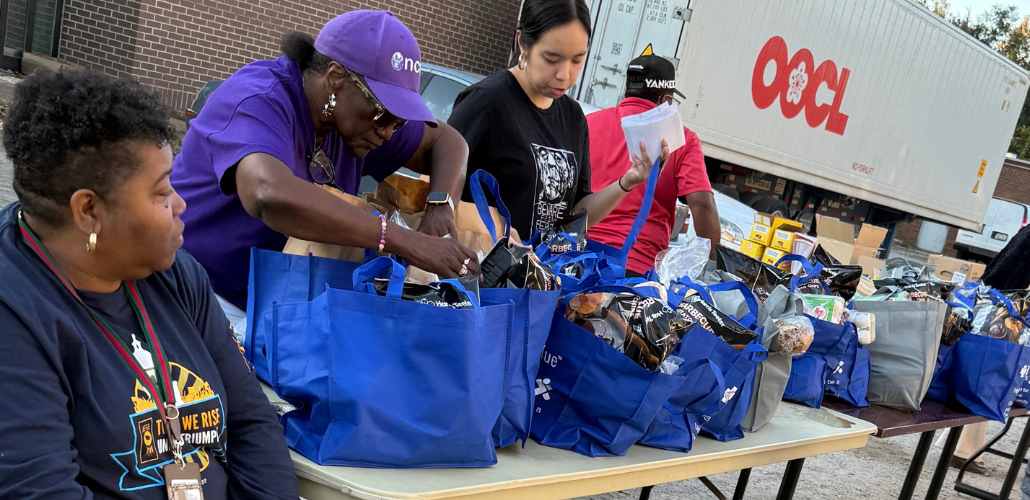
Volunteers sorted, loaded, and distributed hundreds of bags of groceries. They even delivered some to the airport, for workers who couldn't leave their posts. Photo: Kerry Taylor
More than a dozen volunteers gathered on November 14 at the Community Resource Center in North Charleston for a large-scale food distribution aimed at supporting federal employees reeling from the effects of the recent government shutdown.
Organizers described the event as an early step in building a broader “Federal Worker Fightback” to stop job and service cuts and the erosion of worker power.
The collaboration brought together volunteers from several labor and community organizations, including the Charleston Central Labor Council, the Charleston Worker Center, the Coalition of Black Trade Unionists, the National Council of Negro Women, Longshore (ILA) Local 1422, the Machinists, the South Carolina AFL-CIO, the A. Philip Randolph Institute, Government Employees (AFGE) Local 3627, and Local 1199B, which led the 1969 Charleston hospital strike.
Coordinators emphasized that the mix of labor-based groups was critical: the intention was not charity, they said, but solidarity—workers stepping up for one another during a period of political crisis and economic strain.
HUNDREDS OF BAGS OF GROCERIES
Throughout the day, volunteers sorted, loaded, and distributed hundreds of bags of groceries stuffed with fresh eggs, meat, and produce.
They also delivered 60 bags of food to Department of Homeland Security employees at Charleston International Airport. Though unpaid, the DHS workers were unable to leave their posts to drive to the distribution site.

Turnout—among both volunteers and recipients—was strongest when co-workers encouraged one another to participate, a pattern organizers said will guide future actions. Expanding participation among sectors such as the U.S. Postal Service, the Park Service, the Veterans Administration, the Department of Defense, and Social Security will be essential.
DEEPER CRISIS UNRESOLVED
Federal workers arriving at the center shared stories of being forced to work without pay, mounting bills, and weeks of uncertainty. April Lott, President of the Charleston Central Labor Council and Charleston Workers Center, said those conversations underscored the need for a more organized and sustained response. She encouraged anyone wanting to get involved in this emerging work to call 843-513-8723 or email info[at]charlestonalliance[dot]org.
Federal workers may be back on the job, but with another shutdown looming, the deeper crisis remains unresolved. Back pay may help families regain their footing, but it does little to counter the long-term cuts to federal jobs and services—reductions that many consider illegal or illegitimate.
Real change, organizers insist, will require federal employees themselves to shape the political response.
In that regard, the Charleston region may prove critical. The area is home to roughly 11,000 federal employees, the largest concentration of federal workers in South Carolina, according to the Economic Policy Institute.
Organizers thus view November 14 as more than a food distribution. It offered a glimpse of what coordinated, worker-led action can look like in the Lowcountry.
Kerry Taylor is a member of the Charleston Worker Center.