Review: Who’s Got the Power: Hope for Troubled Times
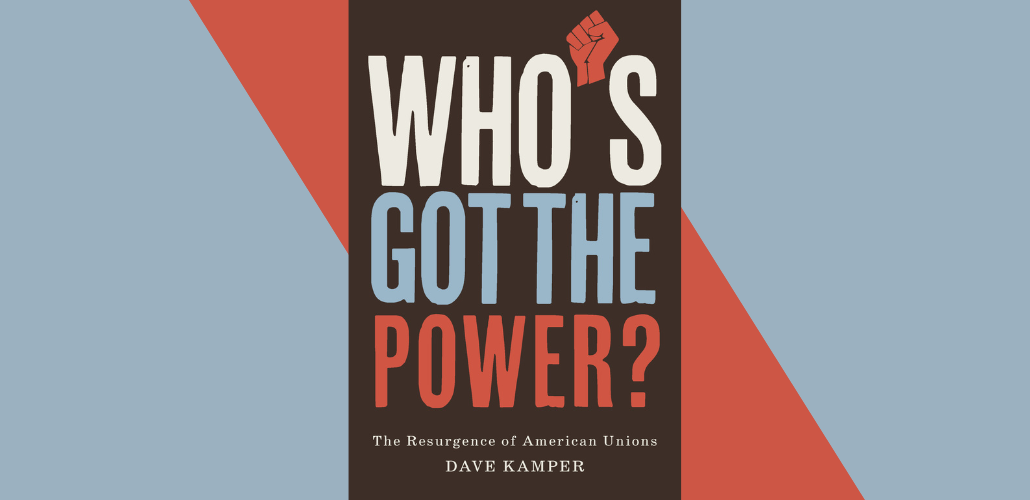
Who's Got the Power? The Resurgence of American Unions by Dave Kamper, The New Press, 2025.
Every few years a book comes out that tries to explain what’s happening in the labor movement and maybe cheer us up from the bad news of union decline. Dave Kamper’s new book, Who’s Got the Power: The Resurgence of American Unions, does the job. And it’s packed with insights about unions and organizing drawn from key labor events during the pandemic era.
Kamper is a longtime union organizer and analyst of the labor movement, whose articles tell some hard-to-hear truths about labor (for one of my favorites, see his piece “We Don’t Know What We’re Doing” at the Forge).
Today, Kamper says in Who’s Got the Power, we are seeing the biggest union upsurge in 50 years. “Again and again,” he writes, “workers turn in the direction of solidarity, taking on corporations and bosses with purpose and commitment.”
In the case studies that are the heart of the book, Kamper describes the surprising boldness and imagination workers have shown in this era.
IS THIS AN UPSURGE?
Are we really in a union upsurge? The union membership rate, which has continued to decline nearly every year for decades, now stands at just 10 percent of the workforce and an alarming 6 percent in the private sector.
However, my analysis of union election data from the National Labor Relations Board found that after the early pandemic years, union election wins, win rates, and number of workers organized all rose from 2022 to 2024. Nearly 100,000 workers organized through elections last year—the most in several decades. Moreover, the number of large strikes has been higher over the past three years than in recent decades. And union approval has been 65 percent or higher since 2020. So I agree with Kamper that something significant is happening.
Kamper cites three contributing factors for this surge of union activity: the pandemic; unrest among young workers; and the rejuvenation of unions like the United Auto Workers. This book pairs well with Eric Blanc’s We Are the Union: How Worker-to-Worker Organizing Is Revitalizing Labor and Winning Big, which also has stories about recent organizing campaigns and identifies some of the same trends.
PANDEMIC STRUGGLES
Kamper tells the story of the three-week Frito-Lay strike in Topeka, Kansas in the summer of 2021, which he identifies as the first major labor dispute of the pandemic era. (In the process, he describes a strike as “one part theme-park haunted house, one part waiting in line at the DMV, one part spring break, and one part storming the castle. They’re not equalized parts, though, and the strikes that work are the ones that get the proportions right.”)
And his strike stories are great. Kamper discusses how the workers were demoralized about the buses coming in with scabs day after day, until they investigated further. A striker flew a drone over the plant parking lot and discovered the arriving buses were empty!
Kamper has a thoughtful chapter on how public school teachers dealt with the chaos of the pandemic, when they and their unions were the target of conservative attacks. A wave of teachers’ union reform and militancy, including the Chicago Teachers Union strike in 2012 and the Red for Ed strike wave in 2018, helped give the unions the tools and confidence to fight on during the pandemic.
Education unions have started bargaining using a practice called Bargaining for the Common Good (BCG) where unions partner with local groups and use their contract negotiations to win things that also benefit the community.
This approach to bargaining, Kamper reminds us, is reminiscent of the UAW’s strategy in 1950, when they wanted to limit the price increases of cars for consumers—and win wage increases for workers. But the union didn’t achieve that goal under the famous “Treaty of Detroit.” And over time, unions have allowed themselves to become limited to bargaining over “bread and butter” issues. Larger ambitions have withered.
But now, Kamper sees hope in this new strategy: “The teachers’ unions have pushed past that barrier. They’ve left the Treaty of Detroit behind. The era of [bargaining for the common good] is one of nearly unlimited possibility for unions that are willing to take on the big fights. When they do, they win.”
(Another example of this union-community bargaining coalition strategy is the Minnesota Model, which was used very effectively in Minneapolis last year.)
Kamper also discusses how during the pandemic, the 50,000-member Association of Flight Attendants was able to negotiate government support for the airline industry that included significant support for workers. The deal also enforced stricter regulations on employers (limiting stock buybacks and executive compensation) than did the federal government’s more widespread Payroll Protection Plan.
A heavy union presence in the airline sector was crucial to the union’s success, Kamper says: “Workers in industries with weaker unions didn’t fare as well.”
THE KIDS ARE ALRIGHT
Kamper’s chapters on young workers organizing are inspiring. The first Starbucks store was organized in late 2021. Now over 650 stores have joined the union. The organizing has persevered through an avalanche of company unfair labor practices, firings, store closures, and stalling on contract bargaining. Kamper wonders how they did it.

“It has to have been the solidarity,” he writes. “An entire generation, let down by every so-called leader and every cherished institution it had ever met, seeks strength within itself, reaching out digital hands all over the country and finding the will and the imagination and the fire and the spirit and the courage to stick it out.”
The book’s chapter on graduate worker organizing is close to my heart. Kamper and I both came up through graduate worker unions in the late 1990s—he at the University of Illinois and I at the University of Michigan.
For decades, grad unions had a substantial presence at public universities. Then the 2016 NLRB Columbia decision authorized collective bargaining at private universities, and there has been an explosion of organizing ever since. I laughed out loud as Kamper described the astounding margins of victories at some recent campaigns:
“In election after election, graduate employee unions have piled up margins of victory so lopsided that even dictators holding sham elections don’t win by as much. Try 1,860-179 at Yale; 1,696-155 at the University of Chicago, the intellectual home of neoliberal economics; 1,414 to just 28 at Boston University… This was quite possibly the biggest margin of victory ever seen in a large union election in this country.”
Kamper notes that graduate employees are winning their unions largely through direct rank-and-file organizing activity, with less reliance on union staff. And they will all graduate or move on after a few years into many other kinds of jobs—many won’t become professors. Thus graduate unions, he points out, are serving as a training program that is spreading tens of thousands of experienced, union-conscious workers throughout the economy.
UNION REFORM AND MILITANCY
The last section of the book covers the extraordinary events of 2023: the Teamsters’ huge contract campaign at UPS and the successful Hollywood and UAW strikes. In all, the year saw 33 large strikes (greater than 1,000 workers), the most since 2000. They involved 459,000 workers–the second-highest number since 1986.
Kamper’s discussion of the internal politics of SAG-AFTRA leading up to their successful strike is fascinating. “There’s never really been labor peace in Hollywood,” Kamper writes, “just armistices before the next outbreak of hostilities, because the nature of the business is always changing, and every change creates another moment of conflict.”
So it was for playing films on TV in the 1950s, when VCRs and video tapes came out in the 1980s, and when internet streaming started in the 2000s. In the last strike, A.I. was a big issue, and probably will be again the next time around.
“Nothing better encapsulates the resurgence of organized labor than the revitalization of the United Auto Workers and their 2023 strike,” writes Kamper. The UAW is a great recent example of union revitalization, as reformers took the helm in 2022. As Kamper says, “Union reform isn’t just about what you stand for; it’s about knowing how to union and to union well.”
I love his discussion of the importance of contract campaigns that involve members, like the one that the UAW executed so well: A series of escalating activities that organized members to pay attention to the negotiations and take supportive actions, up to and including a strike vote and then a rolling strike against the Big 3 automakers.
That approach should be standard in every contract negotiation, but often isn’t, because union leaders don’t see the need for it, don’t want to raise expectations, or don’t trust their membership, Kamper writes. Avoiding a contract campaign leaves a lot of potential power undeveloped, while the union relies solely on discussions at the bargaining table, often a fatal error.
SOLIDARITY CAN SAVE US
This book brings together a lot of Kamper’s wisdom and experience, and the stories are told with compassion and a sense of humor. “If you boil down the American labor movement to just seven words, they are ‘It doesn’t have to be this way,’” writes Kamper. “It’s our belief that a better world is possible. We can make things better; that’s what drives us.”
“For a long time, that belief has been hard to hold on to. But when unions win, it reminds us all that things can be different.”
So if we are in an upsurge, will it continue? Who knows. Trump’s politics of cruelty and chaos are a huge challenge for the labor movement. “It’s at moments like these that labor’s worst tendencies can rear their ugly heads,” Kamper warns. To survive this era, unions may be tempted to stay quiet, cut deals, or look away while vulnerable folks are under attack.
But we can choose another path, and this book provides examples of how. Unions need to increase their organizing and militancy. We have to dig deep and emphasize basic solidarity in these troubled times with “boldness and imagination,” Kamper writes. As AFA President Sara Nelson says in the book’s foreword, “It will take radical solidarity to save our union movement. And I believe a thriving, fighting union movement is the only thing that can save our country and our world.”
“Yes, it’s going to be rough,” Kamper concludes. “But don’t ever count the working class out. We’ve got the power.”
Eric Dirnbach is a labor movement organizer and researcher in New York City.