





Will ICE Ignite a Mass Strike in Minnesota?
"Will ICE Ignite a Mass Strike in Minnesota?"
NO. The conscience and perserverance and communal spirit of the PEOPLE will ignite a strike in Minnesota. Menawhile, ICE can go fuck themselves.

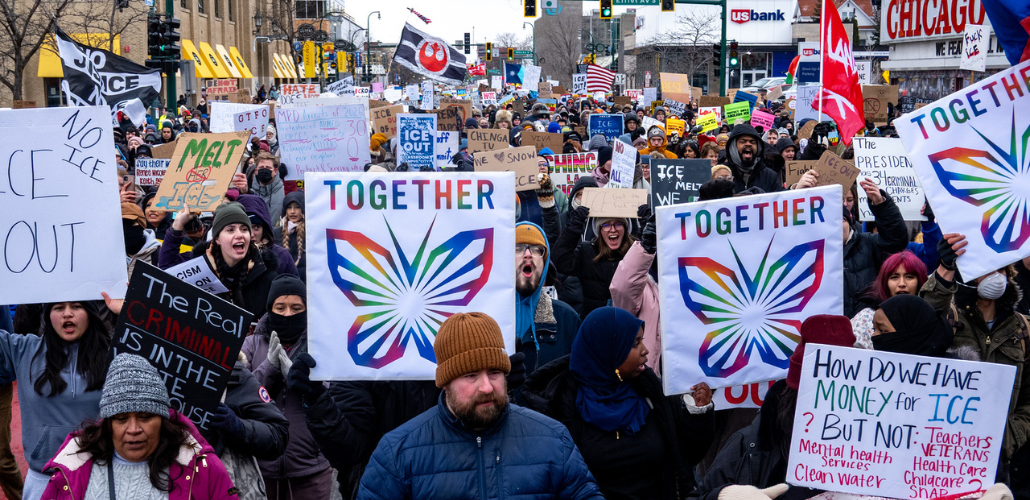
Labor federations and many other groups have called for a day of protest January 23. The momentum is growing from mass protests, like this one in downtown Minneapolis on January 10 that drew 10,000, and building on long-term organizing. Photo: Brad Sigal
Minnesota appears to be in gear for a mass uprising. Unions, community organizations, faith leaders, and small businesses there are calling for a statewide day of “no work (except for emergency services), no school, and no shopping” on January 23.
Festering grievances swelled into a national outcry on January 7, after ICE agent Jonathan Ross shot and killed poet and mother of three Renee Nicole Good in Minneapolis while she and her wife were observing federal agents swarming her neighborhood.
A week later, another federal agent shot a Latino immigrant from Venezuela in the leg. ICE agents have sprayed chemical agents in protesters’ eyes. On Wednesday night, they detonated a tear gas canister underneath the car of a family just trying to get home from basketball practice; the baby, strapped in his car seat, was knocked unconscious.
Trump’s regime has ramped up racist attacks targeting Somali, Latino and Asian communities—battering down doors, raiding small businesses and forcing them to shutter, trailing school buses, dropping tear gas outside schools, circling hospitals. He has threatened to invoke the Insurrection Act, which would allow him to deploy the military to Minneapolis.
Under siege, Minnesotans are leaning on organizations at work and in their neighborhoods to end the terror.
“We are not going to shop. We are not going to work. We are not going to school on Friday, January 23. For some people they call that a strike,” said JaNaé Bates Imari of Camphor Memorial United Methodist Church at a press conference on Tuesday. “For many of us, this is our right to refusal until something changes.”

Among the unions endorsing the call are Service Employees Local 26, UNITE HERE Local 17, Communications Workers Local 7250, the St. Paul Federation of Educators Local 28, Minneapolis Federation of Educators (AFT Local 59), the International Alliance of Theatrical Stage Employees Local 13, Graduate Labor Union, United Electrical Workers Local 1105 at the University of Minnesota, the Transit Union (ATU) Local 1005, the Committee of Interns and Residents (SEIU), and the Minneapolis Regional Labor Federation, AFL-CIO.
“Our labor federations are encouraging everyone to participate on January 23rd,” said Chelsie Glaubitz Gabiou, president of the Minneapolis federation. “It’s time for every single Minnesotan who loves this state and the notion of truth and freedom to raise their voices and deepen their solidarity for our neighbors and co-workers living under this federal occupation.”
Other endorsers include Faith in Minnesota, Tending the Soil, United Renters for Justice, Unidos Minnesota, Communities Against Police Brutality, Indivisible Twin Cities, Women’s March Minnesota, the worker center Centro de Trabajadores Unidos en la Lucha, and Minnesota Immigrant Rights Action Committee. In all, 90 organizations, big and small, have endorsed the call.
Under the banner “ICE Out of MN: Day of Truth and Freedom,” they are calling for ICE to leave the state, for the officer who killed Good to be held legally accountable, for no additional federal funding for ICE, and for businesses to sever any economic ties with the federal agency.
Three thousand ICE agents have swarmed the Minneapolis area in recent weeks, and they’ve become more aggressive, emboldened by the Trump administration’s offer of immunity.
Workers are facing them on the job. Letter carriers organized a rally in December to kick ICE agents off two postal parking lots in South Minneapolis. ATU Metro Transit workers are calling on ICE to stop interfering with bus operations after a violent arrest at a bus stop on January 10 and the detention of a Somali-American Metro Transit worker last December.
“They’re walking onto Metro Transit buses,” said bus driver Ryan Timlin, a steward in ATU Local 1005. “It’s getting to knocking down doors. They’re just doing whatever they can to haul people off. They call this a democratic society here in the United States—it doesn’t feel like it in Minneapolis. It’s a nightmare. The garage I work at in South Minneapolis has a massive East African population. Our co-workers are walking around with passports, especially the Somali community, which Trump is really going after. They’re U.S. citizens!”
He and his co-workers got the local to pass a resolution saying members should not cooperate with ICE—for instance by letting them onto trains and buses—and establishing a rapid-response network. At a January 14 press conference, Local 1005 President David Stiggers called ICE’s repression “a throwback to the darkest times of human history, 1940s Germany.”
Nat Anderson-Lippert, organizing director for the Minneapolis Federation of Educators, says the Minneapolis teachers have drawn inspiration from the Chicago Teachers Union’s sanctuary schools model, which has brought parents and teachers together to deepen school-community organizing. “The level of infrastructure and organizing is so impressive and humbling,” he said.
“The attack on immigrants is not new, but the intensity we are seeing is just extreme, and so many more people are stepping up right now to meet the moment,” said Jason Rodney, an assistant special education teacher at Anishinabe Academy in Minneapolis Public Schools.
In last November’s contract fight, MFE won stronger language from the district to refuse ICE on school grounds unless the agent can show a judicial warrant, including data privacy protections and mental health support for staff. School workers’ jobs are also protected should they be detained or lose their legal status, putting them on the job recall list.
The organizing includes mutual aid, which can mean grocery runs, rent support, and setting up carpools. The union also won the right for families scared for their safety to do virtual learning, and the school has hosted know-your-rights trainings.
Much of it boils down to a foundation of trust built over time, including during the George Floyd uprising. “More people know their neighbors since 2020 than they did before that, and that has absolutely helped us respond more quickly, building neighborhood response networks and mutual aid support right on our blocks,” Rodney said.
Under the pressures of the moment, he said the union has tried to be a steadying force. “We’re in a hundred Signal loops and it can get draining to follow things we aren’t going to take action on,” he said. So teachers are talking to their co-workers and deciding where to focus. “This is a crisis,” he said, but “I think we’re going to leave this stronger. We’re going to get ICE out.”
Trump has used a fraud scandal as a pretext to racially profile Somali U.S. citizens and threaten to denaturalize them. But the repression has sparked brave defiance in some Somali-American workers, like Uber driver Ahmed Bin Hassan, who defied federal agents at an airport parking lot in a video that circulated on social media. “They couldn’t hear my voice when they knocked on my window, but they could see my color,” Bin Hassan told The Intercept. “I knew if these people are going to take me out here today, it’s going to happen. So I’m just going to be me.”
The momentum is growing from mass protests, like the one in downtown Minneapolis on January 10 that drew 10,000. But the bold demands also build on at least a decade of organizing.
In 2020, half a million Americans turned out to Black Lives Matter protests for racial justice following the murder of George Floyd, not far from where ICE killed Renee Good.

In 2022, MFE struck to raise wages for the lowest-paid educators, education support professionals, who were mostly people of color, while the higher-paid teachers were mostly white. The BLM uprising had helped build solidarity between these groups and highlight the racial justice dimension of their contract fight.
It also seeded networks of resistance, which have been reactivated now as Roosevelt High School has been engulfed in a warzone; ICE agents have gassed students and teachers, and the school has emerged as a key site of student walkouts. Marcia Howard, now president of MFE, taught English at Roosevelt when Floyd was killed feet away from her front door. She took a leave of absence to lead in that struggle, turning George Floyd Square into a memorial and protest hub.
CWA Local 7250 President Kieran Knutson says the police murders of Jamar Clark in North Minneapolis and Philando Castile in a suburb of St. Paul also fueled resistance networks and raised consciousness. Now Trump’s attacks on immigrants have opened up tough conversations inside his local.
“If we’re going to discuss something that’s controversial, we’re going to put it all on the table,” said Knutson. We’re gonna have a discussion about it at the membership level, and we’re going to move forward with what the majority believes is right.”
The conversations reflect experiences that members are having in their own neighborhoods. When Knutson was handing out flyers about ICE, two union women told him they were already part of the immigrant defense network, and showed him their ICE alert whistles.
“We fight like hell on all issues of wages, benefits, and discipline,” said Knutson. “And that gives us some credibility to talk about things more broadly. So we talk about the philosophy that an injury to one is an injury to all. I tell people that’s my religion.”
Last December, ICE abducted two CWA Local 7304 members from Laos at the electric-bus manufacturer New Flyer in St. Cloud, Minnesota. They had worked at New Flyer for more than 20 years.
Since 2011, a constellation of forces in Minnesota has been building power by bringing together workers, tenants, and community members to contest for power and transform the economy state-wide.
They’ve organized joint weeks of action, strategized together about how their corporate foes are linked, and begun lining up contract expirations. All this helps lay the groundwork for what may be possible next week.
“Over the last two decades in Minnesota, our labor, faith and community groups have built relationships that allowed us to take on more strategic campaigns together,” said SEIU Local 26 President Greg Nammacher. “We’ve taken on the corporations who run our state to address the racial and economic inequalities they have caused, and won big things.
“Now our communities are now under attack directly from the federal government. And we are going to do everything in our power to defend the workers and people who honor that call.”
To go on offense, you also need backup. The Minneapolis Regional Labor Federation is backing an eviction moratorium, because many workers are afraid to report to work lest they risk being kidnapped by ICE.
“We don’t need to be adding to our houseless population,” said Stacie Balkaran, a spokesperson for the federation. Through its nonprofit arm Working Partnerships, the federation has also funded a network of mutual aid groups. These networks have helped keep people fed after federal attacks to strip the state of SNAP funding, and they are coordinating aid for groceries and rides to and from work.
The federation has established a legal fund to support illegally detained workers, aiming to raise $150,000. (You can donate here.) According to Balkaran, these funds will go to any worker regardless of whether they are in a union or not.
In preparation for the January 23 day of action, the Minnesota AFL-CIO will dispatch union peacekeepers, “so that we can actually keep us safe… and know that they are safe in exercising their First Amendment rights,” said Balkaran.
Although unions have endorsed the calls for Minnesotans to refuse work, school, and shopping on January 23, no union has agreed to strike yet.
“We have not voted on a strike, but our union is calling on people to support this call,” said Knutson. “People can say, ‘This is not a real general strike.’ This is a mass mobilization. To me, at a certain point, a mass mobilization becomes something qualitatively new.”
History shows how mass protests can grow into mass strikes. The 1934 San Francisco general strike began after longshore workers and their supporters shut down the city’s commercial district in a mass funeral procession, following the killing of two strikers and beatings of thousands.
“The funeral march made the general strike, until then at best a threat, all but inevitable,” writes historian Nelson Lichtenstein in his forthcoming book Why Labor Unions Matter, because seeing 40,000 longshore workers and their supporters bring the city’s commercial district to a halt gave the city’s working class a surge of confidence in its own power. Six days later, with backing from the San Francisco labor council, 150,000 workers stopped working.
Unions can advance democracy against authoritarian governments, Lichtenstein writes, but to do so, the unions “have to transcend themselves,” going beyond representing just members to become social movements that can reach for “a vast new set of energies and aspirations.”
That moment may have arrived. “Our actions now will determine what kind of country we will have for a generation,” said Nammacher of SEIU Local 26.
Could the mobilization expand beyond Minnesota soon? “May Day Strong stands firmly in support of our affiliates in Minneapolis who are doing tremendous organizing to stand up a day of no school, no work, and no shopping next Friday,” said Chicago Teachers Union Vice President Jackson Potter, speaking for a national coalition of unions and community groups that has been organizing days of action nationwide. “The way things are going, we will have no choice but to emulate this fearless example as a nation on May 1st.”
Here’s the pledge that Minnesotans are signing via the May Day Strong Coalition.
"Will ICE Ignite a Mass Strike in Minnesota?"
NO. The conscience and perserverance and communal spirit of the PEOPLE will ignite a strike in Minnesota. Menawhile, ICE can go fuck themselves.