As Contract Deadline Looms, Auto Parts Workers Say ‘No Axles, No Trucks!’
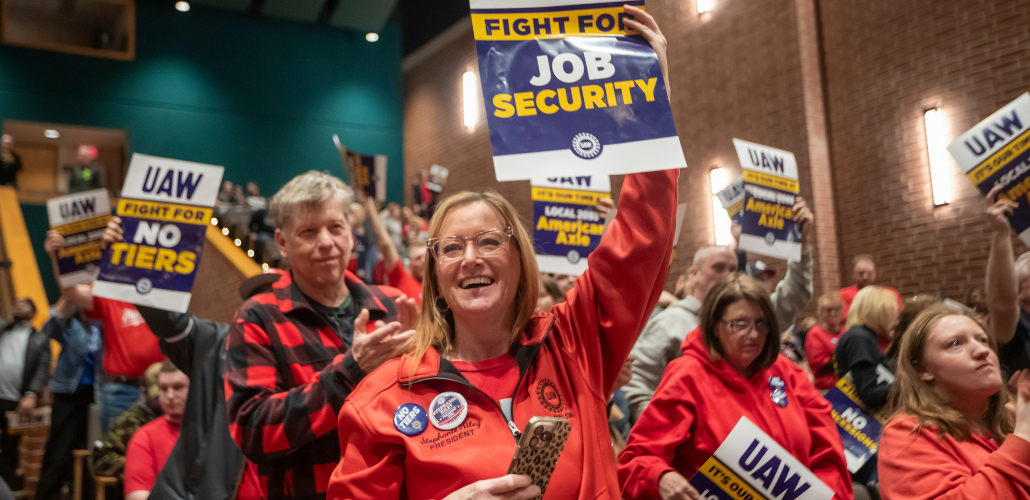
American Axle workers in Three Rivers, Michigan, who supply the Big 3, kicked off their contract campaign with a rally. Their strike deadline is May 31. Photo: Jim West
Axles are to vehicles what joints are to human bodies: the mechanism that facilitates movement. For parts worker Rosie Dodge, who has worked on a paint line for American Axle & Manufacturing for 10 years, the metaphor is embodied in the work environment.
“They just do not treat us like people,” Dodge said. “We are often referred to as bodies, like they don’t even want to give us credit for having a pulse. They do what they call ‘manpower moves,’ and they say, ‘We just need bodies over here.’”
United Auto Workers Local 2093 members at American Axle, a parts supplier for the Big 3 automakers, in Three Rivers, Michigan, are in gear after authorizing a strike in a 98 percent vote ahead of their May 31 contract expiration.
If nearly 1,000 UAW members move their bodies to picket lines at the end of the month, then the wheels on General Motors trucks won’t have axles to run on the road. UAW buttons read, “No Axles, No Trucks.”
SAVED THE PLANT
Workers haven’t recovered from when their wages were slashed in half in 2008, as part of concessions they made to save the axle plant from closure during the Great Recession.
Electrician Jon Krause, a 32-year employee on the bargaining committee, said 90 percent of local members participated in the strike authorization vote because workers are hungry to fight back. He said the high participation showed they were confident about holding the line for no concessions, no tiers, and increasing job security by securing new product for the plant.
In order to save American Axle, Krause said, “we took the concessions. Some people went as low as $14.50 an hour, and then we were hiring at 10 bucks an hour.
“The economy was in the tank,” said Krause. “There was not a lot of leverage; GM had plenty of vehicles, and we were just kind of left hanging. There was no real strategy behind it, but there wasn’t a lot to put there anyway.”
Workers lost their pension; it was replaced by an inferior 401(k)-style plan, with a 3 percent company match after workers contribute 6 percent. The company also introduced tiers for health care and retirement. Today, after a five-year progression, workers top out at $22 an hour, including a shift differential.
Workers have taken note of the lucrative management compensation packages and all the companies American Axle has bought over the years, while workers were fed a steady diet of concessions and closure threats. “To our members’ credit, they’ve had enough,” Krause said. “They can’t afford to live like this, so at this point, they’re willing to fight.”
NO SICK TIME
American Axle is headquartered in Detroit, but its operations span two dozen countries, employing 13,000 hourly workers globally; 9,980 are represented under collective bargaining agreements with various unions, according to a 2025 Securities and Exchange Commission filing.
The UAW represents nine of American Axle’s 24 U.S. facilities. North America is the company’s profit center, generating over 70 percent of its revenue. In 2024, its sales were 42 percent to GM, 13 percent Ford, and 13 percent Stellantis.
Dodge said one of her top issues is time off: workers don’t have sick days. Last year Michigan passed the Earned Sick Time Act, requiring employers to provide paid sick time accrued at a rate of one hour for every 30 hours worked.
“When the law passed, they gave 72 hours to the managers, and we still got none,” Krause said. “Now they want us to carve it out of our vacation time, and we have no interest in doing that. They really do not care. They would just as soon have you there 10 hours a day, seven days a week, if they can.”
WORKING TO RULE
The U.S. auto sector has shrunk and restructured over the past two decades. Companies have shuttered some plants and moved factories to Asia and Mexico, where auto plants and suppliers have integrated their supply chains to create a strong national market. In May, GM announced it will invest $1 billion in Mexico and shift production there from Asia to produce 80,000 cars per year, incorporating parts and components manufactured in the country, further strengthening Mexico’s integrated supplier network.
Within the U.S., since the 1980s, new auto plants and suppliers have set up shop in the non-union South, represented by international companies in Alabama, Georgia, and Tennessee. The UAW has struggled to organize these parts suppliers and assembly plants, though it did finally unionize Volkswagen in Chattanooga after a decade of failed attempts.
Even so, the UAW has leverage in the current political environment, said Art Wheaton, director of labor studies at Cornell University’s School of Industrial and Labor Relations. “At American Axle, one of their products is for heavy trucks, and those things still sell,” he said.

President Donald Trump has rolled back electric-vehicle tax credits and gutted clean-air rules. That means the Big 3 can sell more gas guzzlers, creating an incentive to expand production of heavy-duty axles.
In a February letter to shareholders, CEO David Dauch underscored how “North America large truck and SUV driveline systems” are profit centers for the company.
The Trump administration has “waved their magic wand and said climate change doesn’t exist anymore,” Wheaton said. With the elimination of Environmental Protection Agency restrictions on emissions and fuel economy, “now truck sales are doing quite well, and American Axle will benefit from that. And those trucks, most of them are made here in North America, with a big chunk of them here in the U.S.”
Because these workers have leverage, management has been “trying to bank parts just in case we do strike,” Dodge said. On a typical shift, workers make about 800 axles. Management has mandated weekend work and pressured workers to extend their shifts, boosting production to about 900 per shift.
In response, workers have deployed work-to-rule tactics. “We’ve been working safely and following our job instructions,” Dodge said, “making sure that we make what is needed and not more.”
A SERIOUS CAMPAIGN
Unlike in previous rounds of bargaining, Dodge said, this year the reform leadership of the UAW is mounting an actual contract campaign.
In past rounds, workers got no updates on how bargaining was proceeding. Top leaders made clear that the parts sector wasn’t a priority for the union. In 2021, Dodge said, the leadership agreed to health care concessions, including giving up zero-cost premiums.
“This time around, we really have the backing of the International, which I didn’t see in the last contract, so it’s really refreshing,” she said. “Before it was all hush-hush and secret. We only got to see the proposed contracts after negotiations, and even then, sometimes what they presented to us wasn’t what was in the contract.”
Union meetings that used to draw a dozen people now include hundreds.
“This time, we’ve had help from our local committees to our regional committees,” Krause said, “all the way up to Shawn Fain’s office.” The UAW created a Department of Bargaining Strategies after its 2023 Stand-Up Strike against the Big 3, to support corporate research into employers and involve members in escalating campaigns.
A sharper power analysis of corporate profit centers and growth plans has informed the UAW’s focus on parts suppliers, both as new organizing targets and in contract fights.
Local 699 members at Nexteer Automotive in Saginaw, Michigan, voted down two tentative agreements and on May 21 authorized a strike by 86 percent. Other UAW parts supplier expirations coming up include thousands of workers at Dana across multiple states, Bridgewater Interiors in Lansing and Detroit, Magna seating in Highland Park, and Allison Off-Highway in Indiana.
COMPANY CALLS COPS
“Eighteen years ago, the workers at American Axle made massive sacrifices,” UAW President Shawn Fain told the crowd at a contract fight kickoff rally in April, where the mayor and lieutenant governor also lent support. “These sacrifices weren’t for the company to make $8.4 billion in the last decade and keep it all for themselves.”
American Axle CEO David Dauch has been paid $111 million in the last decade, the UAW says. In 2024 alone he raked in $11 million, mostly in cash bonuses and stock options, according to the AFL-CIO’s Paywatch.
Meanwhile the union says workers are sleeping in their cars or living in motels, and biking to work because they can’t afford the very vehicles they supply parts for.
In response to the robust contract campaign, management is taking the gloves off. In April, workers were talking to their co-workers on non-work time outside the employee entrance and distributing UAW literature, buttons, and stickers when management called the police to escort them off the property, and threatened workers with termination and trespass if they continued leafleting. The union has filed unfair labor practice charges.
“They want you to be afraid,” said Fain at the rally. “But we can win, because we’re gonna fight like hell to get what we deserve. It’s our time, and we’re coming for ours. Are you ready to square shit up?”