One Battle After Another: The Big Contract Fights Coming in 2026
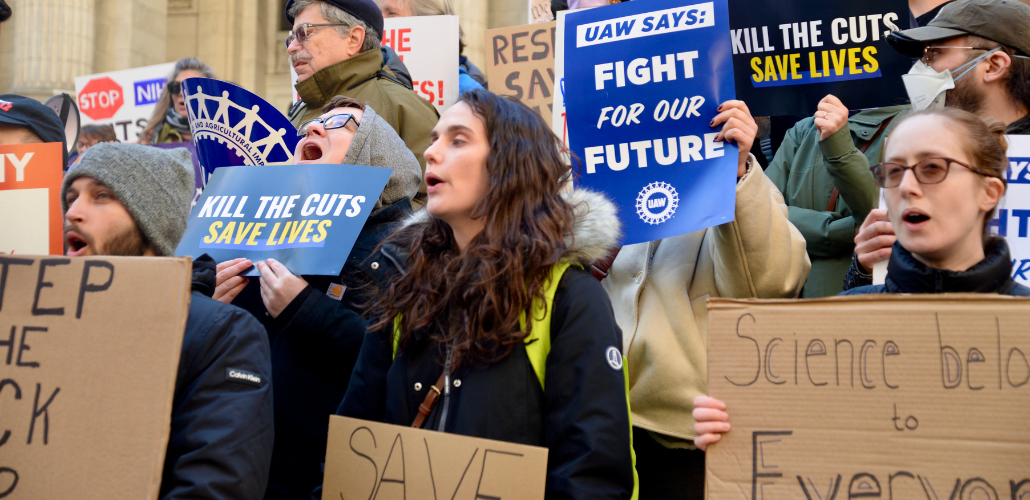
Public university researchers and professors rallied April 7 in New York City. Photo: Jenny Brown
The coming year could keep the strikes rolling through steel mills, state offices, telephone lines, axle plants, baseball diamonds, and hospitals from coast to coast. Union contracts expiring in 2026 could open up major fights by manufacturing, education, entertainment, and government workers.
FIBER AND WIRES
The contract covering 20,000 Verizon workers in the Northeast and mid-Atlantic expires on August 1. Since their seven-week strike in 2016, the Communications Workers and Electrical Workers (IBEW) have agreed with the company on two contract extensions—but not this year.
Retiree health care is a major issue. At the start of 2026, Verizon retirees who are not yet eligible for Medicare face huge increases in their health care premiums. Verizon has not hired much over the past 20 years, as technological changes—including the move to fiber optics and wireless—have dramatically reduced the workforce. Most remaining workers are retirement-eligible, with either 30 years of service or a combined 75 years of service plus age. Another issue is that more recent hires form a lower tier, with weaker layoff protections, pensions, and retiree health care benefits than earlier hires.
CWA also has three contracts coming up with AT&T next year. The AT&T Mobility “Orange” contract, covering 9,000 workers, the biggest of the four contracts in the company’s wireless arm, expires February 13. And AT&T contracts covering 5,000 wireline (landline and fiber) workers in the Midwest and another 2,200 wireline workers across the country expire April 11.
The contract covering 3,500 Teamsters at DHL is up on March 31. Last time around, members won what the union celebrated as the most “financially lucrative agreement” in the history of that contract. It included protections against inward-facing cameras in delivery vehicles. That same day, the Teamsters First Student contract expires, covering 17,000 school bus drivers, attendants, and monitors nationwide.
Construction sector contracts expire for 12,000 Electrical Workers in Los Angeles on June 30. A month later, contracts are up for 1,200 fellow IBEW members in Richmond, California, many of whom work at oil refineries.
“In the next six months, there's going to be a lot more members involved, and the goal is to keep them that way,” said Chris Bonfilio, president of the young worker committee in the L.A. local. Bonfilio expects that a rank-and-file contract campaign, hopefully in concert with officers, will reinvigorate the fight for more paid time off, increased overtime pay, and jobsite safety.
MANUFACTURING
The national oil refinery pattern agreement for nearly 30,000 Steelworkers will expire January 31. The union struck at major refineries in 2015 and 2022 over wages, safety, and staffing demands. This round, the bargaining team aims to win first-time provisions barring A.I. from displacing, monitoring, or automatically disciplining members.
On May 15, contracts expire for 4,400 aluminum workers, members of the Steelworkers, at Alcoa and Arconic plants in Indiana, New York, and Tennessee.
United Auto Workers members at car part suppliers come due for a string of expirations, beginning with 2,500 members at Nexteer building steering controls, followed by 1,200 at Bridgewater Interiors in May. Contracts expire at five American Axle shops throughout the year, including in May for 1,000 workers at a growing Michigan plant. Members there aim to regain the $28-an-hour wages they had before 2008, and set a pattern for other plants to follow.
Some 25,000 Steelworkers at Cleveland Cliffs and US Steel mills, largely in the Midwest, have contracts expiring on September 1. This will be the first Big Steel contract bargaining since Nippon Steel acquired US Steel this year, and securing jobs at unionized steel plants will be a top worker priority.
In October, contracts will expire for 17,000 Boeing engineers and techs in the Seattle area, members of the Society of Professional Engineering Employees in Aerospace.
In May, the contract expires for a thousand UAW members building heavy agricultural machines at Case New Holland in Iowa and Wisconsin. The union is demanding that the company commit to keeping the Iowa factory open.
“The agriculture market in the U.S. is very slow and lethargic right now,” said Keenan Bell, president of the union local at Bridgestone in Des Moines. “They’re not doing well, and we’re not doing well, especially with tariffs changing every month.” But Bell thinks the union can win raises, ease attendance policies for members with kids, and ensure that workers won’t be fired if their work visas expire.
In late July, national master contracts will expire at key firms in the rubber and tire industry, covering 4,000 Steelworkers at five Goodyear plants and 2,400 members at four Bridgestone-Firestone plants. Five hundred members at Yokohama in Virginia will follow in September.
PUBLIC SECTOR FIGHTS
Over 300,000 municipal workers in New York City have contracts up in 2026, just as a labor-backed mayor arrives in office. Some 50,000 New York state workers, largely in professional and technical roles, have a contract expiring April 1.
The contract expires for 96,000 Service Employees (SEIU) workers for the State of California on June 30. Giovanni Martinez, who works at the Housing and Community Development office, says a statewide stewards network is holding lunchtime meetings with union members, and has found that cost-of-living raises and restoring telework options are popular demands.
The nationwide contract for 16,000 National Nurses United (NNU) members at Veterans Affairs hospitals and clinics is technically due to expire in May. Trump has ordered federal managers to ignore contracts for a million workers, so bargaining a new deal may be tough. But the date may become a lightning rod for nurses to force the issue.
Expiring in May is the three-year contract for 200,000 city Letter Carriers (NALC), which took so long to bargain that it was mostly retroactive, awarded by an arbitrator last March after members voted down a tentative agreement. After the groundswell of “vote no” sentiment and a bottom-up campaign for more transparent bargaining, the union leadership is doing a bit more to involve members this time, starting with a bargaining survey.
Still ongoing are the 2025 negotiations for a smaller postal union, the 50,000-member Mail Handlers.
GROCERY WORKERS
In February, a contract covering 30,000 Food & Commercial Workers at New England grocery giant Stop & Shop is set to expire. In 2019, a strike by 31,000 members beat back a plan to double out-of-pocket expenses and increase health premiums by 90 percent. The company, which shuttered 32 stores last year, could seek similar concessions this time around.

A contract covering 19,500 UFCW Local 99 members across 123 Fry’s stores (owned by Kroger) in Arizona expires in March. In August, a UFCW Local 75 contract covering 20,000 Ohio Kroger workers is up. Short staffing is a priority, said member Mason Wyss.
And in June, about 14,000 UFCW Local 876 members at Kroger in Michigan could walk out if they don't reach an agreement.
FREE SPEECH
The Trump administration’s sweeping attack on political speech has chilled campuses and schools across the country. Educators have been fired over social media posts about political commentator Charlie Kirk. Pro-Palestine students and teachers have had their visas revoked, and some still face deportation. Many are turning to their unions as a line of defense.
On August 15, the University of Illinois at Urbana-Champaign Graduate Employees’ Organization (AFT Local 6300) contract will expire. The bargaining unit doubled to 6,000 people over the summer when research assistants voted to join the union with teaching assistants and graduate assistants. Grace Garmire, a steward in the physics department, said workers need to codify the protections that grad workers have in practice, but not on paper.
The University of California’s contract with 29,000 academic student employees (UAW Local 4811) is up December 31, 2025. With federal funding under threat, job security and pay are priorities. The union is also fighting to protect immigrant members, including through paid leave for workers stuck outside the U.S., rehiring rights for those who lose their work authorization, and protections against ICE on campus.
“Management has to pick a side,” said Tanzil Chowdhury, a graduate student researcher and bargaining committee chair. “Are they going to stand with the workers and help us withstand this onslaught from the Trump administration?”
Members are bargaining alongside 7,000 research and public service professionals (RPSP-UAW) and 4,800 student services and advising professionals (SSAP-UAW), both fighting for first contracts. “Many of us saw co-workers essentially kicked to the curb as soon as their project lost funding, often without severance or layoff rights,” said field researcher Carolina Cormack Orellana, a bargaining team member.
At Brown University, 1,000 graduate student workers (Graduate Labor Organization, AFT) have a contract up on June 30. Academic freedom is a priority. The Brown administration “is trying to take advantage of a crisis to impose austerity on all workers on campus,” said Michael Ziegler, executive director of AFT Local 6516.
In June, contracts will expire at the majority of public higher ed campuses in Oregon. First come 2,000 educators and staff across eight community colleges, then 3,000 library technicians, food servers, and other staff represented by SEIU Local 503 at seven state universities.
HEALTH CARE
The contract for 80,000 nurses, aides, and other health care workers at New York’s League of Voluntary Hospitals will expire on September 30. The deal often sets the pattern for fellow SEIU members in health care in the region.
At Kaiser in Northern California, 24,600 National Nurses United members have a contract expiring in August. Company revenues surged more than 10 percent this year, while multiple unions waged strikes over safe staffing and pay.
BASEBALL, TV, AND MORE
The Major League Baseball Players Association contract expires December 1, 2026. Owners will likely continue their crusade to impose a salary cap: Major League Baseball commissioner Rob Manfred stoked outrage when he proposed that a lockout could be “a positive.” But this is a fight the baseball bosses have lost time and time again.
“While 30 billionaire owners continue to get rich off the backs of players’ work, they claim their teams can’t compete without artificially capping labor costs,” said Silvia Alvarez, communications director for the union.
On May 1, the Writers Guild of America’s contract with the Alliance of Motion Picture and Television Producers will expire. In 2023, the Guild struck for 148 days over pay and protections against A.I. This time, health care costs and further A.I. protections are expected to take center stage.
The Washington Post’s contract with the Washington-Baltimore News Guild Local 32035 will expire on December 31, 2026. The 715 members—including workers in the editorial, marketing, ad sales, and purchasing departments, among others—are fighting for wage increases, layoff protections, and protections against the use of AI.
In December, unionized journalists at Politico scored a big win when an arbitrator found that the newsroom violated its collective bargaining agreement when it rolled out two AI-driven tools. “This ruling is a clear affirmation that AI cannot be deployed as a shortcut around union rights, ethical journalism, or human judgment,” Unit Chair Ariel Wittenberg said.
In July, the Hotel and Gaming Trades Council’s master contract covering New York City hotels is set to finally expire; the last deal was a seven-year extension of a five-year contract. The union has lobbied for unemployment benefits to support members in the event of a strike, and has reintroduced its Hotel Employees Action Team to engage members throughout the negotiations.
32BJ SEIU’s New York Metro Residential contract, covering 34,000 doorpeople, porters, supers, and handypersons who maintain and clean thousands of apartments, condos, and co-ops in New York City, is up in April. Members are fighting for higher wages and to defend their premium-free health benefits.
FIRST CONTRACTS
At the Volkswagen plant in Tennessee, 4,300 Auto Workers who won their union in 2024 are still bargaining a first contract. After executives provided a supposedly last offer in October, more than two-thirds of members voted to authorize a strike.
Fights for first contracts continue at Starbucks, where workers have so far unionized 650 stores, and at the Amazon fulfillment center on Staten Island where workers unionized in 2022.
Each of these 2026 fights is an opportunity to build confidence, try bolder tactics, set our sights higher, and practice the cross-union solidarity we're going to need to beat back the anti-union offensive.