How Rhode Island’s Labor Movement Made Its Weight Felt in Politics
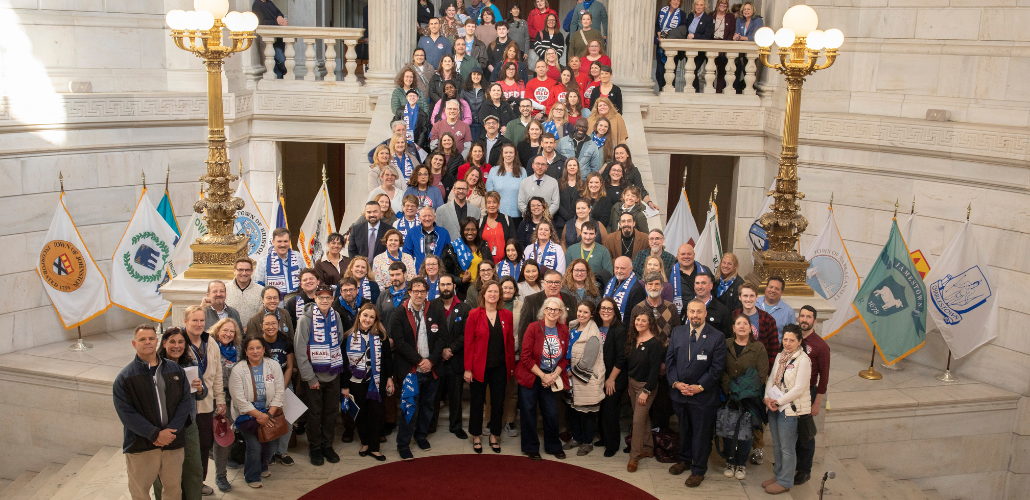
Over the last decade, unions in Rhode Island have shifted the political fortunes of working people in the state. Photo: Ryan T. Conaty Photography.
Over the last decade Rhode Island has been a hotbed of progressive, pro-worker legislation. But it wasn’t always this way. It took years of proactive organizing by the labor movement on legislative and electoral campaigns.
This “blue” New England state was led by Republican Governor Donald Carcieri from 2003 to 2011. During his term he cut 1,000 public sector jobs, passed a regressive property tax law, and attacked pensions for teachers and other public workers—actions that were enabled by centrist Democrats in the state legislature who were lukewarm towards labor.
That’s when forces in labor began to think more seriously about the political process. “We started looking at primaries, because the House of Representatives has much more power than the executive branch,” says Patrick Crowley, current president of the Rhode Island AFL-CIO and a union organizer for 30 years. “Centrist Democrats were able to just win unopposed because labor wasn’t getting involved.”
The AFL-CIO worked with affiliates like the National Education Association state affiliate and the Painters (IUPAT) District Council 11 to map out electoral opportunities. They used VAN, a voter database, to see which districts had concentrations of union members and how many votes it would take to flip seats. Explicitly pro-labor candidates were recruited to run, and in 2010 they took out a handful of anti-labor incumbents.
These new elected officials have demonstrated over time a stronger commitment to labor’s legislative priorities. Since then many more pro-labor legislators have been elected in both the state House and Senate.
But more than just supporting better candidates, unions in Rhode Island have deepened their overall approach to politics by committing more resources and raising the bar on the issues they expect electeds to fight for.
“I was trained that politics is not just going to fundraisers, slapping some backs, and writing some checks,” says Justin Kelley, the political director of Painters District 11. When canvassing, the union tries to focus on having “smaller groups with deeper conversations, instead of just lit drops.”
While this may mean fewer doors get knocked, the longer conversations with voters increase the chance that they will connect with an issue and turn out to vote.
RACKED UP WINS
The building trade unions in Rhode Island have racked up a number of impressive victories over the last 10 years. In 2023 they pushed forward and won legislation making wage theft and employee misclassification, both huge issues in the construction industry, felony crimes.
The building trades have also taken the lead on fighting climate change in a way that creates good union jobs. They worked with Climate Jobs Rhode Island, a coalition of labor unions and environmental organizations, to win glazing standards for all publicly funded construction projects.
These standards for windows and doors lead to energy-efficient buildings with less use of heating and cooling systems, meaning less carbon emissions. This legislation has set the glazing standard for IUPAT in the rest of the country. Next up the unions are looking to win standards limiting workers’ exposure to toxic lead for commercial building renovation projects.
Rhode Island’s Act on Climate, passed in 2021 with the support of the state AFL-CIO, set ambitious and binding targets for carbon emissions reductions. It was followed in 2023 by a law requiring labor standards like prevailing wage rates and comprehensive safety training for large renewable energy projects.
The building trades have also aggressively fought for and won the procurement of big offshore wind projects. These efforts have shown that fighting climate change does not have to hurt unions.
RIPPLE EFFECTS
Wins at the state level can have a positive ripple across the country. “The business class takes the approach of building legislation at the state level and then working up to the federal level,” says Matt Taibi, secretary-treasurer of Teamsters Local 251. “Labor needs to do the same.”
In 2017, Teamsters Local 251 worked to pass the Healthy and Safe Families and Workplaces Act, which allows workers to earn one hour of paid sick time for every 35 hours worked.

At the beginning of the Covid pandemic, Local 251 fought for and won prevailing wage rates for school bus drivers. Now they’re focused on passing the Warehouse Worker Protection Act, which would protect warehouse workers from unsafe production quotas. This would apply to companies like Amazon, a big organizing target for the union.
For NEA Rhode Island, the goal of electoral work has been to “not just win seats, but change what those seats stand for,” said communications director Stephanie Mandeville. The union has revived the practice of bringing educators to lobby days at the capitol, instead of just union staff. This year 120 members came out. These events have forced legislators to take educators more seriously as a political force and given members a sense of their own power.
NEA Rhode Island has also broadened its approach by joining with allies like the Healthy Schools Coalition, a parent advocacy group that works to raise nutritional standards in schools. “When you align workers’ rights with community well-being, you’re building a majority,” said Mandeville. The coalition was able to win student safety and behavioral health committees in every district. Future priorities include a more equal distribution of school funding across the state and a moratorium on charter school expansion.
FACING TOUGH ISSUES
These Rhode Island unions haven’t been afraid to take on social issues that are potentially controversial among members, sometimes holding presentations and discussions on such topics at union meetings.
A same-sex marriage equality bill was signed into state law back in 2013—with the support of labor—two years before same-sex marriage was legalized nationwide. The building trades were among the supporters, after discussions about the issue were held in various locals. This was even more impressive given that it meant challenging the Catholic Church, a powerful institution through whom the trades often get work on building or renovation projects.
Last year unions supported the legislature in passing an assault weapons ban. “We framed gun violence as a workplace safety issue,” said Crowley. Teachers could relate to the rise of school shootings across the county and the increase in safety drills they have to do. Workers who interact with the public, like nurses and transit operators, have experienced more violent incidents at work and could see how banning assault weapons would protect their physical safety.
MOMENTUM ON THEIR SIDE
In no small part due to the political organizing of labor unions over the last 15 years, Rhode Island now has a Democratic trifecta and continues to pass ambitious legislation. In 2024, pensions for teachers and other state workers improved for the first time in 40 years. The state’s minimum wage will rise to $17 an hour in 2027.
In a boon to new organizing, last year a ban on captive-audience anti-union meetings was ratified. Workers can now sue companies if they’re fired or disciplined for refusing to attend one. Rhode Island also became the first state to enact a law that would guarantee graduate students’ right to form a union under the state labor board even if the National Labor Relations Board were to reverse this right.
With momentum on its side, the local labor movement is looking towards other priorities like passing a millionaires tax, for which recent polls of Democratic primary voters show majority support.
Unions have shifted the priorities of the Rhode Island Democratic Party. In 2018 the word “union” didn’t even appear in the party platform. But the 2025 platform has the clear imprint of organized labor.
Crowley believes the labor movement needs to be a “stable anchor” for political organizing in the state. While other progressive organizations of course should be involved, unions have the institutional resources and membership base to meaningfully change the political direction of the legislature.
The experience of Rhode Island shows that when unions are strategic, apply real resources, and approach the political process like organizers, positive change can happen.