Virginia Workers to Governor: Don't Water Down Our Bargaining Rights!
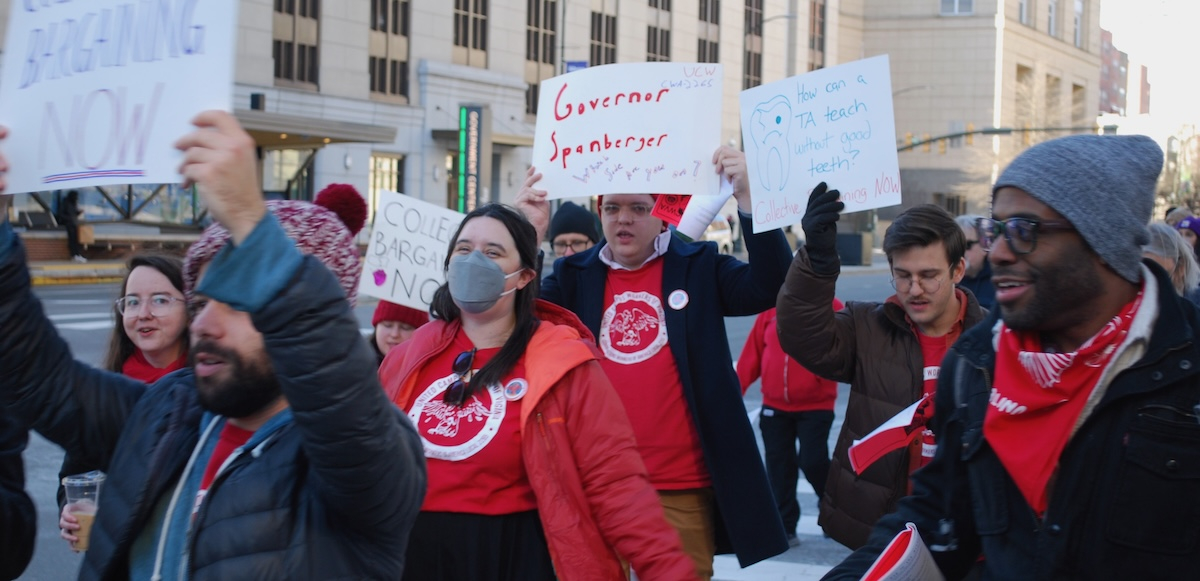
Members of the United Campus Workers of Virginia marched to the state’s capitol in Richmond, Virginia. They are still trying to get college instructional staff included in the new public worker bargaining law. Photo: UCW-VA
After a years-long campaign by unions, Virginia’s General Assembly passed legislation to extend collective bargaining rights to nearly half a million state, county, and municipal government employees.
The new bill still has to be signed by Democratic Governor Abigail Spanberger, who has proposed adding over a dozen amendments which unions say would weaken the bill. These include removing binding arbitration and delaying full implementation of the law until 2030. On April 13, union members marched on the capitol to call on the governor to sign the legislation without the amendments.
Union recognition has been denied Virginia’s public employees since 1946 when the state legislature passed a joint resolution against public sector bargaining to defeat a Black hospital workers’ organizing drive at the University of Virginia. A 1977 state Supreme Court ruling affirmed the ban, which was later codified by legislation in 1993.
With Democrats in control of the governor’s office and both houses of the General Assembly, in 2020 the state allowed local governments to opt in to collective bargaining. Since then, tens of thousands of teachers, school bus drivers, and city workers have won union contracts.
Campaigns across the state sought to expand on these initial victories, winning collective bargaining for some city and school employees in Richmond, Fairfax County, and Prince William County, among others. However the 2020 legislation created a complicated patchwork, because local governments were allowed to reject union recognition petitions. Likewise, the topics unions could bargain over, like wages and benefits, were not consistent from city to city—each government could determine what it would allow unions to negotiate over.
NEW EXPANSION
When Spanberger, a Democrat, won the race for governor in 2025, unions were able to build public support to push through the legislation. They included SEIU, the teachers’ unions, the United Electrical Workers (UE), the Firefighters (IAFF), Transit (ATU), and the United Campus Workers of Virginia. The law extends unionization rights to 28,000 home healthcare workers.
Virginia’s city and county workers had been organizing for several years before the 2020 change. Members of UE-Virginia seeded organizing committees around the state, such as in the Hampton Roads region of southeast Virginia. These unions were started by Black, blue-collar workers in sanitation and other public works departments. By applying a wall-to-wall organizing approach, UE-Virginia’s locals have grown to include workers in social service departments, libraries, and museums.
STEP BY STEP
After the 2020 victory, UE-Virginia worked in coalition with other public sector unions to pass ordinances under the collective bargaining expansion. They won these ordinances in Portsmouth and Newport News, which had more labor-friendly city councils. But municipal elections in 2024 in both Norfolk and Virginia Beach produced anti-labor majorities, leading UE to focus on winning pay increases and workplace rights instead of pursuing collective bargaining ordinances. In Norfolk, for example, UE workers launched and won a campaign for a step pay plan, demanding pay increases based on years of service.
SEIU 512 and its predecessor union, Virginia Association of Personal Care Assistants, have been preparing the ground for this breakthrough since 2006. Tying the fight for union rights to the struggle for racial justice, Athena Jones, a home healthcare worker and chapter leader of SEIU 512 laid out the stakes: “Our ancestors fought for this; Black and Brown women in the state of Virginia, the gateway to the Confederacy, consistently overlooked, marginalized, and not considered as an equal.”
Jones said that the home healthcare workers’ legislative fight concentrated on four priorities: unionization and bargaining rights; removing a 16-hour cap on earned hours; stopping an expansion of electronic monitoring, and a living wage of $15-25 an hour. Currently home healthcare workers are paid $17.97 an hour in the DC metro area and $13.88 in the rest of the state, meaning 53 percent of the union’s members live in poverty. Removing the cap on earned hours would allow workers to be paid for the actual hours they are working since many live-in homecare workers keep providing care after the current daily cap of 16 hours. The legislation will improve conditions for workers in an expanding sector.
“If homecare workers get what we’re asking for, all workers in the state will benefit,” Jones said, since raising standards will put pressure on private employers to raise their wages, too.
SOME STILL EXCLUDED
In the legislation, campus instructional staff are excluded from bargaining rights. But university workers were a huge part of pushing through the law.
In the final weeks of the legislative session, United Campus Workers, a Communications Workers affiliate, carried out an ambitious strategy of town halls to win community support for union rights. The first town hall was attended by 170 people, under the slogan “Charlottesville is a Union Town.” Participants were invited to talk about the problems they faced in Charlottesville and how UVA’s policies impacted affordability and quality of life.

“People could see that collective bargaining could be part of the solution, a vehicle for making things better,” said Ian Mullins, UVA associate professor of sociology and vice-chair of UCW-VA’s Faculty Area Committee. UCW members organized four more town halls in university towns across the state.
Harry Szabo, professor at Virginia Commonwealth University and president of UCW-VA, explained that the university workers’ campaign was not only built around bargaining rights and better pay, but also the needs of community members.
Szabo won election as part of a leadership slate committed to bargaining for the common good if they won bargaining rights. Then, UCW organized a series of town halls where residents could address how universities frequently act as bad neighbors. Universities contribute to unaffordability, said town hall participants, through low wages and by driving up property values. They called on UVA to invest more in public transportation and to recognize the union and support collective bargaining.
Szabo said that workers want to live where they work. She relayed a story of a graduate assistant at UVA who could not afford furniture because of the rising costs of housing and transportation in Charlottesville. “We want universities to be good neighbors,” Szabo said, “How could we turn [community] problems into demands that we make on our universities through collective bargaining?”
FEDERAL GOVERNMENT ATTACKS
The Trump administration has been attacking Virginia universities. Pressure from Trump forced UVA’s president to resign in summer 2025, and later he threatened to withhold federal funds unless the administration could dictate discriminatory gender identity policies, stop affirmative action, and remove academic freedom protection for instructors.
In October, UCW-VA members and local community activists mobilized 1000 people to rally against the changes; in December, union members and students marched on UVA’s governing board. The board fled scrutiny by changing their meeting location.
The illegal firing of six tenured faculty at Virginia State University showed how collective bargaining is necessary to defend instructional workers’ rights. “Faculty were starting to see collective bargaining as how we have a seat at the table, how we protect students and their education, how we protect facilities workers from back-breaking work,” said Mullins. “People are more willing to listen now because of the mobilizations we’ve done.”
But Mullins said that bargaining in itself is not enough to protect universities and university jobs. Building membership involvement through collective action has been key to UCW-VA’s campaigns. Mullins said. “We have gotten existing members to bring someone new; every action we’ve had we’ve gained new members. UCW has been able to grow by getting people involved, cultivating active members and getting them to stay, not just to pay dues.”
For Cecelia Parks, librarian at UVA, the campaign clarified the vision of the union. “Without bargaining our fights have been largely against something—very reactive,” said Parks, who is chair of UCW-VA’s Political Coalition and Policy Committee. “It’s important to give members something very positive to fight for that will change their lives. It’s exciting and gives people something to plug into.”
Unfortunately, lobbying by university presidents prevailed and instructional staff were explicitly excluded from the law. “The fight is not over yet,” said Parks. “We will keep going until all public sector workers in Virginia have bargaining rights.”
The governor appears to have gone in the opposite direction with her proposed amendments, however. “The governor’s changes would remove many of the guaranteed worker protections from the law and put their future in the hands of the uncertain regulatory process,” said the Virginia Public Sector Labor Coalition, which includes many of the state’s biggest unions. “This move bypasses the General Assembly and grants any governor the power to derail collective bargaining without a single public vote. Under the governor’s substitute version of the bill, many workers who currently have collective bargaining agreements would actually have fewer protections than they do now.”
Unions are pushing the General Assembly to vote down Spanberger’s amendments and send the original bill to her desk to sign.
This article has been modified to include updates on amendments to the bill proposed by the governor.