We Started the School Year with a March on the Principal
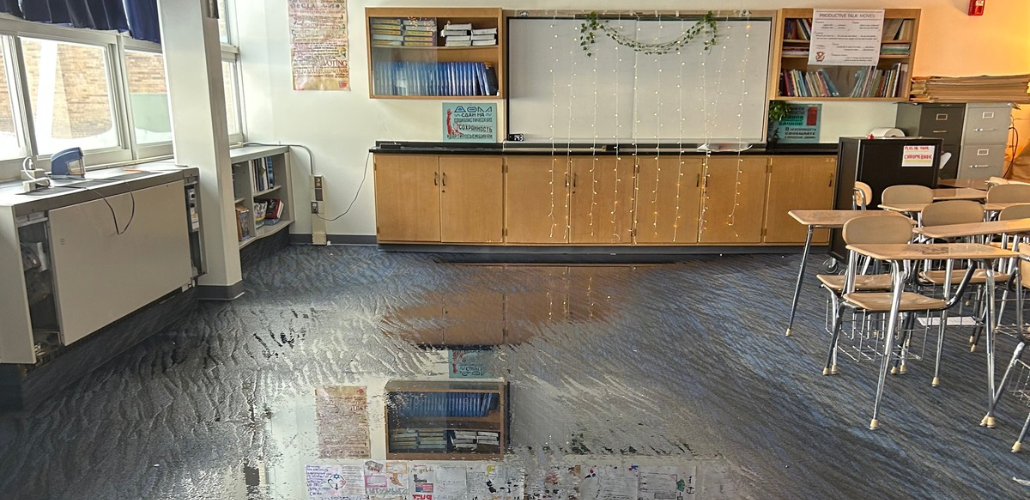
Our classrooms have been flooding multiple times a year. As demoralized as my co-workers were, this issue had the juice we needed to lead a workplace action—everyone cared enough to do something about it. Photo: Kayla Sharpe
At Ferndale High School, nestled in a Detroit suburb, one of our most pressing problems is the dilapidated building, built in the 1950s.
The outdated heating and cooling systems are prone to classroom floods—in the last nine months I've experienced three. Once boiling hot water sprayed out of the HVAC unit during class, nearly injuring a student.
It was late August—our last Sunday night of freedom before our teacher professional development week—when six of my co-workers and I received an email from our principal. She said that a few classrooms had flooded again the previous week, but the damage was limited and our classrooms were “ready for our return.”
“Tomorrow is still the beginning of a fresh school year,” she wrote, “and I’m looking forward to welcoming everyone back and starting the year together on a positive note.”
She made the mistake of including all affected teachers as recipients, instead of blind copying us, so I knew exactly who to reach out to.
That evening I spent lots of time on the phone with my co-workers and my fellow union building representatives. We all had experienced previous flooding, so we were skeptical that our classrooms would actually be ready for our return the following morning.
Ever since I began working at this school in 2024, my mission has been to convince my co-workers we should be compensated in some way when our school administrators fail us. Whenever we’ve asked administrators to address issues like poor attendance or facilities problems, we’ve gotten responses like “That is not my fault” or “I do not have the power to fix that.” This energy has been so demoralizing for our teaching staff, and it seemed to me that my co-workers had gotten used to just accepting the b.s.
But having cut my teeth as a political organizer on my college campus and read Secrets of a Successful Organizer, I could tell that this issue had the juice we needed to lead a workplace action—everyone cared enough to do something about it. By Monday morning I had devised a plan with the support of my fellow building reps.
INDUSTRIAL FANS
Our suspicions were correct; words can hardly describe the scene we walked into. Each of the seven flooded classrooms had eight to 15 industrial fans blowing on the floor, dehumidifying machines siphoning water out of the classroom windows, and no functioning air conditioning.
Teachers were supposed to spend this day organizing and preparing our classrooms. Most of us spend hundreds of dollars of our own money to purchase supplies, decor, soft lighting, and small comforting touches to make our classrooms the warm, safe environments we know students need. It takes a fair amount of time to unpack those things from the summer months and get the space ready for the school year.
When I saw the state of my classroom, I knew it was going to be impossible to get any sort of work done in that environment. My next step was to walk door to door and check in on my six co-workers who had been looped in on that email. No classroom was even close to being a functional workspace.
I could feel the swelling anger, and knew the moment was ripe to make an ask. “We do not deserve this,” I told my co-workers. “What if we all went to the principal and asked for something in return?”

I told them about the plan the other building reps and I had come up with: The affected teachers could march together to the principal’s office and ask that either we receive pay for the additional hours it takes us to set up our classrooms outside of contract time, or we be excused from a professional development session during the week to set up our classrooms during work hours.
Everyone was too angry to be afraid. All but one agreed to join our march on the boss.
The six of us found our principal in a teacher’s classroom. She stepped into the hall to see us standing there shoulder to shoulder, looking upset. None of us will ever forget her response: She took out her phone, started filming us, and said, “Oh I am going to put this on TikTok, it’s the first day of school and the teachers already want something from me.”
When she saw how deeply stunned we were, she put her phone back in her pocket and asked what was wrong. I reminded her of her email, and informed her that our classrooms were in fact not “ready for our return.”
I told her this wasn’t fair to us, and explained how we felt it could be rectified. She said she understood our frustration and would “look into” allowing us to timecard extra hours.
We did not feel incredibly hopeful. There’s too much wiggle room in the phrase “I will look into that.” But to our surprise, we received an email from the principal saying she would be able to approve three hours of paid time for classroom setup.
LESSONS LEARNED
Since this action, I have debriefed with the teachers that participated. While we’re glad we won some compensation, we realized we should have come with a number in mind. We were doubtful that we would win any kind of concession, so we didn’t even think that far ahead. We were able to get the most necessary work done within the three approved hours, but could have benefited from more time.
Still, once the rest of our staff heard about our action, our building was buzzing with excitement. I heard co-workers 15 to 25 years my senior say, “That was so cool!” “I didn’t even know you could do that!” “I wish I was as brave as you when I was your age!” So in my mind, it was a success.
I think the most powerful thing we can do as organizers is be hopeful, and share that hope. The message of “You do not deserve this mistreatment” seemed to really resonate. In education, we grow so used to getting beat down from all angles that we can forget we deserve to be treated with dignity.
I’m very proud to have helped my co-workers work together at that moment. I hope this will help us find the courage to take on our next workplace issue without fear.
Kayla Sharpe is a high school social studies teacher in Ferndale, Michigan, and a building representative with the Ferndale Education Association.