Philadelphia Orchestra Musicians Protect Their Hearing and Their Craft
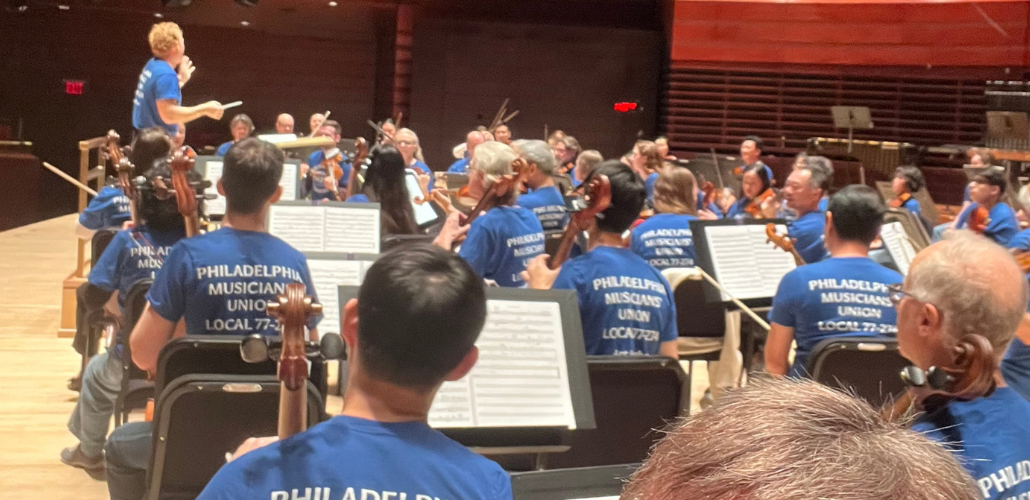
Orchestra musicians wore their union T-shirts at certain concerts as part of their contract campaign. Photo: Derek Barnes
Philadelphia Orchestra musicians have won first-in-the-nation protections against hearing loss. The groundbreaking provisions, which could serve as a model for other orchestras, are part of a contract just ratified by Musicians (AFM) Local 77-274.
They also secured a raise of almost 13 percent over three years, which will help keep pace with inflation and attract high-quality artists. But for the musicians, the most important gains related to their working conditions and artistic integrity.
The orchestra usually performs classical music without amplification, but sometimes plays in a supporting role to pop artists who use large sound systems. During one such performance last year, the musicians were seated right next to unbearably loud speakers, with no way to address the situation.
“Our phones were blowing up about it afterwards, and we knew this had to be a priority,” said Local 77-274 Vice President Marjorie Goldberg.
STOP THE CONCERT
The issue goes beyond discomfort. Hearing loss can impact a musician’s career, especially one who performs very precise classical music in an ensemble.
Under the new contract, decibel meters will be placed onstage during rehearsals and performances. If the sound levels get too high for too long, musicians can remove themselves or even stop the concert.
Artists performing with the orchestra will be required to attend rehearsals to ensure that sound details are worked out in advance. And management will provide a $150 allowance for musicians to buy professional-level hearing protection.
The union also proposed, and management agreed, to open up unlimited opportunities for students of all ages to attend dress rehearsals and sometimes meet with members of the orchestra. Experiences like these can spark a lifelong interest in the arts.
“It’s very important for developing the next generation of musicians and music-lovers,” said violinist Dara Morales, a member of the bargaining committee.
In addition, management will be required to meet at least quarterly with the musicians’ education committee to discuss ways to improve outreach.
Increasingly, the orchestra has been asked to do concerts where they perform the soundtrack while a movie is shown. But a movie soundtrack is written to be recorded in small chunks in a recording studio, not for hours at a time.
Playing it all straight through, live, can be very physically demanding and even put the musician at risk of long-term physical injury due to repetitive motion. For brass players, these scores often call for sustained playing of loud and high notes in a way that’s not common in symphonic pieces.

Now the orchestra has a limit of two film programs per subscription season. This also provides opportunities for other orchestras that are more used to playing that type of program, such as the Philly Pops.
STARTED EARLY
The orchestra’s last contract fight was much more contentious and almost led to a strike. This go-round, the union started laying the groundwork earlier, beginning with a detailed survey on priorities. Substitutes and extras were surveyed as well.
“This time we were very prepared,” said Local 77-274 President Ellen Trainer.
Though management didn’t push back as hard as it did three years ago, members still had to organize pressure. When CEO Ryan Fleur stopped showing up to bargaining sessions, the union launched a petition demanding he be present. Every single orchestra member signed. Fleur started appearing again.
After one concert, musicians passed out flyers thanking the audience for supporting classical music. During movie-soundtrack concerts, they wore their union T-shirts.
Principal players—the section leaders for each group of instruments—signed a petition demanding that substitute players receive pension contributions, which had been eliminated for them when the orchestra declared bankruptcy in 2012. Now substitutes will receive a 5 percent pension contribution starting in year three of the contract.
The bargaining committee used a phone tree to keep in touch with members and coordinate actions. Once the committee met for two hours after a concert that ended at 11 p.m.
A UNION FAMILY
The contract reflects years of bottom-up organizing to transform the local.
A slate of reform leaders won office in 2019. They ran to rebuild a union they saw as stagnant and unresponsive. Before, “people didn’t feel like the union did anything except take dues,” Trainer said.
Freelancers worked on various different contracts and never interacted with each other, “a bunch of small islands, ” she said. The Philadelphia Orchestra musicians in particular felt very separate from the rest of the membership.
Since taking office, the leaders have worked to involve members in the life of the union and to make connections across different workplaces. The local is more connected to the local labor scene, and members provide music at various picket lines and union events. “We’re much more active now, and freelancers feel like the union cares about them,” said Morales.
Goldberg was especially proud that five or six orchestra members showed up to an action this year supporting musicians at the Forrest Theatre. “It definitely feels more like a union family now,” she said.