How Letter Carriers Can Organize to Prevent Smoke Injury
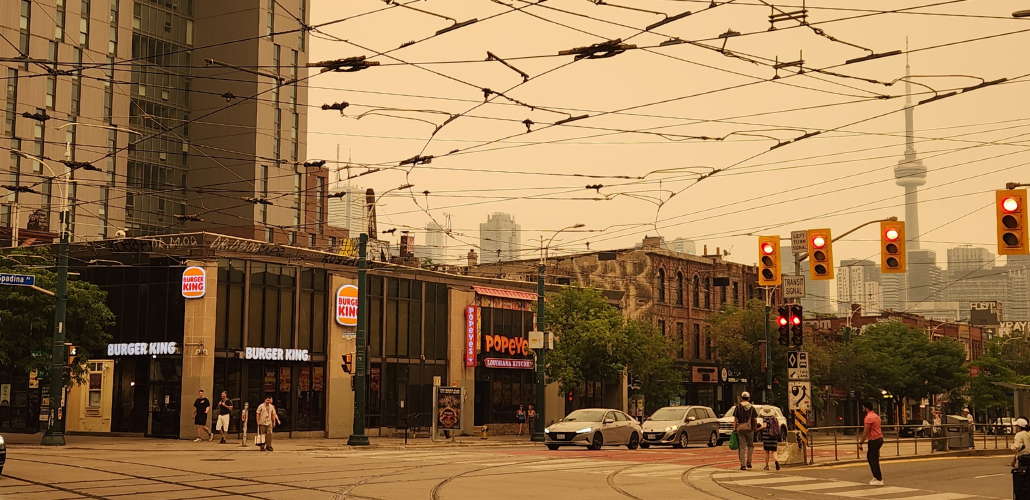
Wildfire smoke is affecting outdoor workers across much of the U.S. and Canada. This photo shows orange skies over Toronto on July 15. Photo: ARandomName123 (CC BY-SA 3.0)
Letter carriers and other people who work outdoors, especially in the upper Midwest and East, are experiencing hazardous levels of smoke from Canadian wildfires. Some areas have been experiencing AQI (Air Quality Index) measurements of over 300, even over 500, with local authorities advising residents to stay indoors.
As temperatures continue to rise from climate change and vegetation dries out and catches fire from lightning, this situation will get worse.
We are being given advice by Postal Service management and our union leadership to make individual decisions about whether we are safe delivering mail in these conditions. Wrong! We are berated with the slogan “Safety Depends on Me!” Wrong!
Management should be following local health advisories and keep carriers off the street in these conditions. But reports from carriers all over the Midwest let us know that management is instructing carriers to deliver the mail and use a mask if desired and available. Wrong!
Many carriers will follow management instructions despite concern for their own or co-workers’ safety because they fear management retaliation if they do not—especially people in the more vulnerable job categories of City Carrier Associates and Part-Time Flexible employees.
Or they assume that they will not be impacted by the smoke. (Hint: wildfire smoke inhalation can damage healthy individuals over time; see the last section of this article.)
Or they do not want to be considered weak when others are going ahead. Or they don’t want to bring back mail to have to face overburdened days to come.
THE ANSWER: COLLECTIVE ACTION
What is to be done? Collective action to protect all carriers, together, in the area. Here’s a step-by-step approach:
- Educate carriers on their right to refuse to work outdoors when there is serious smoke from wildfires, using stand-up meetings, flyers, bulletin boards, and breakroom meet-ups.
The criterion for when mail delivery is unsafe is not only when there is a “risk of death or serious bodily injury.”
We have the right to avoid any illness or injury caused by unsafe air quality, which can be predicted by Air Quality Index and is scientifically proven (see the last section of this article).
Even the USPS directives, distributed as stand-ups in late July, state, “Those who are most at risk are… active people of all ages who exercise or work vigorously outdoors…”
- Demand (by circulating a petition or speaking up at a stand-up meeting) that management supply every carrier with an N95 or P100 mask. If necessary, use multiple 1767 Hazardous Condition and Article 14 Safety and Health grievances with evidence from local authorities or nearby AQI readings.
- Get all carriers in your station or your area on a WhatsApp chat.
- Assign carriers to monitor air quality index (AQI at AirNow.gov) and keep track of local authorities’ directives.
- Decide together (consulting AirNow.gov) how the group should respond to certain AQI levels, i.e. when to refuse to go out without N95 or P100 masks, when carriers with respiratory conditions should bring the mail back, when everyone should bring the mail back, etc.
- Talk through the consequences if everyone brings the mail back. Will management discipline all of us? Can we threaten to go public if they try? What if mail piles up and takes a while to get delivered?
- When alerted by the monitors, spread the word of AirNow.gov advice and indicate that “many carriers may want to” bring the mail back. Prepare carriers for these words that allow “plausible deniability,” i.e. you are not calling for a strike, only for carriers to be safe.
- When bringing the mail back, fill out form 1767 (hazardous conditions) describing the specific hazardous conditions (e.g. AQI and/or local authority directives).
Also fill out form 1571 (undelivered mail) describing the mail curtailed. Inform management that you will not work outside but that you are available to work inside. Do not leave until your shift is over or until directed by management (fill out form 3971 for Administrative Leave).

HEALTH RISKS OVER TIME
Wildfire smoke inhalation can damage healthy individuals over time. The smoke contains a high concentration of fine particulate matter and toxic pollutants. These ultrafine particles penetrate deep into the lungs, enter the bloodstream, and trigger systemic inflammation and oxidative stress, which can lead to cumulative cardiovascular and respiratory risks, as detailed by the U.S. Environmental Protection Agency.
While healthy individuals may recover from short-term exposure, repeated or prolonged inhalation without protection can cause lasting consequences. Health risks over time include:
- Respiratory decline: Cumulative exposure can lead to reduced lung function, small airway obstruction, and heightened vulnerability to asthma or chronic obstructive pulmonary disease (COPD).
- Cardiovascular stress: By causing inflammation and increasing blood pressure, particulate matter elevates the risk of long-term cardiovascular events such as heart attacks and strokes.
- Increased toxic load: Smoke often contains hazardous chemicals from burning buildings, vehicles, and synthetic materials. This significantly increases the toxicity and long-term cancer risks compared to standard urban air pollution.
- Systemic damage: Emerging research from institutions like Stanford indicates that the toxins entering the bloodstream can also affect the nervous system and brain health.
To minimize risks, you should always check your AirNow report during smoky conditions and use properly fitted NIOSH-approved N95 or P100 masks when outdoors.
Jamie Partridge is a retired member of Letter Carriers (NALC) Branch 82 and former union officer.