Rutgers Labor Center to Celebrate Life and Legacy of Tony Mazzocchi
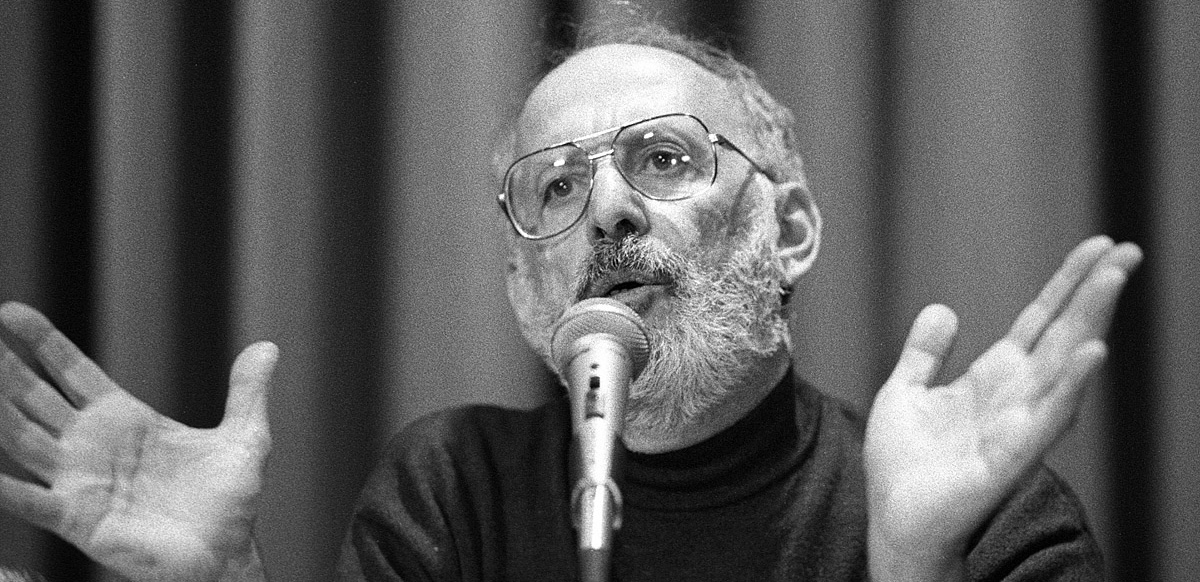
Rutgers is hosting a conference June 4-5 for the centennial of the birth of visionary labor leader Tony Mazzocchi. Here, Mazzocchi is speaking at the 1991 Labor Notes Conference. Photo: Jim West, jimwestphoto.com.
In the 1960s and 70s, conservative leaders of the AFL-CIO and many national unions viewed militant activists in the civil rights, anti-war, environmental, and women’s movements with alarm. When student radicals started migrating from campus and community organizing to unionized workplaces, labor officials did not welcome them.
But a World War II veteran from Brooklyn named Tony Mazzocchi did. Mazzocchi had risen through the ranks of the Oil, Chemical, and Atomic Workers (OCAW), a CIO union which had a strong tradition of rank-and-file activism and internal democracy. He welcomed Sixties’ radicals into the ranks of labor and went on to personally mentor them. Many of these unofficial Mazzocchi students became effective organizers, grievance handlers, contract negotiators, strike leaders, and movement builders.
Mazzocchi was a role model and catalyst for activism on issues ranging from civil rights to labor-based environmentalism, job safety reform, single-payer health care, nuclear disarmament, and union democracy. His story is recounted well in Les Leopold’s 2007 biography, The Man Who Hated Work and Loved Labor. As an OCAW local officer in New York, legislative director in Washington, and later the union’s national secretary-treasurer, Mazzocchi managed to juggle day-to-day union responsibilities with a tireless commitment to building workers’ political power.
A hundred years after Mazzocchi’s birth, and nearly a quarter century after his death in 2002, several hundred of his friends and allies, new and old, are gathering at the Rutgers University Labor Center on June 4-5, for an in-depth discussion of his life and legacy.
Tony’s path was unusual. After combat duty in the Army, he went to work in a Queens cosmetics factory and joined OCAW Local 149. As a union shop steward, organizer, and eventually president, he helped triple his local’s size. He built a strong cadre of shop floor leaders, started a book club and credit union, and, according to his biographer, sponsored a “vast array of social activities” that “combined to create a remarkable new spirit at work.” Even though Local 149’s membership was 95 percent white, it allied itself with the rising civil rights movement.
In 1957, Mazzocchi helped launch the Committee for a Sane Nuclear Policy (SANE) to oppose atom bomb testing. His longtime involvement with SANE put him in touch with leading scientists, environmentalists, and activists who later joined him in building a new movement for occupational safety and health.
Within the 200,000-member OCAW, Mazzocchi helped elect a new national union president in 1965, after a bitter struggle with top OCAW officials linked to CIA meddling in foreign labor movements. He became the union’s national legislative/political director.
THE LABOR-ENVIRONMENT CONNECTION
In this Washington, D.C. role, Mazzocchi linked emerging public concern about environmental pollution to the source of the problem—workplaces where workers were exposed to toxic chemicals at much higher levels than anyone in surrounding communities. At his initiative, organized labor began to shift from a traditional emphasis on job safety ( protection against injuries) to dealing with the causes and long-term health effects of occupational hazards.
A high-school dropout himself, Tony recruited a high-powered network of medical researchers to provide documentation for lawsuits, reports, press releases, hearing testimony, and investigative reporting. He regularly dispatched these allies to probe for the causes of members’ illnesses. He also organized non-stop “road shows” that brought workers together with those experts—and forced lawmakers to listen to both.
Mazzocchi’s drive to pass the Occupational Health and Safety Act in 1970 is a case study in building effective labor clout. (His critical role in OSHA’s passage was even noted by President Nixon.) From MassCOSH in Boston to Work Safe in the Bay Area, the local occupational safety and health coalitions that Mazzocchi helped create are still fighting for job safety and health.
POLITICAL SETBACKS
Mazzocchi ran twice to become president of OCAW. But in hotly contested convention elections in 1979 and 1981, members in the nuclear industry proved to be his Achilles heel. Conservative opponents critical of his “anti-nuke” politics and “incessant boat-rocking” mobilized against him, and he suffered narrow defeats.
But Tony confounded his foes, as usual, by making an unexpected political comeback. In 1988, he returned to OCAW leadership as national secretary-treasurer. He used that post to promote worker education initiatives, like the Labor Institute, and to fight for a new labor-based political party.

The Labor Party got off to a promising start in 1996 amid growing rank-and-file disillusionment with the Clinton Administration. Its founding convention in Cleveland drew 1400 delegates, including rank-and-file activists, local officers, some national union officials, and labor-oriented academics.
During the LP’s early years, Mazzocchi’s relentless personal barnstorming around the country helped generate much of its labor funding and support. Unfortunately, dreary and divisive left sectarian squabbles soon paralyzed some chapters. The election of President George Bush in 2000 and resulting Republican attacks on labor drove almost all unions back into the Democratic Party fold.
MAZZOCCHI’S LEGACY
Two key Labor Party demands—single payer health coverage and “Free Higher Ed”—the latter inspired by Mazzocchi’s own experience with the original GI Bill became centerpieces of Bernie Sanders’ presidential campaigns in 2016 and 2020.
As Les Leopold, a Rutgers conference organizer and Labor Institute founder, points out, Mazzocchi always raised hopes and expectations by “conjuring up a labor movement that… would be militant and green. It would bring about radical changes that would stop global warming. It would give workers real control over the quality and pace of work, and over corporate investment decisions. It would champion the fight against militarism and for peace and equality. It would win free health care. It would dare to create a new political party to counter the corporate domination of the two major parties.”
In a period of declining union density, many union leaders are now in a Trump-inspired defensive crouch. Few project anything like Mazzocchi’s expansive vision. But among working people, there’s evidence that support for working-class-centered politics is building.
The two-day event in New Jersey will begin with panels and workshops featuring speakers who worked with Mazzocchi or whose current organizing was inspired by him. Organizers say it will also include a more “interactive, worker-centered, action-centered day of strategizing, learning from the lessons of the past and applying them to the present and future.”
The conference will officially unveil the Tony Mazzocchi Archive, to be permanently housed at the Rutgers Labor Center. It will feature not just OCAW-related documents but a wide-ranging oral history project, capturing the voices of workers influenced by the visionary leadership and pragmatic radicalism that Brother Tony embodied.
(For schedule and registration information, go to Tony Mazzocchi Conference.)
Steve Early was an early member of Labor Party Advocates, a pre-curser to Tony Mazzocchi’s Labor Party. He’s been involved with the Communications Workers of America, as a national staffer or rank-and-file member, since 1980. He was a co-founder of Labor for Bernie and has written six books about labor, politics, or veterans affairs.
Rand Wilson, also active in the Labor Party, was a volunteer organizer, and later a shop steward and executive board member, for OCAW Local 8-366. Today he works for a labor-backed coalition, CHIPS Communities United, that is campaigning for labor and community benefits from the tax-payer subsidized semiconductor industry.
The co-authors can be reached at Lsupport[at]aol[dot]com.