Auto Worker Delegates Back Union's Fighting Direction at UAW Convention
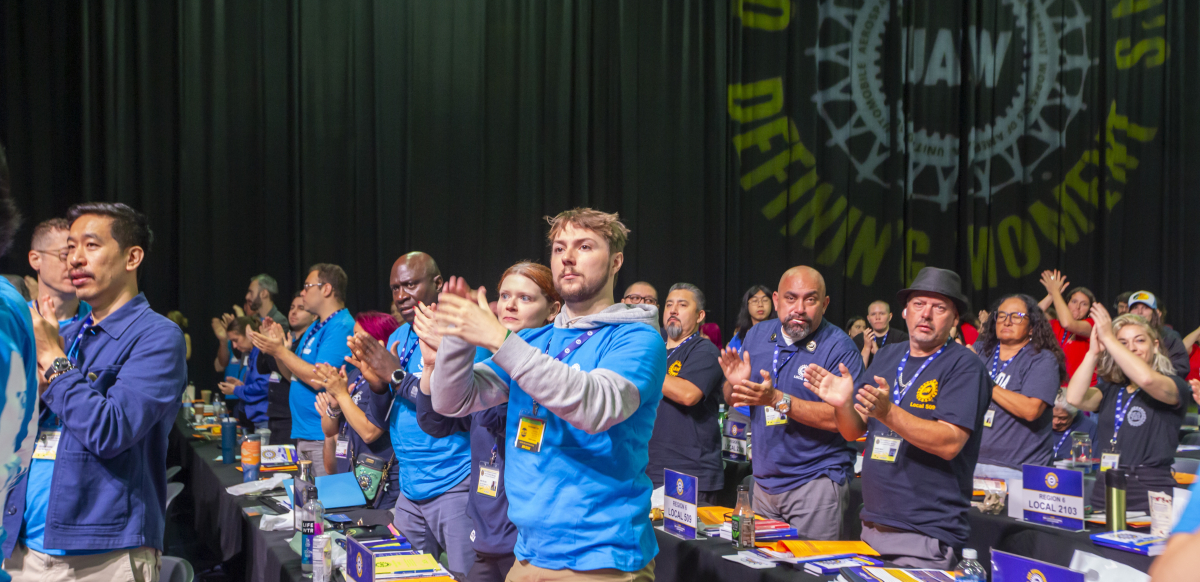
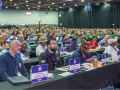
Delegates who assembled in Detroit voted to increase the money designated for new organizing and to maintain dues at 2.5 hours per month in order to bulk up the strike fund. Photo: Jim West, jimwestphoto.com
Delegates to the United Auto Workers constitutional convention affirmed this week the aggressive direction the union has taken under President Shawn Fain, who took office in 2023 and immediately set the 400,000-member union on a new path, illustrated in bold campaigns like the Stand Up Strike against the Big 3 automakers.
The 1,000 delegates who assembled in Detroit voted to increase the money designated for new organizing and to maintain dues at 2.5 hours per month in order to bulk up the strike fund. The union is looking ahead to a projected rematch with the Big 3 on May Day 2028, when contracts covering 150,000 auto workers expire. The UAW has called on other unions to align their fights then, too, to build more leverage on employers and politicians and win big demands.
“Keep in mind how far we’ve come in the last four years,” Fain said in his speech at the convention, which is held quadrennially. “We’ve gone from defense to offense. We’ve once again become a leading force in the labor movement.”
A NEW DIRECTION
Local union leaders who had participated in and led fights with management, aided by the International union, were enthusiastic proponents of the union’s new way: hard-hitting contract campaigns with high member involvement; ambitious, even life-changing contract goals; and strikes when necessary.
Workers at the parts supplier American Axle in Three Rivers, Michigan, were just coming off a two-week strike that brought home their top demand of $30 an hour by 2030, while also winning more paid days off and defeating health care concessions. The 1,000 workers make axles for General Motors’ highly profitable heavy-duty trucks. “We saw the wins from [the new strategy] working at GM,” bargaining committeeman Jay Korf said. “We were like, we don’t need to be that far behind.”
Likewise at Daimler Truck, which has facilities in North Carolina, Georgia, and Tennessee, workers won a record pact that ended wage tiers two hours before their contract expired in April 2024. Their strong contract campaign convinced management that workers would indeed walk out, just six months after the Stand Up Strike (see box).
Volkswagen workers from Tennessee, fresh off winning a first contract in February, told Labor Notes how they’d won their union two years ago. They had a “tight network—and then the Stand Up Strike pushed us over the top,” said bargaining committee member Chris Brown.
VW workers were riveted by the UAW’s gains at the Big 3, watching Fain’s weekly Facebook Live updates. To stave off a yes vote , the company gave them an immediate raise. “People said, ‘We got an 11 percent raise and we didn’t do nothing,’” said bargaining committee member John Rout. "What if we actually did something?” That something was to vote in the UAW, which won them another 20 percent raise (and much more).
At Electric Boat in Connecticut last year, the 2,400-member Local 571 took a strike vote for the first time in over 40 years. When management wouldn’t budge on members’ top demands, including retirement security, the union changed its approach, with help from the International. Leaders brought members to the negotiating table, held Q&As after work with the bargaining team and strike prep committee, built a network of over 100 strike captains, and held red-shirt rallies where company executives could see them. When the local asked members to sign up for picket duty shifts, 1,200 signed up in the first hour, with the line snaking through the hotel parking lot. They won a 30 percent pay increase, 9 percent in the first year.
Delegate JoAnna McClenathan, a member of UAW Member Action, said she and many of her co-workers hadn’t bothered to vote in the last UAW elections. “We didn’t go to meetings, we didn’t vote on things—we went to the Christmas party and the picnic,” she said. “This new approach revitalized our union. We wouldn’t have gotten there without the new direction of the UAW.”
BIGGER STRIKE FUND
Delegates voted, with around two-thirds support, to keep financing the union’s strike fund by maintaining member dues at their current level.
Without that vote, dues would have slipped back to a lower level—two hours’ pay per month—once the strike fund grew above $850 million, a level it is nearing. Some delegates were hoping to be able to report a dues cut to their members, and spoke against the higher cap, arguing the union was “moving the goal posts.” (Press were barred from the convention floor during business, so this info and the vote total comes from delegates inside.)
Fighting Know-How Spreads
An example of how the Stand Up Strike affected members in other sectors of the UAW is the Daimler Truck contract campaign in 2023-24. Shop chair James Waggoner, who works at the Freightliner plant in Cleveland, North Carolina, said the Stand Up Strike showed him that the UAW International was “pulling the trigger on strikes.” Before, Waggoner said, “year after year the International would force you into granting the company’s [contract] extensions.”
It was also the first he knew, given his previous UAW training, that you could bargain without “a gag order, a blackout.” “They always told us ‘the members can’t handle it,’” he said. But there was the UAW president on Facebook during the Stand Up Strike, telling members just what was happening at the table—and announcing the next strike target.
The Daimler committee had started preparing way ahead of time, with “input meetings” at the union hall. Members brought demands the committee hadn’t thought of, Waggoner said. The contract campaign included red-shirt days, homemade “Tick Tock” signs in the workplace, to show management time was running out, and practice picketing. A plant manager was furious when workers chanted “No Bucks, No Trucks!” during a dignitary’s visit.
During negotiations, the committee was able to give members daily updates. Waggoner would email a summary to UAW headquarters in Detroit and the communications staff would handle emailing it to all members that same day. The local also got all the information it needed about Daimler’s financials from union lawyers on site and from nerds in the International’s Research Department.
Fain himself, just six months after the Stand Up Strike that rocked corporate America, came to the Daimler bargaining table. On the day the contract was to expire, management still hadn’t responded to some of the union’s important proposals, such as COLA and profit-sharing. Fain slid a two-page list of demands across to management, announcing, “You have ten minutes to sign this, or we’re on strike.”
Because Daimler managers knew the threat was real, Waggoner said, they signed. Members ended tiers and got 25 percent wage increases, a common wage grid across all six Daimler plants and parts distribution centers, COLA, profit-sharing, and more.
Now, the strike fund will grow to $1.3 billion before dues are scheduled to be reduced. “We want the strike fund funded enough to be able to continue any time we need to strike,” said James Waggoner of Local 3520 at Daimler Truck (see box).
Strike pay will be increased to $550 a week, up from $500.
Crucially, the resolution also allows the union to devote $100 million from the strike fund between conventions to organizing new members and building strong contract campaigns. Previously that number was $60 million.
“What’s at stake is whether we want to grow and expand the labor movement or look inward,” said Ahmed Alliboy, financial secretary of Local 4811, which represents 60,000 workers at the University of California. His local is part of Region 6, which has organized tens of thousands of new members at universities across the West Coast over the past few years. Region 6 delegates overwhelmingly supported the strike fund resolution.
The expanded money for organizing will be critical for the union’s efforts to expand on the April 2024 victory at Volkswagen in Tennessee and organize more Southern assembly plants. The union has active campaigns at Mercedes and Hyundai in Alabama as well as Toyota plants in Kentucky and Alabama. At the Mercedes plant in Tuscaloosa, the UAW lost an election in May 2024, but alleged the company violated the law during its anti-union campaign; the National Labor Relations Board is still conducting hearings.
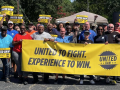
Volkswagen workers pledged to be part of the effort to organize the rest of the South. “No more are the companies going to be allowed to pit us against each other,” said Steve Cochran, president of Local 42, as he stood with a dozen other Volkswagen workers in front of the convention on Wednesday. “We’re dedicated to going all over the South and reaching down and finding those workers who don’t have the respect we get in our plant and giving them a hand up.”
The expanded strike fund was also seen as important in preparing for May Day 2028 at the Big 3 and beyond. The union committed toward building toward action around that date “as a central strategic objective—aligning our organizing, bargaining, research, communications, and political work toward a coordinated moment of maximum power.”
ONE MEMBER ONE VOTE
Fain was the first president elected under one member, one vote, which replaced the previous system where convention delegates chose the union’s top leaders every four years. Under that system, the self-described Administration Caucus had ruled for 70 years, running the union as a one-party state in which the caucus tightly controlled appointments and punished dissent. Fain’s upstart reform slate, Members United, ran in 2022-23 on a platform of “No Corruption, No Concessions, No Tiers.”
Members will again choose leaders in direct elections later this year: president, secretary-treasurer, three vice presidents, and nine regional directors, who combined make up the International Executive Board (IEB).
Ballots will be mailed on August 21 and counted October 6. Candidate forums are scheduled for July and August. Slates, which consist of two or more candidates, must be declared by July 10.
Fain is running with the United UAW slate, which includes a couple of leaders who’ve been on the reform agenda from the beginning, as well as many incumbent regional directors and top officers who opposed him in the last election. Some have been won over by the success of the Stand Up Strike and other fights; others, perhaps, see which way the wind is blowing.
OPPOSITION
Running against Fain’s slate are three IEB members who were originally elected alongside him: Secretary-Treasurer Margaret Mock and Vice Presidents Mike Booth and Rich Boyer. Not far into the new officers’ terms, they fell out.

Fain felt that Mock was managing the union’s finances in a way that undermined the union’s new approach. She refused to sign off on expenditures other officers saw as necessary, such as buying new picket signs for the Stand Up Strike or billboards for the union drive at Volkswagen. Boyer, meanwhile, was accused of failing to enforce the contract at Stellantis and of responsibility for a new attendance program that members hated.
At Fain’s urging, the IEB voted to relieve Mock and Boyer, who both come out of a Stellantis truck plant in Warren, Michigan, of key responsibilities.
Later, the federal monitor overseeing the union called the board’s actions “retaliation.” The two were returned to all their posts earlier this year, and Fain’s chief of staff (a former Labor Notes staffer from 2016 to 2020) was pushed to resign.
Mock is running for re-election as the union’s top financial officer, while Boyer is challenging Fain for the presidency, along with a handful of lesser-known candidates. Brian Keller, a Stellantis worker from Local 1248, is running again. Keller won 14 percent of the vote in the last election, and led unsuccessful efforts to recall Fain last year. The other three candidates are Tricia Geiger of Local 651, Greg Mooney of Local 2147, and Will Lehman of Local 677.
Four regional directors on Fain’s slate are running unopposed: Mark DePaoli in Region 1A, Mike Miller in Region 6, Tim Smith in Region 8, and Brandon Mancilla in Region 9A. There will be contested elections for the rest of the posts.
As of now, United UAW is the only group running as a slate.
DIRECT ELECTIONS NOT ENSHRINED
The reform network UAW Member Action (UMA) held its annual membership meeting the night before the convention. (The group was formed after an earlier caucus that boosted Fain to power suffered internal disagreements and dissolved.) The group championed the package of strike fund reforms that passed on the convention’s first day, although it was pushing for $625 a week instead of the $550 that passed.
UMA lost on another big priority, though: protecting the members’ right to vote on top officers. An amendment submitted by more than 20 locals and International officers would have, in effect, enshrined one member, one vote in the constitution. Under the amendment, convention delegates would not have been able to get rid of direct elections and return to the election-by-delegates system; only a membership referendum could do so.
On the convention’s last day, a member objected and the union’s general counsel ruled the amendment unconstitutional, in a move some feared was orchestrated by old guard forces.
Cheryl McGee, a first-time delegate from the Allison Transmission plant in Indianapolis, was disappointed. “As a delegate I shouldn’t take on the responsibility of voting for who my members want,” she said. “That’s not what they elected me to do—to take their right to vote away.”
The election for top officers this year will be held via the one-member, one-vote system. But the battle to keep it that way may have to be fought again at the next convention in June 2030.
The convention voted up a resolution, backed by Member Action, to extend retired member status to members who retire with 30 years' employment in a UAW shop or who retire at age 55 or older with at least 10 years in a UAW-represented workplace. Previously, the constitution limited retired member status to those who retired with a pension—and many workers, including those hired at the Big 3 since 2007, now get 401(k)s rather than pensions.
DISCONTENT
Fain is the favorite to win re-election, but discontent certainly exists. Trump’s attacks on electric vehicles have undermined billions in investments made by auto companies, leading to long layoffs at some plants. At Stellantis, many workers are up in arms over the company’s attendance policy and got no profit-sharing checks last year, while the promised investments the UAW won during the Stand Up Strike, such as the reopening of the Belvidere, Illinois, assembly plant, have yet to materialize. And general cynicism, born of decades of experience with concessions, plant closings, and the union’s approach of “jointness” with the bosses, is still common.
Some delegates were frustrated that most of the resolutions and amendments on the convention agenda had been initiated by International officers rather than taken from the hundreds submitted by locals. They responded by using the process for “pulling a resolution out of committee” and got enough delegate support to do so, on matters large and small, at least a half dozen times.
In previous rubber-stamp conventions, only a handful of opposition delegates would raise their hands to pull out an unsanctioned resolution. “Last convention [in 2022] was the first time in decades anything of substance was pulled out for debate,” said veteran reformer Scott Houldieson, a trustee of Local 551 at the Chicago Ford Assembly Plant and a leader with Member Action. “This time even more have been pulled out. More delegates are willing to speak up. The fear of reprisal for speaking up has melted away.”
One of the pulled-out resolutions committed the UAW to divesting from bonds issued by the state of Israel. For decades, the UAW was a steadfast supporter of Israel through such bonds. Now, the union indirectly holds roughly $400,000 worth of Israel bonds. The resolution was put forward by the Unite All Workers for Democracy caucus, whose supporters are concentrated among graduate students and legal services workers in Region 9A. The proposal received support beyond the caucus, passing 321 to 287 on the convention’s last day.
NEW POLITICS
The convention also gave a glimpse of the union’s new approach to electoral politics. Since Fain took office, the UAW has been willing to back anti-establishment politicians such as Senate candidates Graham Platner in Maine and Dan Osborn in Nebraska and House candidate Claire Valdez in New York City.
“Just how we’ve changed how we bargain and how we organize, we’re changing how we do politics,” Fain told the convention. “We’re going to invest in candidates that have our backs, that share our ideals and principles. We’ve got enough millionaires and billionaires and businesspeople in Congress that are bought and paid for—we need working-class people in the halls of Congress.”
Abdul El-Sayed, a Bernie Sanders-type candidate who the UAW is backing in the Democratic primary for Senate from Michigan, addressed the convention on its closing day. El-Sayed told delegates he’s running to “get money out of politics, put money in your pockets, and win Medicare for All.”
Ballots in the UAW election will go out two months from now. Then it’ll be up to members to decide whether they want to keep the union moving in the fighting direction Fain has been taking it.