
Learning, Recharging, Uniting at Labor Notes 2026
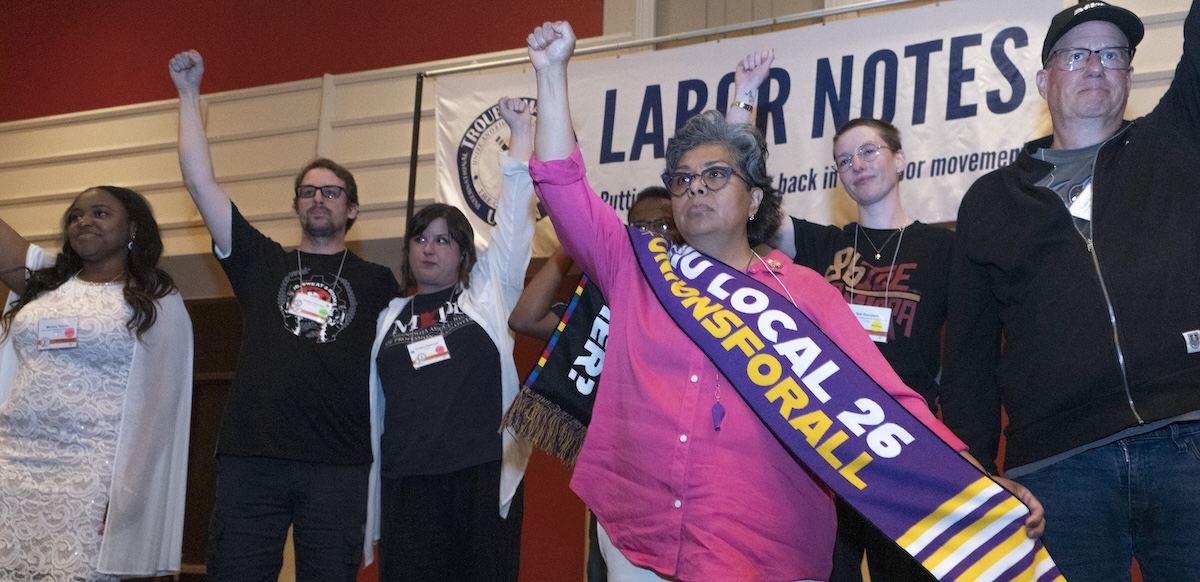
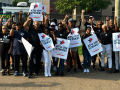
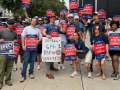
A delegation of workers from various unions and worker centers collectively accepted a Troublemakers Award on behalf of ‘Twin Cities Workers Who Turned Back the ICE Surge’ at this year’s Labor Notes Conference. Two days later, some were indicted for their protest roles. Photo: Joe Brusky
In a time when there’s real cause for fear and despair—and when the Trump administration is pushing hard to divide us—the Labor Notes Conference June 12-14 in Chicago was an oasis of inspiration and solidarity.
In every hallway you could feel the electric buzz of conversation, of strategies in the making. Labor Notes gives workers a rare chance to come together across unions, sectors, and identities. Conferencegoers packed into sessions on overcoming division: “Organizing in the Multiethnic Workplace,” “Building Unity Across Job Classifications,” “Overcoming Generational Divides.”
Friday night’s plenary audience rose to its feet in a prolonged ovation for the Minnesota unionists who fought to defend their families, students, and neighbors last winter when anti-immigrant federal troops occupied the Twin Cities.
St. Paul educator Mara Solis explained how teachers and parents coordinated school safety patrols and offered groceries, laundry services, and legal clinics to those sheltering at home. Endorsing a one-day citywide strike against the federal occupation on January 23 was a risky decision, she said—but it put the union on the right side of history.
The audience joined in on her refrain: “No one is coming to save us. We keep us safe.”
‘A STRIKE IS A SCHOOL’
Tchelly Moise told the crowd how he started at the JBS beef plant in Greeley, Colorado, shortly after immigrating from Haiti. “It was one of the fastest opportunities to start working,” he said. “Your family is depending on you.”
But the job was dangerous. The rapid line speed meant pain in his hands, shoulders, back, and knees. “When people say, ‘Immigrants do this work,’ I want people to understand: Immigrant workers did not make these jobs bad,” he said. “The companies made the jobs worse, and then used vulnerable workers to keep the system going.”
Workers at the Greeley plant struck for three weeks this spring—the industry’s first major strike in decades—dancing and singing together on the picket lines in their 57 languages. They won a raise and safety gear… and something more: “A strike is a school,” Moise said. “After the strike, something changed. The workers saw themselves differently.”
BATTERIES RECHARGED
This year’s 300 workshops and panels (browse the program in PDF or interactive format) covered a kaleidoscope of topics. Some sessions addressed bigger-picture political aims, like “Building a Tax-the-Rich Campaign” and “From May 2026 to May 2028: Seasons of Class Struggle.” Others focused on nuts and bolts, like “Simulated Bargaining” and “Grievance Handling: Best and Worst Practices.”
One popular workshop straddled both realms: “How to Break Your No-Strike Clause (And Live To Tell About It).”
At the heart of the conference each year are sectoral meetings, where workers meet up with others in the same industry from different locations and unions. The building trades meeting was bigger than ever. The Amazon worker convening was the largest one held yet, anywhere.
Bricklayers Local 13 member Norma Gomez, a first-timer who came with another member of the worker center Arriba Las Vegas, said she appreciated being among so many other union activists in an atmosphere “without prejudice.” She was especially proud to take a photo wearing her Rosie the Riveter bandana alongside the delegation of Minnesotans who stood up to ICE.
Alfonso Martínez Valero, an Amazon worker from Spain, told the Sunday plenary how bottom-up organizing in his warehouse enabled workers to invent tactics that threw the company off balance. “Amazon was expecting a traditional strike,” he said in Spanish. “But we strikers were far more flexible and creative. People changed their routes. They reorganized picket lines in minutes. They spotted weak points on the fly.
“Decisions were made very quickly because they came from the bottom up. There was no gap between the organizers and the people fighting… That made it very difficult for Amazon to anticipate our moves. And there was a moment when I realized that even Amazon was starting to lose control of the situation.”
Jesus Iturbero, who transports auto parts and is the president of an independent truck drivers union in Mexico, met with workers on the U.S. side of the supply chain. He was surprised to see workers from so many countries at the conference.
“I was struggling with morale before, because we were facing many setbacks in my union, but participating raised my spirits,” he said. “I returned home with my batteries recharged, really motivated and ready.” He hopes his union can collaborate with U.S. workers to increase their joint leverage.
“I think what most surprised me was the energy,” Iturbero said. “The singing, the chants.”
RAT PUPPETS
The Labor Heritage Foundation worked with Labor Notes to put on our most ambitious arts and culture program yet, including 17 arts and media workshops, five exhibits, four films, a concert, three song swaps, and a labor history pub quiz. Another 25 workshops began with a song or poem to set the mood.
A jubilant parade into the Friday plenary session, led by a brass band, featured fruits of those workshops—newly created chants, picket signs, and papier-mache “Scabby the rat” masks—plus a giant puppet representing fascism and four huge tapestries portraying labor struggle past and present.
This year’s conference also featured more workshops in Spanish, as well as sessions in English with simultaneous interpretation.
Hundreds of volunteers ran flipcharts and markers to workshop rooms, gave directions, kept hallways clear, did set-up and clean-up, and worked the registration and merchandise tables. Some said volunteering was a highlight of the weekend, because it was an easy way to connect with a cross-section of people.
Longshore worker Mike Jefferson, a first-time conferencegoer from South Carolina, found himself working the registration desk side by side with a longshore worker from California. Soon they were comparing how their hiring halls worked; Jefferson appreciated how the West Coast system could distribute work more equitably. And the conference got him thinking about how union dockworkers, who handle a lot of Amazon cargo, could support the workers organizing in Amazon warehouses.
DETOURED, NOT DETERRED
A dramatic thunderstorm and tornado warning on Thursday canceled many flights, turning conference travel into an unexpected ordeal. A few people had to cancel their trips entirely, but many braved delays and detours to get to Chicago.

After watching three flights canceled, longshore worker Zack Pattin of Tacoma, Washington, asked a ticket agent about flights to anywhere within driving distance of Chicago. He got a ticket to Detroit—after an animated discussion with the agent, a Teamster, about how to reenergize your union. “Always be organizing,” said Pattin, who made it just in time to lead a Friday morning workshop on “Secrets of a Successful Organizer: Beating Apathy.”
Some people abandoned their flights and carpooled with other stranded conferencegoers they’d met in the airport. Others whose planes got diverted to Indianapolis spent Thursday night in tornado shelters before continuing on to Chicago.
New York City food delivery worker Antonio Solis and his co-workers organizing with the Workers' Justice Project came in a carpool with two Amazon organizers, driving 14 hours, tornado winds tailing them. This was his third time at the conference, and Solis said in Spanish that he was once again “fascinated by the opportunity to meet and learn from other workers in the same fight against the bosses.” This year he learned about the challenges of organizing in the South, from a North Carolina restaurant worker.
The 2026 conference, like the last one, was capped at 4,700 registrants, the most we could safely fit in the venue—which meant we had to turn thousands of people away. We’re moving our next conference to a bigger venue in downtown Chicago (March 24-26, 2028).
People brought their whole selves to the conference. A brigade of birdwatchers trooped to a nearby park early one morning. At night, conferencegoers mingled at receptions celebrating reform caucuses and international guests and a watch party for the decisive Knicks-Spurs championship game. During a brief power outage, people at a pulsing dance party broke into chants until the music resumed.
This year’s expanded childcare program included crafts, stories, and trips outdoors. Some kids were reluctant to leave at the end of each day.
Ohio state worker Olivia Rickard said her four-year-old was excited to have his own “Little Flamekeepers” nametag. After the first day, he kept recognizing new friends around the conference and running up to hug them—engaging in a bit of “baby networking.”
AFT Massachusetts President Jessica Tang said her son preferred this “new school” to his old school, and “he was very disappointed that ‘new school’ was only temporary.”
‘WE HAVE THE BLUEPRINTS’
Of the many inspiring union stories told at the conference, a particularly satisfying genre begins with a past Labor Notes Conference.
“Back in 2022, a small group of federal workers from different agencies met here at Labor Notes,” Paul Osadebe, then a Housing and Urban Development civil rights lawyer, told the Friday night crowd. “People don’t know this, but that was the first time anyone in history ever had FUN.”
The FUN—the Federal Unionists Network, that is—grew from there. By the 2024 conference, “we saw the urgent need to organize for the possibility of a second Trump term,” he said. “Labor Notes gave us the language, the tactics, and the mindset for how to do that.
“I started to understand that lawsuits would not be enough to stop the destruction that was coming,” he said. “But I also learned that my co-workers and I, and 2 million-plus federal workers, had everything we needed to fight back.”
When Trump got reelected and “we entered the hell dimension we’re in now,” Osadebe said, FUN activists were primed to organize whistleblower teams, devise media strategy, and persevere through retaliatory firings, including his own.
Another such story: “I showed up at the Labor Notes Conference two years ago alone, disheartened, and frustrated,” electrical worker Emily Lumpkin told the Sunday plenary. “I was looking for answers, for direction—and it was here that I found it when an IBEW brother handed me a black-and-white half-page flyer with the name of an organization I’d never heard of, the Caucus of Rank-and-File Electrical Workers…
“How many of us have found ourselves desperately wishing that there was some machine that could just turn all that apathy and anger and grief into action?” she asked. “I have good news. That machine exists! It is the rank-and-file caucus. We have the blueprints, and you can build it too.”
One more: “Four years ago, I came to Labor Notes alone,” wrote Rev. Ryan Brown, co-founder of Carolina Amazonians United for Solidarity and Empowerment (CAUSE), on the conference Facebook page. “This year, we came as a delegation [of 19 workers]. Next conference, we’ll bring more.
“Because this is more than a conference. It is a revival of working-class people discovering their power and fighting back. I watched workers from North Carolina walk through those halls and realize they belong in every room where decisions about their lives, families, and futures are being made.”
Videos from the 2026 Labor Notes Conference
Friday Main Session
- Eva Lopez, SEIU Local 26
- Mara Solis, Saint Paul Federation of Educators
- Paul Osadebe, Federal Unionists Network
- Tchelly Moise, JBS Beef, UFCW Local 7
- Jon Krause, American Axle, United Auto Workers Local 2093
- Arts Welcome: Ricardo Levins Morales, labor artist
- Music: Michael Laslett and Bela Sanchez, Seattle Labor Chorus; Pam Rogers, DC Labor Chorus; and Clamor & Lace Noise Brigade
- Chair: Barbara Madeloni, Labor Notes
Sunday Main Session
- Emily Lumpkin, Electrical Workers (IBEW) Local 968, Caucus of Rank & File Electrical Workers
- Alfonso Martínez Valero, General Confederation of Labor, Spain (Amazon)
- Alex Hall, Oregon Nurses Association
- Music: Kim Gooden, 1199 SEIU, and “The Labor Notes” band from UE-COGS
- Chair: Danielle Smith, Labor Notes
Panel: Opening Up Bargaining
- Caressa Aamodt, Electrical Workers (IBEW) Local 520
- Justin Brown, Brookline Educators Union
- Alano De La Rosa, Teamsters Local 90
- Facilitator: Maya Suzuki Daniels, United Teachers Los Angeles
Panel: The Soul in the Machine: Resisting A.I. Pressure on the Character and Quality of Our Jobs
- Vanessa Coe, National Union of Healthcare Workers
- John Hasegawa, Mt. Hood Faculty Association
- Aíne Lynn McEvoy, IATSE Art Directors Guild
- Kinsley Searles, NewsGuild of New York
- Facilitator: Sean Fern, Office and Professional Employees (OPEIU) Local 153
And coming soon, recorded at the conference... the first-ever live episode of the Labor Notes Podcast!


You must log in or register to post a comment.