
American Axle Strikers Set to Win $30 by ’30
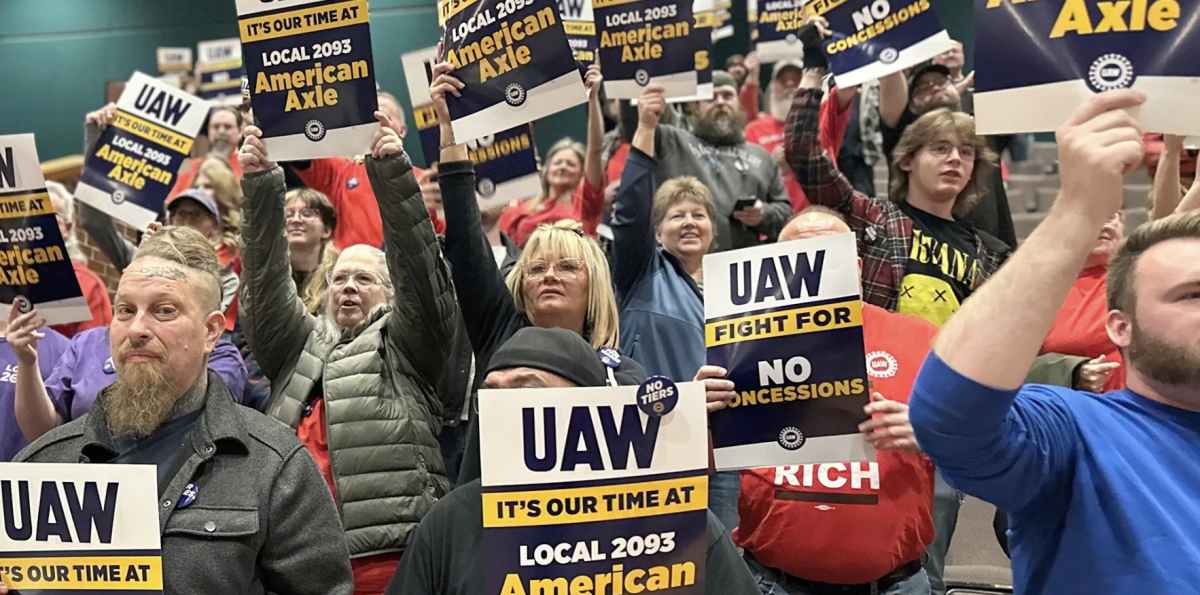
Under the new tentative agreement, the most senior American Axle workers will immediately jump from $22 to $30. Others will move to $30 over four years. Photo: UAW Region 1D
Update, June 16: American Axle workers voted to ratify the contract over the weekend, with 80 percent voting in favor.
For years their pay topped out at $22 an hour, max. Now $22 becomes a new hire’s starting pay, under the tentative agreement workers at American Axle reached on Wednesday, after 10 days on strike.
Their slogan and demand was “$30 by ‘30.” By 2030 all 1,000 workers in the plant will be making $30 an hour.
During the financial crisis in 2008, many longtime American Axle members saw their pay slashed in half, from $29 to $14.50. The strike was an attempt to recoup some of what they lost.
Workers are still picketing, though, until the ratification vote on Sunday.
On the line in Three Rivers, Michigan, today, workers were quick to correct me—they haven’t settled yet. They’re waiting to see the details in writing. “I’m glad they’re saying that,” said UAW Local 2093 President Pete Adams, at the union hall.
LEVERAGE
When the strike began, American Axle’s main customer, General Motors, had only a two-week supply of the axles it needs to build its hugely profitable heavy duty trucks. That supply was rapidly drained as GM was running its Flint truck plant on a six-day schedule.
Without axles, GM couldn’t finish its trucks. Workers knew how essential their labor was to the company’s moneymakers. When I asked workers about their “leverage,” they all said their leverage was “the members.”
Members voted by 98 percent to authorize a strike; there have been zero scabs. Tom Baker, who’s worked at the plant for 32 years, said the company was offering only 50 cents an hour each year, and wanted to make workers pay a dollar more per hour for health insurance. “They made it easy to go on strike,” he said.
Baker is one of the “legacy workers” who hired in before 2008 and now make up less than 10 percent of the workforce. In that financial crisis year he saw management cut workers’ pay literally in half, from $29 to $14.50.

Under the new tentative agreement, the legacy workers will immediately jump from $22 to $30. Others will move to $30 in four steps over four years. Workers also won more paid days off and beat back health care concessions.
Mark Hicks, 67, could have retired already but said he stayed around for this contract fight to “take a bite of their kneecap.”
“It’s going to be a different place to work,” said Adams. “There’s going to be way less turnover. [CEO David] Dauch doesn’t realize what a favor we did them. No one wanted to work here for $18 an hour.”
“At first, I didn’t want my daughter working here,“ said Hicks, “but now I’m going to tell her to take a look at it.” The plant is a little less than half women.
MAIN VEIN
Three Rivers turns raw steel into axles, in 800,000 square feet, on three shifts. Gina Atherton, who cuts gears, calls it American Axle’s “main vein.” She talks about the local’s contract campaign, with meetings, leafleting, stickers, pins, and T-shirts. Politicians, in this election year, were falling over themselves to show support.
Most important was guidance from the international union. “I’ve never seen that kind of support,“ said Adams, who’s been president for 10 years. “[UAW President] Shawn Fain has started doing things completely different, and it’s working.” Fain spoke at the local’s contract campaign kickoff rally.
Adams praised the international’s new bargaining strategies department and mentioned videos of members telling their stories that were shown in the community. A poster in the union hall shows a long list of supportive local businesses.
Adams says the contract sets a record for pay for the UAW’s Independents, Parts and Suppliers Department, where workers have long lagged behind fellow members at the Big Three automakers.
By the time Three Rivers workers vote on Sunday, GM’s two-week supply of axles should be just about out.




You must log in or register to post a comment.