In Bus Factories, A Triple-Decker Win
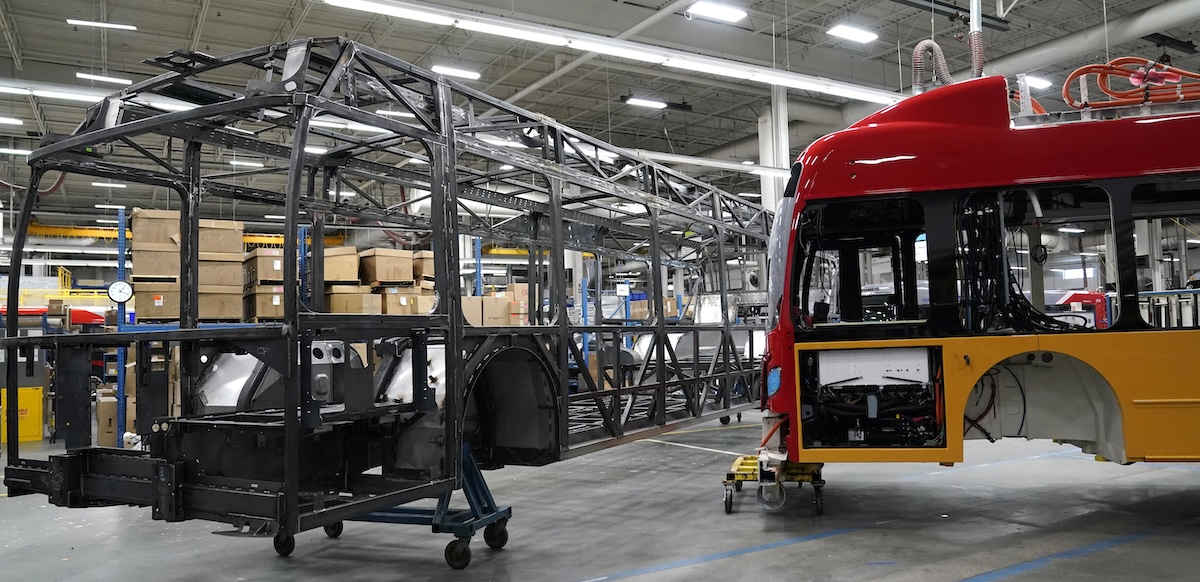
The Communications Workers won a card-check neutrality agreement at a bus manufacturer that helped organize workers. Above, New Flyer electric buses are displayed at the company's St. Cloud, Minnesota, factory. Photo: Abbie Parr/AP
What does it take to unionize factories today, especially in the South? In the last two years, bus manufacturing workers secured first union contracts and a national master agreement across New Flyer facilities in three states.
Their strategy shows how, with pressure from transit agencies that buy the buses, union members from organized sites leading outreach to non-union workers, and fighting stewards on the line, workers can unionize plants across a whole company.
New Flyer, North America’s largest bus-making company, expanded heavily in the South during the last decade, a common employer strategy to move to areas with few unions, sharp poverty, and racial splits to exploit. About a quarter of its production is electric or hydrogen buses.
But in the last three years, 600 New Flyer assemblers in Alabama, 700 parts makers and warehouse workers in Kentucky, and 100 workers in upstate New York won union recognition and first contracts with the industrial wing of the Communications Workers (CWA).
Alongside 1,000 already-unionized members at the company’s two Minnesota plants, they just settled a national master agreement that locked in new holidays, more humane attendance policies, health care cost caps, and a slew of other benefits. During the campaign to win that national deal, a supermajority of workers at each plant signed on as dues-paying members, even in Southern states where they could get full benefits without paying dues.
These bus builders welded together a living union, across a national company, despite tough terrain.
TRANSIT AGENCIES PILE ON
The union got this far thanks to some novel strategies, though none was without tradeoffs.
City transit agencies are the major buyers of buses. That provided a potential source of leverage from outside the factory.
As New Flyer increased production in non-union Southern plants, it falsely told buyers that it was paying Minnesota wages: as much as $5 an hour higher. The nonprofit Jobs to Move America and the Los Angeles County transit authority sued New Flyer for breaking wage and hiring equity promises on $500 million of bus orders.
In addition to not paying the wages it claimed, the company was engaged in blatant racial discrimination in hiring and promotions. Jobs to Move America kept organizing city bus buyers to ramp up the pressure on the company, and the L.A. lawsuit eventually forced the company to agree to expand training and hire more workers of color.
At the same time, New Flyer signed a neutrality agreement with CWA, pledging that managers wouldn’t oppose the union and would recognize it when a majority of workers at each plant demonstrated their support, through “card check” instead of a ballot election.
Importantly, the company committed to agree to union contracts after an independent arbitrator settled the final bargaining differences with the union. Major corporations like Amazon and Starbucks have stonewalled bargaining for years to deny first union contracts, even after workers overwhelmingly won their union elections.
In exchange for the clear path to a first contract, union officials agreed to refrain from publicly criticizing the company, picketing, or striking for five years. They judged those tradeoffs were worth the open door to a binding deal.
JUMPED INTO ORGANIZING
The new union drives focused on building strong plant organizing committees. At the Kentucky plant, they built a team with 14 members, while the larger Alabama plant had 30.
Organizing visits by union members from other New Flyer plants were key. Workers from six CWA locals jumped into organizing, including from nearby GE and AT&T facilities.
“We sent a bunch of folks to New York, Kentucky, and Alabama to talk to members, then have one-on-ones,” said Matt Lelou, president of Local 7304 at the plant in St. Cloud, Minnesota. Eight members from that local made repeated trips and calls. “In an earlier phase we would go to a gas station near the plant, meet who we could. After the neutrality agreement, we had a window when we could go into the plant and meet members much more easily.”

“Our wages were $5 to $7 an hour more than Anniston [Alabama] for the exact same job,” Lelou said. “Our health care was a big difference.” Workers listened differently to those who built the same buses. “They fully understood they were doing the same thing.”
More sparks came from workers with union experience in prior jobs. In Kentucky and New York, that included former Teamsters from UPS and Pepsi. In Alabama, a former Steelworker helped lead the drive, and was later elected president of the local.
In the middle of a shift soldering the computerized “brains of the bus” for $19 an hour at the New York plant, George Kerr met a union organizer in the break room who “showed me the labor peace agreement, especially the arbitration clause. It blew my mind. I thought, we can do this, get a contract here.”
Neutrality agreement or no, some managers on the floor found chances to harass union supporters. Flo Larkins, an organizing committee member in Alabama, said, “Managers would be pushing back on us on the organizing committee, even when we weren’t talking union.”
Union supporters in Kentucky found they could build on existing networks from a source rarely tried elsewhere: addiction recovery groups. However, the closeness built in those groups could cut both ways. “A superintendent at the plant actually ran one [recovery] group,” said assembler Eileen Hagerman. “He’d say, ‘Man, you can’t support this union, I pulled you up out of the gutter.’” Still, Hagerman said, the public speaking experience and trust built in recovery helped workers take collective action.
With these foundations, New Flyer workers won union majorities at one plant after another. Members at the New York plant announced their win, and company recognition of their union, in August 2022, followed by the Kentucky plant in February 2023, and the Alabama plant in January 2024.
Bargaining for first contracts and local union officer elections began within months. But according to veteran activists involved, the card check agreement allowed more of a “contract first, organize second” approach than in many other hard-fought drives. That meant hard work ahead.
BUILDING A LIVING UNION
Workers quickly learned that a contract on paper didn’t mean much in practice—not without a fight.
At the Alabama plant, longtime worker Stevie Joe Thornton said a manager tried to force them into overtime daily, despite clear limits in the contract. Thornton walked out during the forced overtime, and later persuaded others to join. But he said it was going to take patient work to shift the culture. “These people have had whips cracked on them for years,” he said. “Now that people have the contract, they’ve been fighting back, saying you can't make me work over, you've got to post it [in advance].
“When you do it as a group, it stands out more, it has a bigger impact.”
Union activists have focused on building a steward network within each plant. In Kentucky, every Monday in between shifts, 15 stewards meet to talk about pushback on contract-breaking managers, and how to persuade new workers to join.
Caring personal relationships have been key to growing the union, especially from the “meemaws” (grandma types) on the floor who look out for others. One joined the union after managers took away the candy bowl she kept out for others, and a steward helped her push back. About half of the workers in the plant are women—more than at most factories—and the majority of stewards are women.
At a weekly meeting, stewards workshopped how to press a grievance from two Black workers against a hostile manager who'd stuck them in an isolated, backbreaking role. In a plant where a majority are white, stewards were clear that fighting racist job assignments is union business. Others were working to get the contract translated into Spanish for a group of immigrant welders.
Tougher tests lie ahead. New Flyer headquarters and a few major plants are in Canada. After Trump imposed a 25 percent U.S. tariff on Canadian imports in January 2025, delays for parts and materials held up the New Flyer lines stateside. “If there’s a part shortage, we can’t finish buses, and we can’t start the next one,” said Hagerman in Kentucky. Management compensates by pushing for faster work and overtime.
To unionize a manufacturing company across the country at once, CWA wagered it could win contracts fast and foster a deep union culture after. On soldering irons and drill presses, with union picnics and stewards meetings, bus builders are making good on that bet.