
The Billionaires Have Two Parties: An Organizer’s Review
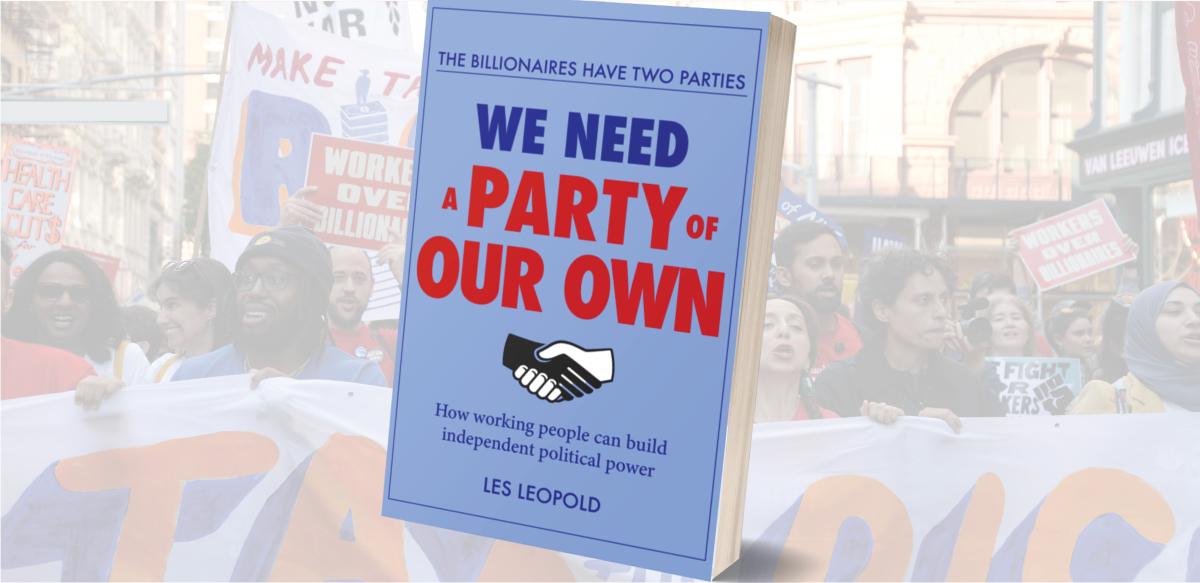
The Billionaires Have Two Parties, We Need a Party of Our Own: How Working People Can Build Independent Political Power by Les Leopold, 2026, J. P. Zenger Books.
In my 25 years as a union organizer and labor educator, my core purpose has been to help working-class people recognize and act on their own power.
In that work, I’ve come to rely heavily on the writing of Les Leopold. Whether it was running workshops based on his Reversing Runaway Inequality in the lead-up to the 2016 Verizon strike, or using Wall Street’s War on Workers as a teaching text with union apprentice electricians, Leopold’s work has helped me translate complex political economics into something workers can engage with, debate, and act on.
With his latest book, The Billionaires Have Two Parties, We Need a Party of Our Own: How Working People Can Build Independent Political Power, Leopold challenges us to not just understand the system, but confront it. He’s challenging labor movement folks to rethink how we are organizing politically, who we are organizing for, and whether we are actually building the independent working-class power this moment demands.
REENGAGING UNION MEMBERS
I read this book with two questions we in the labor movement are dealing with in real time: How do we reengage union members who have drifted away from our political program? And how do we make political education part of our organizing strategy instead of something that only appears during elections?
The Billionaires Have Two Parties starts with working people’s actual experiences, drawn from a sizable survey Leopold and colleagues conducted of voters in four “rust belt” states. The survey asked them about what they want, what they’re angry about, and what kind of political organization could actually represent them. From that foundation, Leopold shows that solidarity around economic issues may be the clearest way forward.
Drawing on the survey’s findings, Leopold shows that working people broadly support an economic populist agenda that includes taxing the wealthy, stopping corporate price-gouging, capping prescription drug prices, protecting Social Security, and preventing layoffs at companies that receive public money. They even support policies that are often labeled “radical,” like a federal jobs guarantee.
One proposal that stood out to me was prohibiting corporations that receive taxpayer support from conducting compulsory layoffs. Layoffs would have to be voluntary, based on buyout packages. The proposal directly addresses the crisis described in Leopold’s earlier book, Wall Street’s War on Workers, about mass layoffs, stock buybacks, and the decline of worker political power. This line captures the book’s moral core: “The people of our country should be the center of our economic system, not a source of wealth extraction for the few.” This is the change we are all organizing for.
'INDEPENDENT’ POLITICAL POWER
As an organizer, I am not surprised that the economic policies Leopold highlights are popular. Job security—and economic security in general—is a key reason why workers organize.
But I’ve thought a lot about why workers aren’t as supportive of their union’s political program as they were in the past. Many members are disengaged because they don’t trust the institutions claiming to represent them—including their own unions. Partly it’s because even with a union, workers have become less economically secure. And yet we union activists continue to tell them to support union-backed candidates. Understandably, some workers see this dysfunction and decide not to vote the way their union is telling them to.
The book names that the Democratic brand itself has become a barrier. Workers may agree with a populist economic program, but react negatively when that same program is attached to a party they see as elitist and out of touch. When unions operate only inside that partisan frame, we’re asking members to choose between institutions many of them already distrust.
The book points to a different approach: grounding political discussion on shared economic interests, collective power, and what workers can win together. It also calls for framing our political power as “independent” rather than dependent on the Democratic Party.

One important lesson organizers can take from this book is that unions’ political power is not bestowed upon us by whoever happens to be in office. It is created by worker solidarity and collective political action. The fight in the workplace and the fight in the legislative halls are not separate. They are different arenas of the same conflict over who has power, who writes the rules, and whose interests the government protects. And shouldn’t we, as a union movement, be inherently independent? Aren’t we, through our unions, our own political organization?
MEET WORKERS WHERE THEY ARE
The book does not avoid hard questions. Leopold takes on the sometimes competing nature of economic justice and progressive movements. He points to a debate in which Hillary Clinton pushed back against Bernie Sanders’ economic populism by asking whether breaking up big banks would end racism, sexism, or other discrimination. Leopold does not dismiss these struggles. But he argues that economic populism provides a broad base for solidarity, and that a working-class movement cannot require total agreement on every social issue at the outset.
As a union organizer, I understand this dynamic. Long ago, I learned that organizers cannot be partisan or ideological in their approach. We need to meet workers where they are, find ways to unite them, and identify widely felt issues that can bring people into collective action.
Unions can be a place where people actually change their views. Many times, the act of coming together and acting together opens up people’s worldview. It moves them out of individualistic attitudes and helps them see the power of solidarity. But that’s less likely to happen if we start by judging workers who don’t already agree with us, or who identify with a party that is hostile to unions.
To unite members, we can’t begin with party labels. We begin with issues that everyone can understand and feel: job security, staffing, fairness, health care, and pay.
One of the book’s most concrete contributions is when it begins mapping political terrain. Leopold is not arguing for third-party campaigns everywhere. Instead, he identifies specific openings—like Republican districts where Democrats are uncompetitive. Here, an independent working-class candidate may not function as a spoiler at all. Here, class-based independent politics can take root without the usual constraints.
Leopold’s emphasis on political education, worker-to-worker discussion, small-group engagement, and collectively developing demands aligns closely with good organizing practice. If workers are going to build independent political power, they need spaces to think together, debate, and define their own agenda. They need to move from being an audience for politics to being active participants in shaping politics.
A HELPFUL FRAMEWORK
The book is not without limitations. Economic populism has broad appeal, but agreeing on economic issues does not automatically produce organization or sustained solidarity. Building a new political association that includes the broader non-union working class won’t be easy for many unions. And running candidates isn’t the same as building an organization. The book is clearer on where independent politics might emerge than on how it becomes durable.
But the book does push organizers toward a helpful framework and narrative. It challenges us to stop treating politics as something we do for members and start treating it as something we build with them—independently of the two parties. It asks us to consider whether our current political approach is developing power or simply maintaining relationships with institutions that no longer command workers’ trust.
The Billionaires Have Two Parties ultimately argues that workers need their own political voice, their own platform, and their own organization. Whether or not one agrees with every part of that argument, the underlying point can’t be ignored: We need independent working-class power to change the status quo.
Steve Lawton is a former president of Communications Workers Local 1102 on Staten Island and now an organizer with CWA District 1. Buy The Billionaires Have Two Parties here.




You must log in or register to post a comment.