
We’re Making ‘Tax the Rich’ More Than a Slogan
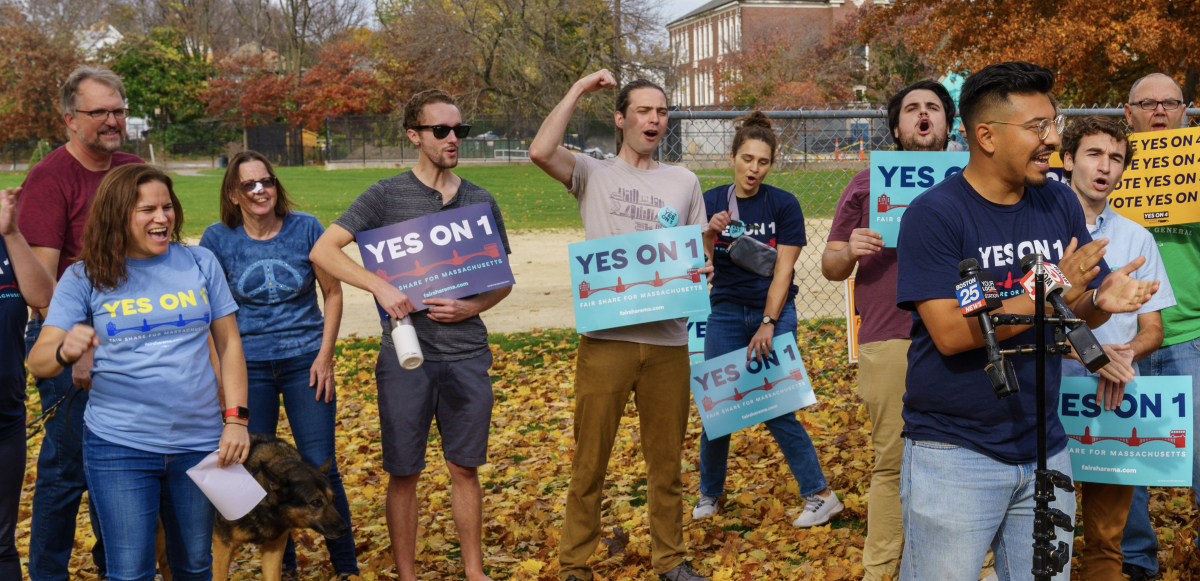
Fair Share campaigners led by the Massachusetts Teachers Association knocked on a million doors to pass their “tax the rich” referendum. Now the money is rolling in, providing free tuition, school meals, free regional buses, expanded child care, and more. Photo: MTA
Taxing the rich should bring a smile to your face. It certainly brings one to mine.
Here’s what passing the Fair Share Amendment in Massachusetts allowed us to do, in just the first years since its passage in 2022: Offer free community college tuition to every resident (bringing a 40 percent increase in enrollment), free school meals for every student, free regional buses, a multi-billion-dollar capital program for public higher education and public vocational high schools. And we’ve been able to invest in literacy programs, and expand access to affordable childcare and early education.
We did it by making the rich pay a small additional tax (4 cents on every dollar) on their income above a million dollars a year. That tax affects just 25,000 households in a state of 8 million, less than one percent of the state’s residents.
Because the rich are so very rich, that small surtax produced $3 billion this past year, all dedicated to public education and transportation.
Fair Share changed our state constitution, so it’s there every year, and it’s not going away, much to the chagrin of the billionaire class.
But if they were honest (which they are not) the rich would admit they don’t even feel it. Beyond the fact that $100 million to them is like pennies you might have sucked up into your vacuum cleaner, the uber-rich in Massachusetts just got their money back: the 1% in Massachusetts received a $3.3 billion tax cut from Trump and the Republican Congress this year as part of the Big Ugly Bill—paid for by stealing health care from the working poor.
“Workers Over Billionaires” was the slogan on Labor Day. It should be the slogan every day. The coalition of Democrats and Republicans who perpetuated a politics of austerity, the undermining of unions, and attacks on the very idea of government have paved the path to full-blown authoritarianism. It is an unholy—but unsurprising—alliance of the 1%-of-the-1% who own much of the wealth in this nation, and the authoritarians who find democracy and unions an inconvenient obstacle to their power and rapacious goals.
We are reaping what mainstream politics sowed. The labor movement has to plant new seeds.
FIFTY-STATE CAMPAIGN
One row to plant is a 50-state campaign to tax the very rich, to fund our public schools and colleges, protect health care, make public transportation efficient and free, and most importantly, expand our vision of what is possible. Our states need the money. They needed it before, and with the federal attacks on state budgets, we need it more than ever.
Taxing the rich will be popular among working people—it has always been popular—but it’ll be even more popular as the reality of what this regime is doing to people’s health care and public schools becomes clearer. This year is terrible; next year, when the Medicaid cuts hit, it will be catastrophic.
Taxing the rich should not just be a blue state strategy. It is a working people’s strategy. We in the teachers unions learned an important lesson in Kentucky in 2024. On the very same ballot where Donald Trump won by 30 points, the people voted by the same margin to reject private school vouchers. They loved their public schools and could tell vouchers were a scam to hurt their schools, while giving more to those who don’t need it. There’s a politics there to build on.
JANUARY CONVENING
Unions and community groups are gathering in Boston at the end of January to do just that. It's not an academic policy conference, it’s a convening of activists who are in the middle of a tax campaign, those at the very beginning, and others who are “revenue-curious.”
We in the Raise Up Massachusetts coalition, which led the Fair Share Amendment campaign, will share what we learned about how to win these notoriously difficult campaigns. Washington state activists will talk about their new wealth tax proposal—a 1 percent tax on stocks and bonds of people who have more than $50 million of wealth, or just 4,300 individuals in the state. Maryland union leaders will share how they won improvements to their progressive taxation system to generate significant new revenues from the 1%. Californians will discuss the ballot campaign they won several years ago to extend taxes on the super-rich. And labor and community groups from around the country will learn about the policy choices, and more importantly, the organizing strategies needed to win.

Working on legislation or ballot initiatives might seem off to the side of building the disruption we need across the country—the big demonstrations, the direct action. But it’s hugely important to win material gains for working people, to show that politics can work for workers.
We in Massachusetts were pleased when New York City Mayor-elect Zohran Mamdani kept pointing to our state as a place that had taxed the super-rich, lost none of them or their taxes to outmigration, and was able to invest in what matters to working people.
Winning material gains with and for working people is hugely important right now. A freeze on rent plus providing universal childcare and free buses, the platform Mamdani campaigned on, would immediately improve the lives of New Yorkers and build an even stronger movement for greater moves for economic justice.
So now is a good time to bring this fight to every state, and to every multimillionaire and billionaire.
The Tax Convening, led by MTA and other NEA and AFT state affiliates, as well as the State Revenue Alliance and May Day Strong, is by invitation only. Please email mpage[at]massteacher[dot]org if your union or community organization is interested in attending.
Max Page is president of the Massachusetts Teachers Association.





You must log in or register to post a comment.