Labor Mobilized for ‘Many vs. Mighty’ Midterms
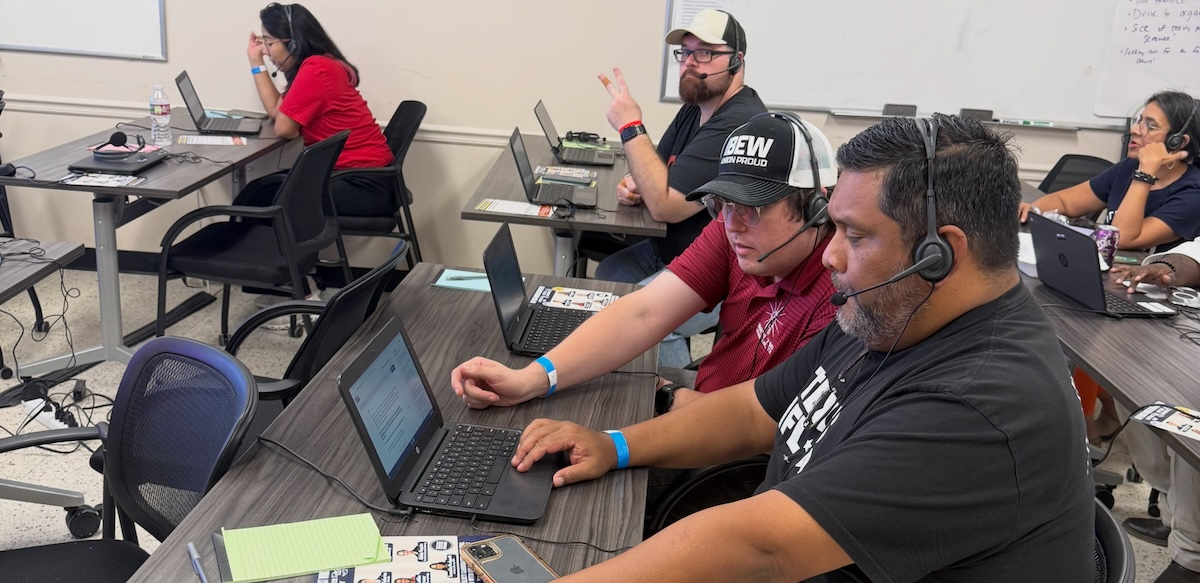
Communications Workers District 6 members and others worked successfully in Texas to elect union members this election cycle, and plan to hold them to a “Contract with Working Texans.” Photo: CWA District 6.
Something different was in the air as the labor movement mobilized for the midterms.
More than usual, unions were willing to support insurgent candidates against the Democratic Party establishment who refused corporate donations, and championed a Bernie Sanders-style list of working-class issues: Medicare for All, a higher minimum wage, union rights, immigrant rights, stopping war, and taxing the rich. Many are union members themselves. And they won.
United Auto Workers President Shawn Fain called the election “the many versus the mighty.”
In Michigan, the UAW was a key backer of the victorious Abdul El-Sayed, who earlier defeated the party’s depressing primary choice for U.S. Senate. “You had a lot of rich people who tried to… buy a seat, to buy these races,” Fain told Michigan Advance. “Michiganders… are telling these people they’re not for sale.”
Logger and union member Troy Jackson won a Senate seat against 30-year incumbent Republican Susan Collins in Maine after the UAW and the Maine AFL-CIO helped defeat the establishment choice in the primary there. In Ohio, labor stalwart Sherrod Brown faced a river of crypto lobby cash but recovered the Senate seat he lost in 2024.
In Texas, the Communications Workers (CWA) mobilized for union-member candidates up and down the ticket, asking candidates to commit to a “Contract with Working Texans.” Governor-elect Gina Hinojosa signed on—she’s a labor lawyer, member of Texas State Employees Union/CWA, and the first Democrat elected Texas governor since 1990.
Various union members and leaders are headed for Congress. Ironworker Brian Poindexter won in Ohio. Pennsylvanians elected firefighter and union president Bob Brooks. Forest Service smokejumper and local union vice president Sam Forstag won in Montana. VA nurse and union member Mitchell Berman beat a Republican incumbent in Wisconsin.
In New York, UAW members and Democratic Socialists of America (DSA) congressional candidates Claire Valdez and Darializa Avila Chevalier defeated establishment Democrats in the primary, then romped November 3.

Richard Ojeda, a champion of the West Virginia teachers’ strike of 2018, won a Congressional seat in North Carolina, beating the head of the National Republican Congressional Committee. "We were elected to elevate the lives of working people across this country,” said Ojeda. “We're coming in LASER FOCUSED on the mission. Help people. Hold anyone who has hurt people accountable. Tax the billionaires. The end.”
Others lost, but came way closer than expected. In Nebraska, Kellogg’s strike leader and independent Dan Osborn came up short (44-50) for U.S. Senate. He faced ferocious attack ads, with $24 million in ‘independent’ spending. In Florida, former SEIU organizer and DSA member Angie Nixon defeated the establishment Democrat in the primary and almost won (48-50) a Senate race the pundits had written off. She got zero support from the national Democratic Party.
CORPORATE DEMS UNDER FIRE
Now some unions have come out swinging, demanding more from the party. The Machinists (IAM) sent a letter urging Senator Chuck Schumer to resign as party leader. OPEIU did the same.
The IAM “is through with any member of leadership, in any political party, who stops one iota short of being a ferocious, unyielding and unbending champion of working people,” said President Brian Bryant. “This means… sweeping economic policy changes that will recalibrate the vast, immoral, economic injustice in this country.”
The United Electrical Workers concurred: “The credit for these wins belongs not to the Democratic Party—whose leadership has offered at best tepid resistance to the Republican agenda over the past two years—but to the working people across the country who have spent the last two years organizing and fighting back in their communities and workplaces.”
UE set out an ambitious agenda: a $25 minimum wage, Medicare for All, dismantling ICE, taxing the rich, protecting Social Security, and passing labor law reform including the PRO Act and card-check recognition for speedier union recognition. National Nurses United said voters expect a stop to health care cuts, stat.
President Trump can veto most bills Congress passes, but Vermont Senator Bernie Sanders insisted on November 9 that Congress needs to do its job and pass a bold working-class agenda. If Trump vetoes the bills, that’ll raise the stakes in 2028 to elect a president who will sign them.
It’ll take a lot of pressure get corporate Democrats to defy their paymasters. So plans are afoot for May Day 2028, when the Auto Workers and other unions have important contracts expiring. The plan is to keep the focus on working class demands, backed by a season of contract campaigns and strikes.