Oil Tanker Mates Fight for First Contract Against Familiar Employer Stalling Tactics
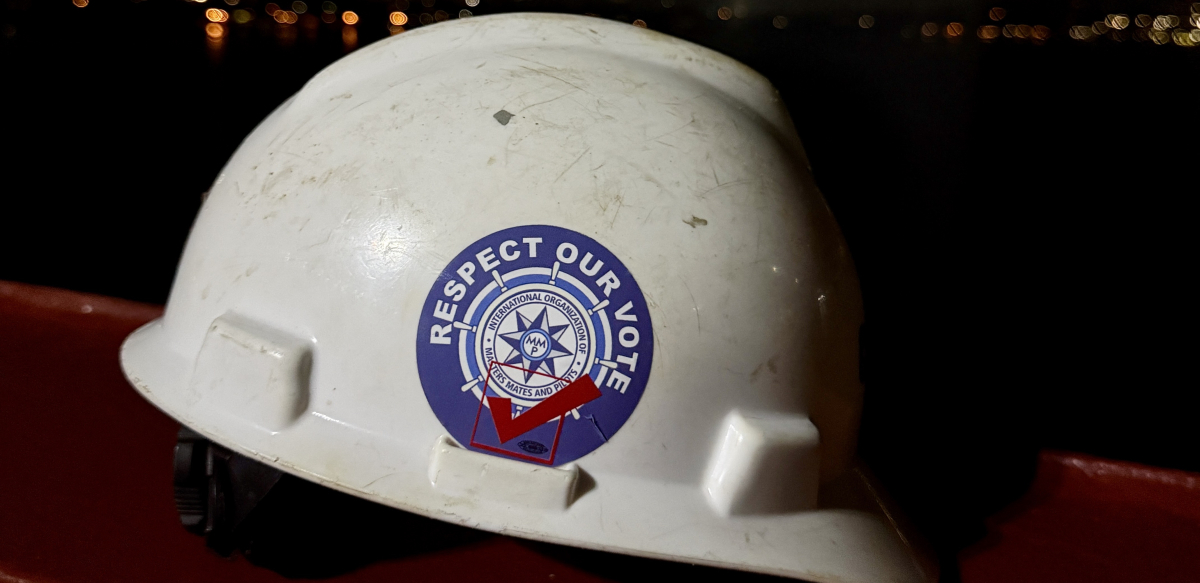
Like workers at Starbucks, Amazon, Whole Foods, Trader Joe’s, and other employers, licensed deck officers on oil tankers owned by Saltchuk Resources are confronting companies’ stalling tactics and abuse of the U.S.’s weak labor laws. Photo: Masters, Mates, & Pilots
Imagine sleeping each night above more than a million barrels of oil while navigating the open ocean, maneuvering through narrow channels, and passing beneath bridges in some of the country’s most congested waterways. The hours are long, the work is physically demanding, and the risks are ever present.
That’s what licensed deck officers—chief mates, second mates, and third mates—do aboard oil tankers. These highly trained, federally licensed maritime professionals live and work on board ships for months at a time in an intense, high-pressure environment. They are responsible for overseeing the safe operation of vessels and managing cargo operations worth billions of dollars.
Most mates on U.S.-based oil tankers have unions to maintain standards and defend their rights. But some are still fighting to organize.
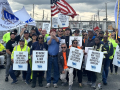
For the past two years, Saltchuk Resources has delayed bargaining a first contract and resisted landmark maritime organizing victories at its subsidiaries, Overseas Shipholding Group (OSG) and Alaska Tanker Company (ATC). As a result, 125 licensed deck officers have faced the challenge of maintaining a union presence while fighting for a first contract. Represented by the Masters, Mates, & Pilots (MM&P), these workers are demanding these companies come to the table and negotiate.
VOTES TO ORGANIZE
In January 2024, 25 licensed deck officers at Alaska Tanker Company, who transport crude oil from Alaska to mainly West Coast ports on the company’s fleet of four vessels, voted to unionize. That October, another 100 officers at Overseas Shipping Group, which has a fleet of 13 tankers, also overwhelmingly voted to join the MM&P. These wins represented “the largest successful bottom-up organizing effort of licensed deck officers in the U.S. merchant marine in at least 50 years,” said MM&P President Emeritus Don Marcus.
The deck officers are seeking the same protections and professional standards already secured by their union counterparts throughout the highly unionized maritime industry. Their priorities include competitive wages and benefits necessary to retain skilled mariners, fair scheduling systems, career advancement opportunities, enforceable protections against unilateral policy changes, and a meaningful voice over working conditions.
Unlike many workers on union ships, officers at ATC and OSG face the risk of toxic benzene exposure, high-risk tank cleaning operations, and grueling cargo turnarounds with no say in the matter. Without a union, management has held unilateral power over the fleet's policies and been able to change relief schedules and extend tours at sea on a whim.
“I have safely and efficiently operated some of the largest American-flag ships the last seven years and things are not improving despite the energy sector making record profits,” said Alex Gilmore, a third mate at Alaska Tanker Company. “We’re committed to the safety of these ships, the environment, our customers, and each other, and we need a contract to ensure our concerns are addressed.”
MANAGEMENT STALLS
Pressures created by management’s responses to the global pandemic, which included sudden layoffs and communication failures, combined with the absence of an enforceable collective bargaining agreement, further accelerated the push toward unionization.

Rather than accept the outcome of the union vote, ATC and OSG launched an aggressive legal campaign aimed at delaying negotiations, dismantling the bargaining units, and exhausting the workers’ momentum. The Saltchuk subsidiaries argued at the National Labor Relations Board that Chief Mates should be classified as “supervisors” and therefore excluded from union representation. After Regional Directors in Regions 12 and 19 rejected those claims and certified MM&P, the companies appealed to the full NLRB in Washington.
The dispute then became entangled in the broader political battle surrounding the NLRB itself. Following President Trump’s January 2025 termination of Board member Gwynne Wilcox, the Board lost its quorum, freezing the case for more than a year. In March 2026, after Trump finally restored the quorum by appointing a third Board member, the NLRB issued a unanimous decision rejecting the companies’ appeals and affirming the bargaining units.
With unfair labor practice charges over ATC and OSG’s refusal to recognize and bargain with the union granted summary judgment from the NLRB, MM&P continues demanding that the companies bargain. But Saltchuk’s subsidiaries appear intent to continue to drag things out—the companies are appealing the NLRB’s decisions in federal court.
ACTING LIKE A UNION
Despite the prolonged delay tactics, deck officers at ATC and OSG have continued building momentum and functioning as a union. Workers have formed bargaining committees, established internal communication networks, and distributed weekly newsletters. Deck officers have organized surveys, petitions, contests, and industry advocacy campaigns.
The organizing effort has also produced immediate gains. Workers successfully pushed back against health care cuts, established a training reimbursement program, improved travel conditions, and secured the long overdue distribution of an Officer Handbook, laying out rules on issues like the length of tours, officers’ duties, travel reimbursement policies.
The four ATC vessels are designed to bridge the gap between the Trans-Alaska Pipeline and the refineries of the U.S. West Coast. A single ATC ship carries approximately 1.3 million barrels of crude oil. The 13 OSG vessels transport crude oil and refined products like gasoline and jet fuel critical to the U.S. economy.
Today, these deck officers continue operating in some of the world’s most strategically sensitive maritime corridors while simultaneously fighting to secure their first union contract. Like workers at Starbucks, Amazon, Whole Foods, Trader Joe’s, and other employers, they’re confronting companies’ stalling tactics and abuse of the U.S.’s weak labor laws. The outcome of this dispute now represents more than a labor disagreement. It has become a test of whether workers in one of the nation’s most critical industries can successfully exercise their right to organize and bargain collectively.
Daniel Ginsberg-Jaeckle is a senior organizer with the International Organization of Masters Mates & Pilots.