Stewards Corner: How We Made UPS Create Full-Time Jobs in Our Local
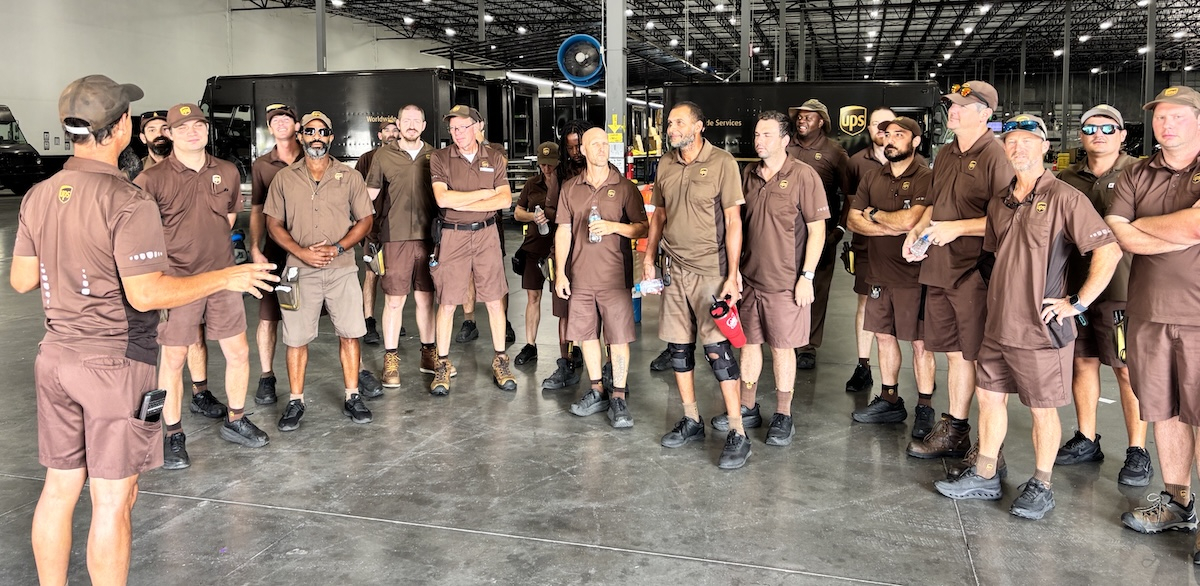
South Carolina’s Teamsters Local 509 fought back against understaffing and won new driver positions. Photo: John Gascey
Often, winning something in your contract is only half the battle—the other half is enforcing it.
It was a huge win in 2023 when our national contract campaign made UPS end its two-tier driver program. After the lower-tier drivers moved up to regular, our center in Charleston, South Carolina, had 91 full-time delivery drivers.
But over time, drivers left, and eventually our center dropped down to 75. When we asked management to fill vacant jobs, they said we had adequate staffing.
We filed grievances. They were denied because we had not proved we needed more staffing. So we set out to prove it.
Management was filling the gaps by having lower-paid union members do some of the deliveries, in violation of our contract. For instance, air drivers are only supposed to deliver air packages. Temporary drivers (part-time warehouse workers doing some delivery, called RTDs) are only supposed to be used during the busier months of the year.
We filed grievances on air drivers delivering ground packages, on temporary drivers working out of season, and on temporary drivers from other buildings being sent to work at our building, a violation of seniority.
DIVIDE AND CONQUER
Management did everything they could to divide and conquer. In the morning meetings they blamed us for air drivers getting fewer hours, and told our fellow delivery drivers it was our fault they weren’t “getting help.”
The company would clean up its act temporarily and try to blame problems on us. For a while, it almost worked—members did blame us! But after a few days or a week, things would go back to normal, and drivers would be dealing with the same problems.
We started having conversations with the temporary and air drivers, explaining that the real solution was more permanent, full-time jobs. Even when some drivers were mad at us, we would continue to share timely information and talk with them one on one about how the company was trying to cheat all of us out of our time and our work.
Any time we found out that air drivers had touched ground packages, we made sure they got paid the top rate for regular drivers, as the contract requires. This can be a difference of $15 an hour or more, so the company was really robbing these workers by paying them the lower rate.
When an air driver filed his own grievance for the first time, we knew we had reached a tipping point. Members started to see what was happening—the long-term erosion of good union jobs. As others saw the checks he was getting, they started to follow suit.

By then there were a dozen members documenting air and RTD violations. Members would tell us when they saw new faces at the building and we’d document the seniority violation.
A shop steward from a nearby building, someone we had met at a Teamsters for a Democratic Union workshop, would tell us when management sent RTDs from his building to come work out of ours.
For a year we documented these violations every day, building our case that we needed more full-time driver jobs. We built a team of members by showing members instead of telling them: “An injury to one is an injury to all.”
TIPPING POINT
Meanwhile UPS had offered a $150,000 buyout nationwide to entice people to leave the company. Before peak vacation season, the people who had applied for those buyouts were approved, and we lost a number of drivers.
That left a bigger workload for the drivers who remained, and more people than ever got interested in enforcing their rights against excessive overtime.
Under our contract, if you request to be on the “9.5 list,” then you can grieve and get paid a penalty every time you work more than two 9.5-hour days in a week. After you reach five violations, the penalty is elevated even higher, which makes management think twice.
Drivers also have the right to request an eight-hour day, twice a month, and get paid another penalty if management denies it.
Drivers who had never been on the 9.5 list got on the list and started filing grievances. We maxed out our eight-hour requests every week. In our group chat we would thank and congratulate every member who had enforced their 9.5 rights.
Management was paying out grievances every couple weeks for thousands of dollars in penalty pay. Drivers who had never filed before were saying, “I can’t believe it took me this long to start filing grievances!”
Enough members were enforcing the contract that management couldn’t single anybody out. By the time our grievance on RTDs working out of season was heading to the grievance panel, we had our first batch of drivers eligible for the elevated penalties for 9.5-hour violations.
UPS tried to get us to settle for three new positions. Our local had our back, and we told management “no way.” The company folded and agreed to create a dozen full-time driver jobs for our center and 21 jobs across our local.
The jobs were posted and filled by seniority, so some of the part-timers who had been working as RTDs were able to become full-time delivery drivers. One union sibling came up and said, “I want to thank you so much. This is going to change my life.” This was a man who, a few years ago when he was first hired, refused even to join the union.
This fight was long. We built our army up along the way. Members got involved—and now it’s our job to keep them union active!
Russell Sires and John Gasceyare Teamsters Local 509 shop stewards in South Carolina. A version of this story was first published by Teamsters for a Democratic Union.