Dolly Parton Helped Us to Speak Up and Join Together
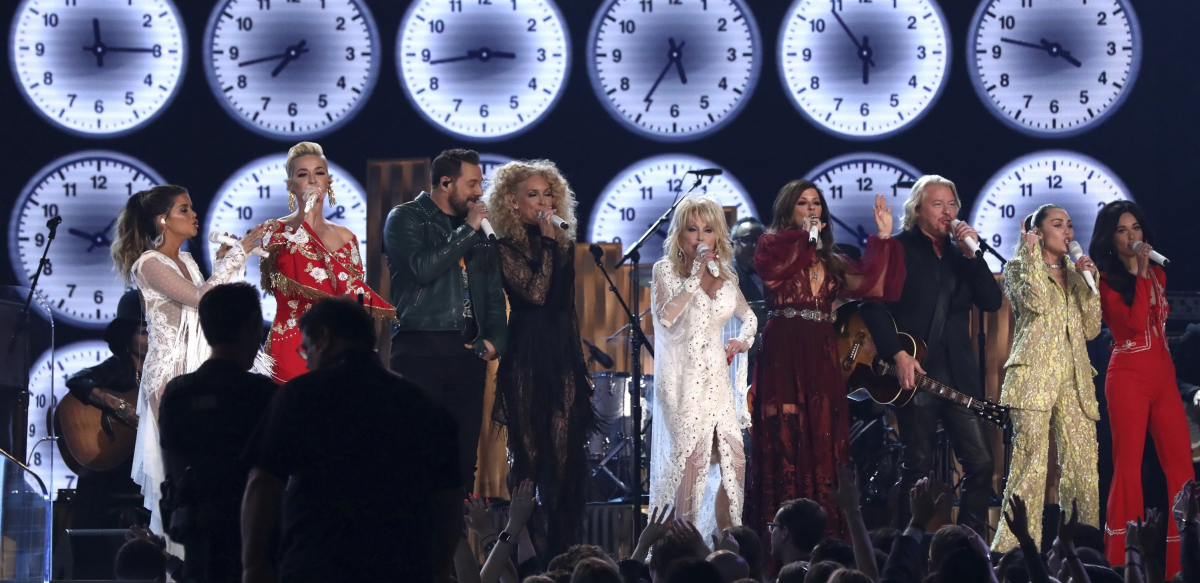
Dolly Parton and an array of other musicians performed her song “9 to 5” at the Grammy Awards in 2019. The song was inspired by the organizing of women office workers, then it became their anthem. Parton died August 25. Photo: Matt Sayles/Invision/AP
Dolly Parton’s song, “9 to 5,” has endured as a beloved anthem for nearly half a century. What many people don’t know is that the direct inspiration for the song—and the hit movie—was the 9 to 5 working women’s movement that began in Boston in the early 1970’s. It was the movement that inspired the song and the movie—and the song and the movie gave the movement a giant boost.
In 1972, I was one of ten women office workers who started sitting in a circle on our lunch hour talking about our jobs. We talked about low pay. Unequal pay. Training men to be our own supervisors. Having to do favors—all kinds of favors— for our bosses.
Before long, our group became a significant factor in Boston’s labor scene. Wielding media coverage, government pressure, and creative demonstrations of office workers’ discontent, we won millions of dollars in back pay and raises and improved women’s job situation throughout the city. After a few years we went national, with chapters from coast to coast, and our woman-led union, District 925 of the Service Employees (SEIU), began to take shape.
Enter Jane Fonda. Jane knew one of our leaders, Karen Nussbaum, from the antiwar movement, and when she said she’d decided to make a movie about the concerns of office workers, we were over the moon. She met with our members to plumb their frustrations, revenge fantasies, and aspirations. And in a stroke of genius, she invited Dolly to join the cast.
Dolly was already a superstar as a singer and songwriter, but she’d never been in a film. Alongside Jane and comedian Lily Tomlin, she turned out to be a natural in her role as Doralee Rhodes, the sweet and greatly annoyed target of lecherous attention from her evil boss.
One day on the set she took out her guitar. “I’ve got a song,” she said.
Her toe-tapping tune perfectly encapsulated working women’s grievances and our dreams. It begins with pride, moves on to anger, then summons a sense of collective purpose. It ends with victory: “The tide’s gonna turn, and it’s all gonna roll your way!”
Before 9 to 5, office workers had never been the main characters on the big screen. In fact, although we were 20 million strong—one third of America’s female workforce—we were basically invisible. When people pictured a worker, they saw a man in a hard hat brandishing a wrench. But now audiences were laughing and cheering as the three women managed to remove their boss from the office and implement a slew of worker-friendly policies, from job-sharing to flex-time to child care.
The film made clear that the problem was the boss, not the secretaries, and that the answer was women taking collective action. As people howled at the boss’s ridiculous antics, they realized that the old ways had to go. The American office was never the same.

One morning shortly after the movie came out when I was riding the bus to work, I overheard one woman talking to another. “So I said to him,” she said, “‘No, I will not make your coffee!’ I just saw 9 to 5!”
Dolly’s way of contributing to that sea-change was all her own.
While Jane Fonda headlined our public events and spoke eloquently to the media about our issues, Dolly did not. She walked no picket lines and made no public statements. Instead, she served as a powerful model. She knew working women, knew the obstacles to success from the inside. Her warmth and empathy were boundless. Just by being who she was, she helped forge a path for countless women, helping them to move forward from silence to making common cause with coworkers.
In 2019, the podcaster Jad Abumrad asked Dolly if she thought of herself as a feminist. “No, I do not,” she responded. “I think of myself as a woman in business.”
Later she spoke a bit differently to Time magazine. "I suppose I am a feminist,” she said, “if I believe that women should be able to do anything they want to."
Such statements were typical of many of the women who joined 9 to 5. They didn’t see themselves as part of the women’s liberation movement, yet they believed passionately in fairness and equality on the job. Our movement worked hard to provide a safe space for such women, along with those who did feel comfortable with the feminist label. Dolly’s example and her outsized presence helped us create that safe space and build unity among women all along the political spectrum.
Decade after decade, Dolly helped us to speak up and join together. We owe her a debt.
[Ellen Cassedy was a founder of the 9 to 5 organization of working women. She is the author of the memoir Working 9 to 5: A women’s movement, a labor union, and the iconic movie. Here is a documentary film on 9 to 5’s organizing.]