A Lack of Democracy in the United Farm Workers Gave Chavez Immunity
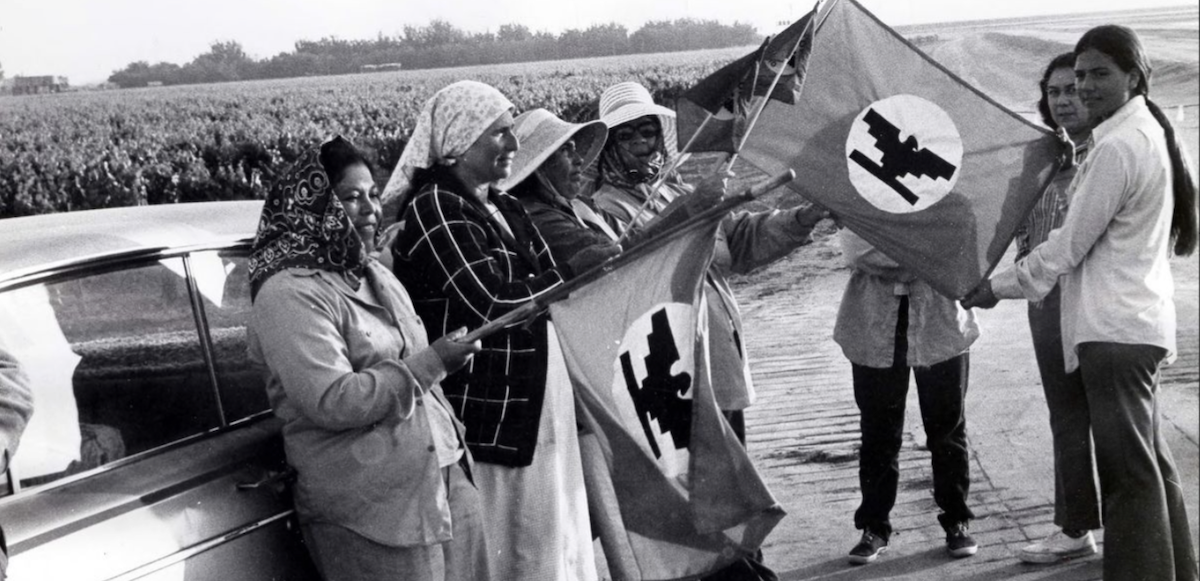
Strikers and supporters of the United Farm Workers (UFW) gather during a strike in May 1973. Lack of democratic organization was a fatal flaw that allowed Cesar Chavez to abuse girls and women, and also led to the downfall of the union itself. Photo: Walter P. Reuther Archives.
In 2011 Frank Bardacke published an 800-page history of the Farm Workers union: Trampling Out the Vintage: Cesar Chavez and the Two Souls of the United Farm Workers. It opened many eyes to the reasons the UFW became a shadow of its former self.
Bardacke starts the book with an epigraph, a quote from Shakespeare’s Julius Caesar: “O what a fall was there, my countrymen! Then I, and you, and all of us fell down...”
Bardacke was a farmworker in the fields of the Salinas Valley for six seasons in the 1970s. When he decided to write his book years later, he went back to his carpool co-workers, finding them still at work in the fields. In 1994, the union had been thoroughly defeated for nearly 10 years—but his old friends were afraid even to mention its name where the foreman might hear.
I interviewed Frank Bardacke after a New York Times investigation revealed evidence that Chavez had sexually abused young girls who were volunteering with the union, and the allegation that he had also assaulted union co-founder Dolores Huerta. –Jane Slaughter
Jane Slaughter: The revelations about Cesar Chavez as a sexual predator: many people have said they were “surprised but not shocked” or “shocked but not surprised.” How did you react?
Frank Bardacke: The abuse of Ana Murguia was rumored at the time among UFW staff, primarily at the La Paz headquarters. Many of the rumors originated with Ana’s stepmother, Kathy Murguia. But people just didn’t want to hear it. They didn’t want to look into it very deeply because Cesar was one of these powerful men who could do anything he damn well pleased; he was immune from investigation.
It puts him in the category that seems to be so prevalent these days, or at least more known about: powerful men who can do whatever they want to do, including groom children and abuse women, and they don’t have to answer for it.
Where did that power come from?
For the men we know about, it comes from money or political connections or celebrity. Where did Cesar’s power come from?
The first answer is that he had just turned a losing 1965 grape strike into the most successful boycott in American history, at the conclusion of which, in 1970, farmworkers won the most substantial contracts they’d ever had: a hiring hall, grievance procedures, seniority lists. They’d never had those before.
That’s the first reason he had power. Through that he became a celebrity. He was the organizer, the architect, and the main energy behind that boycott, a hero and a celebrity with the kind of immunity that modern celebrities have.
But the second reason was an internal reason within the UFW. Everybody within the organization owed their job to Cesar. He appointed everybody, he could discharge anybody at his will, which he often did. That wasn’t just theoretical power; periodic purges pulsed through the organization. So you didn’t disagree with Cesar except at the peril of losing your job.
Those were the two reasons that no one wanted to follow up on the rumors of abuse. He was an authentic hero who had led and directed that boycott, and everybody in his organization owed their job to him.
Tell us more about the structure of the UFW.
That’s a crucial part of this. From the beginning, say in the early 1960s, the structure was basically volunteer organizers appointed by Chavez who earned $5 a week, plus expenses if on some kind of assignment.
That structure lasted even when the UFW Organizing Committee (UFWOC) became an actual union. They continued this organizational structure of volunteers. They did not set up union locals. The union constitution did not have provision for union locals. There was no way that an ordinary farmworker could elect anybody; everybody served at Chavez’s pleasure. That included the field offices in local places where there were farmworker contracts.
Then in 1970 there was a victorious farmworker strike in the Salinas Valley. There was a provision in the agreement that allowed for farmworkers to elect their own reps, called field reps, who would help enforce the contract in the local areas.
Field reps were in place in addition to the field offices, where everyone owed their jobs to Chavez. But the paid reps owed their jobs to their crews. They got the pay equivalent to what their former crews were making. They were highly skilled, high-paid crews, earning as much as $500 a week back in the day.
This was an entirely new situation in the UFW and Chavez had tremendous trouble from the outset with the field reps—who could disagree with him. People hadn’t successfully disagreed with Chavez for nearly 15 years. There was no tradition of arguing and debating and voting as in other unions.

The paid reps became quite independent and collectively they decided that the big problem in Salinas was that they only had half of the valley organized, and for the union to survive, they had to organize the nonunion companies.
So they started organizing the nonunion companies and had some success. But Chavez was never comfortable with the Salinas contracts. There were lots of contract disputes and Chavez had never dealt with contract disputes. He was sick of the complaints, he thought contracts were a pain in the ass. He was busy with the boycott, which he thought was the most important tool the union had.
But what was the boycott for if not to win more contracts?
The reality of contracts was different from the idea of getting more contracts. Contracts brought problems, especially in 1970 in Salinas after a victorious strike. The workers were testing the extent of their victory. They were filing grievances and fighting for seniority rights.
It was the year I went into the fields and I was astounded by the militancy. I was on a crew that was told to thin the lettuce, and people wouldn’t leave the bus because they said the fields had been fumigated too recently—this was a right which was in the contract. The foreman was furious. He ordered us to go into the fields and somebody went to the union office and somebody came out and argued with the boss and we never went to work that day.
Chavez was primarily a boycott leader by this time. He was not really interested in rank-and-file problems on the ground. Moreover, he could see the reps were expanding their constituency and he thought they would become even more powerful. He ordered them to stop organizing, and when they didn’t, he fired them. Even though he didn’t have a legal right to do so.
There was a big battle and it all came out at the UFW convention—and the growers knew about it. They knew the union was divided, and in 1980 they went on the offensive and basically defeated the union. This story in all its gory details can be found in my book.
Is there a lesson here for unionists about how their unions should be run?
Yes. Democratic unionism is essential to union strength. Open discussion and debate is essential to building the kind of unity that you need. The lack of democratic organization is what caused the downfall of the UFW. The lack of democratic organization not only gave Chavez immunity in his abuse of girls and women, but is also what caused the downfall of the UFW.
Is there a lesson about making it all about one leader?
I’m not against leaders. Good leaders are essential to a movement. The main lesson I see is that the good leader has got to emerge out of a democratic tradition and democratic discussion and shouldn’t serve for life.
What about the rumors that the union was opposed to undocumented workers?
That is another long, sad story. At various periods the union was actively opposed to the undocumented. They even set up their own border patrol line in the Imperial Valley, called the “wet line.” The UFW had an anti-illegals campaign in the early ’70s in which they actually fingered undocumented people to the INS [Immigration and Naturalization Service] . UFW loyalists would provide a list to the local INS office of the undocumented people working in the fields.
These were their co-workers.
Yes. Close to half the workers in the fields were undocumented by this time. Why would an organization that was trying to organize field workers set one half of field workers against the other half?
Chavez’s answer was, “We have to explain to the boycotters why we are losing contracts. Illegals is the answer. The undocumented are taking the contracts away from us.” Which points to the fact that the best way to understand Chavez in the mid-1970s was as a boycott leader, not a farmworker leader. He sacrificed the organizing of farmworkers to strengthen his boycott organizing.
What now?
I’m for taking down the statues and renaming the schools and the streets. I’m not for replacing them with the name of Dolores Huerta, who was a loyal lieutenant and very often the point person in the various purges of people who had elicited Chavez’s displeasure.
If you want to give them a name of a farmworker, give them the name of one of the reps who are still known in the fields. Cleofas Guzman. Mario Bustamante.