
Honda Mexico Worker Wins Reinstatement After 15-Year Fight
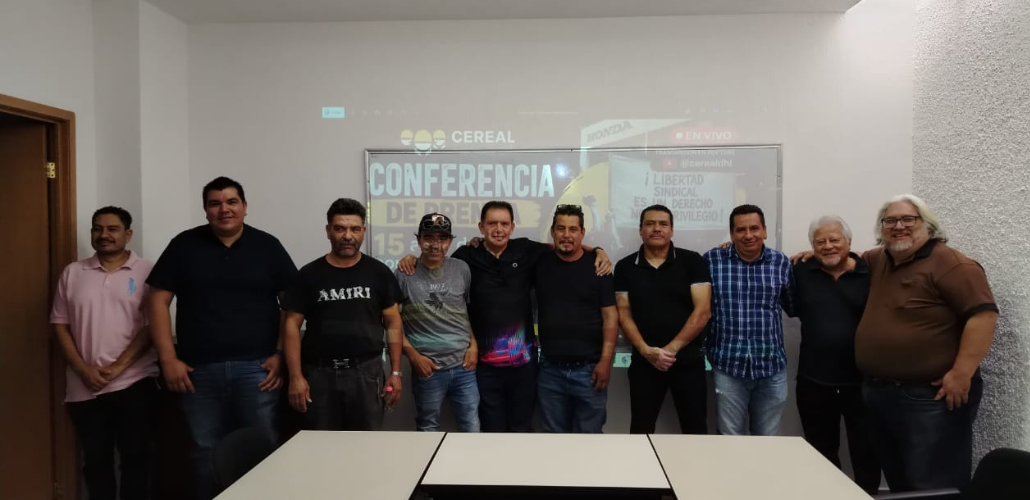
Former Honda workers and community supporters gathered for a press conference on Solorio Alcalá's reinstatement. Photo: CEREAL
The leader of Mexico's Honda workers’ union won reinstatement last week, in an important win for workers seeking to build real unions in the country's massive auto sector. But it took 15 years for José Luis Solorio Alcalá, of the Union of United Honda Workers of Mexico (Sindicato de Trabajadores Unidos de Honda de México, STUHM), to get one step closer to justice.
Solorio Acalá was fired in 2010, months after a campaign to organize the plant went public—and just three days before Christmas. Within a year the entire organizing committee had been fired, he said. Some, like him, have held out for the slow wheels of justice to turn in their favor.
In June, Mexico’s Federal Board of Conciliation and Arbitration, which mediates labor disputes, finally ordered Solorio Acalá reinstated. But the victory was bittersweet, he said, because he suspected his long wait was far from over: Honda quickly filed an appeal.
A FAKE UNION
On paper, the Honda workers already had a union when Solorio Acalá and his co-workers began organizing. In practice, it was nothing of the sort.
“The only union rep we knew was the manager of human resources,” Solorio Acalá said.
The fake union was an affiliate of the notorious Confederation of Mexican Workers, or CTM, which has built a reputation for imposing pro-boss “protection contracts” that lock in low wages and prevent true union representation. The CTM affiliate still represents workers at the plant today.
“It’s a profitable business model,” said Elías Iván García Ríos, Director of the Center for Reflection and Labor Action (CEREAL), which has supported Honda workers in their fight for reinstatement.
“When I see the amount of collective bargaining agreements that the CTM has accumulated in Mexico, what I see is an incredible business,” García Ríos said. “It operates [to protect] companies, and has sold itself to many of them.”
Long before a true union was on the horizon, workers started acting like one. “We all helped each other out,” Solorio Acalá said: “If someone would fall behind, everyone would help them catch up.”
ORGANIZING ON THE (SECOND) JOB
In 2008, upon learning that their legally mandated profit-sharing checks would be far smaller than expected, Solorio Acalá and his co-workers marched on human resources, demanding to know why the payout was low when productivity had only increased. They won about 10,000 pesos (about $578 U.S.) more than expected, he said, plus nearly $300 in food vouchers.
Workers started to feel more confident after that fight, he said.
Where did this sense of camaraderie come from? One factor that certainly didn’t hurt: “In the 10 years I worked there, the majority of the workers, in addition to working at Honda, had second jobs because the wages were so low,” Solorio Acalá said. Many of them, including Solorio Acalá, worked as waiters, and would help each other land work where they could find it.
People had wanted to organize an independent union at the plant for many years, but would be fired shortly after word would get out, he said. But while working their shared side gigs, they could speak freely: “We’d arrive early, talk with our co-workers. And that’s how things got put in motion.”
‘AN ACT OF INTIMIDATION’

Solorio Acalá, still organizing despite his firing, was arrested in March 2012, while distributing union materials to his former co-workers. A Honda security guard stated that he had stolen a pen-shaped video camera, which Solorio denied. He was detained for 48 hours. A year later, the charges were dropped.
But in 2019, Solorio Acalá was arrested again for “false statements” pertaining to his 2010 dismissal. In the course of arbitration, Honda presented signed documents asserting that Solorio Acalá had not been fired, but had voluntarily resigned. Solorio Acalá maintained that it was not his signature. He was held on bail in a maximum security prison.
The worker-run tire factory cooperative Tradoc paid his bail, characterizing the detention as an act of intimidation against the union. Ultimately, a forensic expert paid for by the arbitration board determined that the signature wasn’t his, Solorio Acalá said, and the matter was dropped.
SLOW JUSTICE
Raúl Celestino Pallares Cardoza, recording secretary for the STUHM, was among those fired in 2010, but won reinstatement and returned to his job in November of 2014. But Pallares Cardoza was kept isolated from other workers, he said, and he was fired again four days after returning.
“They never assigned me to a specific work area, failed to register me with the IMSS [Mexican Social Security Institute], and never issued me a worker identification badge," he told El Economista at the time.
The ruling is a reminder of the severe difficulties faced by workers who want to organize real, democratic unions in Mexico. “When a worker has been fighting for justice for 15 years, something is wrong,” said Jesús Torres Nuño, former leader of the Tradoc cooperative, at a press conference on Solorio Acala’s reinstatement. “We’ve had [different parties in power], and workers haven’t seen change.”
Mexico’s 2019 labor law reforms were meant to strengthen workers’ rights to form independent unions. “I think it’s completely in the hands of the companies, co-opted by [corrupt] union leadership,” said García Ríos. “The implementation of that justice is still far from being agile, democratic, and at reach for working people.”
Helping back up those reforms was a new tool under the USMCA trade agreement known as the rapid response mechanism, which allows unions and workers to bring complaints against employers who violate Mexican workers’ right to organize. If a facility is found to be violating workers’ rights, it faces sanctions and may ultimately lose access to the U.S. market.
But because the original violation took place before the reforms entered into effect, fired Honda workers do not have recourse to the rapid response mechanism, even though their rights continue to be violated. If Solorio Acalá is able to return to the plant and is fired again for his organizing, he would have recourse. So Honda has a significant incentive to continue to fight his reinstatement, which is why they were so quick to file an appeal, García Ríos said.
“I ask that you imagine the life of these fired workers,” said García Ríos. “Living so many years with the agony [of] not knowing how you will support your family.” Over time, he said, many have developed health issues as they age. “[It’s] something that could happen to you, or me, or anyone. We need models that [can deliver justice] faster.”
Over the past 15 years, Solorio Acalá has eked out a living as a waiter, Uber driver, and package courier. Much has changed at the Honda facility since. Back when he was on the job, the plant assembled the Accord, and later, the HRV. But in 2019, the facility stopped assembling cars and shifted to motorcycles and spare parts.
Solorio Acalá worries that by the time he’s allowed back on site, production practices at Honda will have changed significantly, and he’ll be on the back foot. But some things, he suspects, will be much as he left them: “Things haven’t changed within the facility. [From what I hear] from some workers, things are the same or worse.”
Also unchanged is his resolve: “Sometimes justice is slow. But when you have truth on your side, it’s worth it to keep fighting. It’s the right thing to do.”



You must log in or register to post a comment.