List-Building 101, or How to Expand Your Reach as a Troublemaker
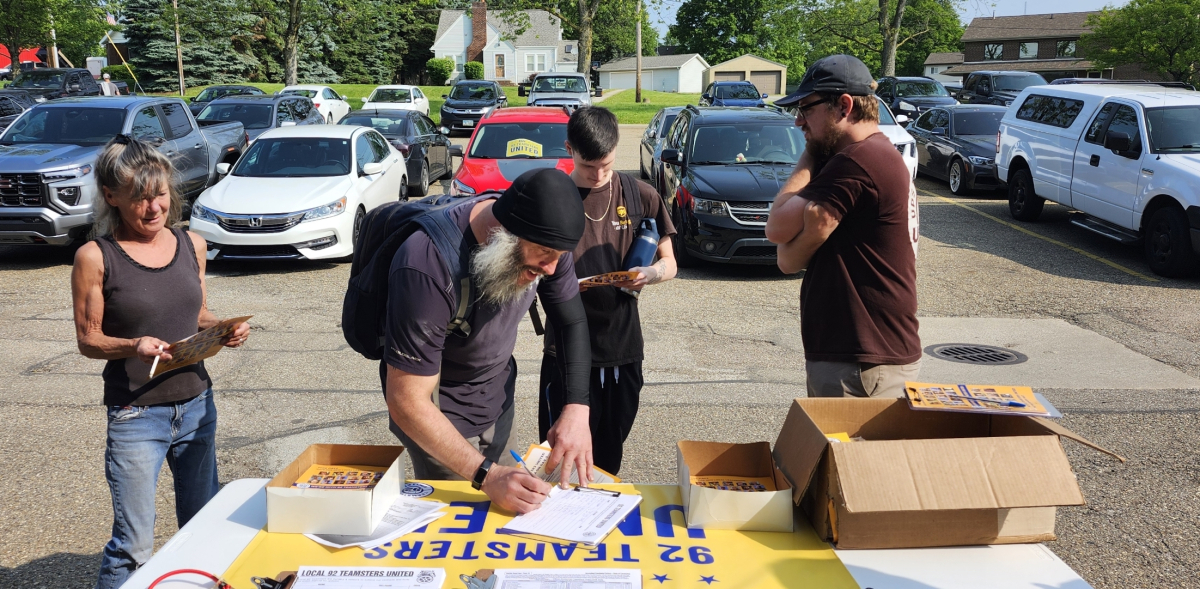
A petition can be a good way to build a list. So can a survey or pledge. Photo: Local 92 Teamsters United
Effective troublemakers need many skills. One of the most important, though not the most glamorous, is list-building.
If you otherwise have the fundamentals of organizing in place but you’re still struggling to reach more people, make sure you’re paying attention to your list and not leaving an opportunity on the table.
KEY COMPONENTS
What is a list? Well, it’s a list of your co-workers. It should contain their names, of course, but also each person’s job, their department or shift, and how to get in touch with them, especially their phone number and email address.
Your list should also track their level of support for your particular organizing effort, whether it’s a union drive, a health and safety petition, or a campaign for union office. If you’re building a list over time, such as over the course of a unionization campaign or as part of building a union reform caucus, you should also track their support for past actions.
If you’re new to list-building and you’re a pen-and-paper type, start there. If you’re organizing with a group or in a large workplace (or across multiple worksites), however, it’s a good idea to store the information in a spreadsheet that trusted organizers have access to.
Make sure all the information ends up stored in one place, even if you have multiple people collecting it. You can find an example of what a list (sometimes called a chart) might look like, at bit.ly/MakeAChart.
WHO NEEDS A LIST?
Every organizer needs a list. If you’re in the leadership or staff of your union, you hopefully already have access to a list of the members. Probably it could use some improvement, such as updating contact information or adding columns to track support for union actions.
Frequently, union reformers or workers just starting out to form a union are not in a position where they already have a list, and must build one from scratch.
Lists are vital for union reformers who need to organize with other rank-and-file members, or for members running for union office, who will need to make sure their co-workers vote.
In these scenarios, your list may not contain everyone in the workplace (although it would still be useful to have such a list), but it definitely needs to contain your supporters.
A good, well-maintained list, and knowing how to use it, can be the difference between a failed campaign and a successful one.
HOW TO BUILD IT
Any campaign that’s grounded in organizing fundamentals—addressing widely and deeply felt issues, with respected workplace leaders at the helm—is also a list-building opportunity.
A petition can be a good way to build a list. So can a survey or pledge. Circulate forms in person during your conversations and meetings, and in online spaces or chats where members congregate.
Even before you launch a campaign, however, think about your personal networks. Whose contact info do you have already? For workers who don’t always work at the same site, or whose work sites change frequently, such as in construction or the entertainment industry, think of people you worked with on past projects.

These contacts are the start of your list. Everyone on the organizing team can pitch in to build the list with their connections.
Sign-in sheets for in-person events, or registration data for Zoom events, are also useful. Require attendees to provide their contact info. Getting these sign-ups should become a key task of the organizers on your team. Also, try to upload the data from sign-in sheets promptly into your main list, rather than leaving them to collect (digital) dust.
There are also more passive ways to build a list, such as through a campaign website or social media. Always make it easy for someone encountering your web presence to sign up for email updates, or to give you their contact information in some form.
Don’t get too obsessed with tracking your social media engagement, especially if it’s not translating into actual contacts you can invite to get more involved. (But if someone leaves an incisive comment or seems like a good potential activist, do reach out to set up an actual conversation.)
Finally, set a time each week to maintain your list, and continue to build it. Make sure you have assigned clear responsibility within your team for this essential work.
HOW TO USE IT
You’ve built a good list—now what do you do with it?
Communicate with people on your list. In addition to one-on-one conversations, most organizing campaigns these days use mass emails and texts.
While it’s a mistake to rely solely on one-way mass communications, a good communications strategy and well-timed outreach to your supporters can be an important supplement to strong organizing. It can convey updates, help turn out supporters to events and actions, and raise money. So communicate regularly with your list.
Use it to assess the areas where your organizing is strong or weak. Which departments do you have a lot of support in? Are there key departments where you have not a single contact?
Do your supporters seem to skew in ways that could affect your success, like identity, job title, location, or language spoken? Your list should have representation from the groups that you have previously identified as important to your organizing. If you’re missing some groups, figure out how to get them involved.
Use it to identify potential leaders, and to turn supporters into activists. You need to work through your list—through in-person conversations or phone calls—to identify the people you want to recruit into more active roles.
Remember that real leaders take action, and aren’t necessarily the loudest or most radical-sounding in the group. Most important, real leaders have followers, meaning they have influence with certain co-workers. Make an organizing “ask” of them, such as inviting them to an event, and see if they not only follow through, but can also recruit co-workers to join them.
Building lists—and making good use of them—takes some work and attention to detail, but if you make it an automatic part of your organizing, it will pay off!