In Major Breakthrough, Volkswagen Auto Workers Reach Tentative Deal
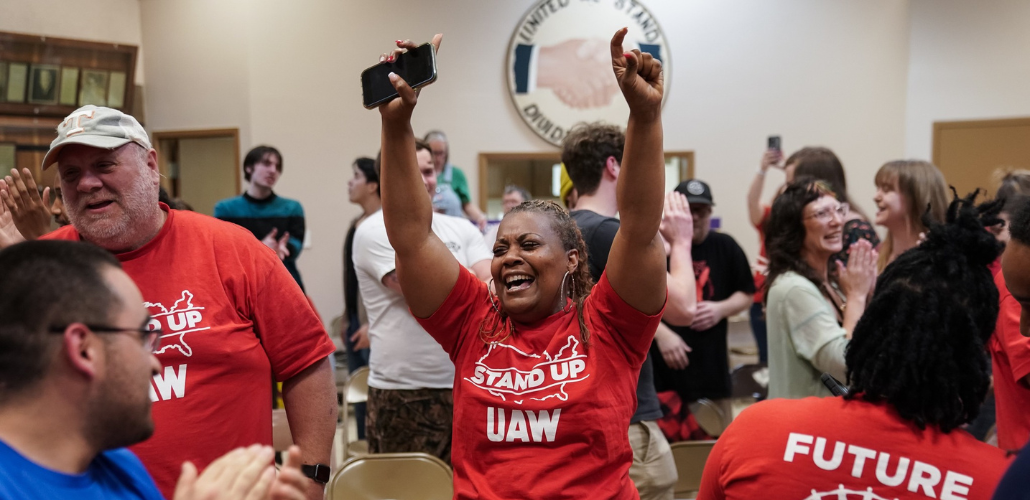
Workers at the Chattanooga assembly plant reached a tentative agreement with Volkswagen on February 4, almost two years after voting to unionize (pictured). Photo: UAW
Volkswagen had dangled a treat: a ratification bonus of $4,000, sweetened by $1,500 if a first contract at its assembly plant in Chattanooga, Tennessee, was approved by Halloween 2025. But auto workers had a trick up their sleeves: collective action.
One hundred and sixty workers on the second shift hampered that day’s production schedule by skipping work in a mass call-out. Workers used sick time or paid time off to secure the day off, leaving management in a bind.
“They couldn’t run the lines,” said bargaining committee member Josh Epperson, an equipment operator who was once a Walmart supervisor. “They limped along where they could. They tried to move people around. And ultimately they decided to cancel production.”
Days earlier, a majority of workers had voted to authorize a strike if necessary. “We really do control whether or not these lines run, whether these machines produce cars,” said Epperson. “It was an eye-opening moment for the company as well.”
On February 4, workers there reached a tentative agreement with Volkswagen—almost two years after voting by 73 percent to join United Auto Workers Local 42.
Volkswagen is the world’s second-largest automaker. That domino falling could have ripple effects across non-union auto plants.
“I hope that the other plants here in the South are watching,” said bargaining committee member Yolanda Peoples, who works on the engine assembly line. “We just achieved something that everyone thought that we were not able to do. We now have our seat at the table, and it’s going to be life-changing for a lot of people in our plant.”
THE DETAILS
The agreement comes with a 20 percent wage increase, equal to around a $7 wage bump for production workers, over the four-year contract. The cost-of-living adjustment is 45 cents per hour on top of the base wage, depending on inflation.
The UAW had demanded a 24 percent raise to achieve parity with the Big 3 auto makers: Stellantis, General Motors, and Ford. The top rate for production workers at the plant will be $39.41 by the contract’s end in 2030, compared to $43 per hour by 2028 at GM’s assembly plant in Spring Hill, Tennessee.
New hires will begin at $23.40 per hour. Progression to the top rate for production and skilled trades will be 48 months. Skilled trades will top out at $49.86.
The deal improves health care and includes bonuses of $6,550 per worker upon ratification, plus annual bonuses of $2,550 for the life of the agreement. Profit-sharing will be doled out on a sales percentage, for example, a payout of $1,500 for over 8 percent in sales. Workers maintained their attendance bonus of 8 percent annually.
Strong job security language includes a standard successor-and-assigns clause ensuring that the collective bargaining agreement would transfer over to any new buyer. Workers also won more time off—including two floating holidays, totaling 16 paid holidays—and the right to strike over health and safety grievances.
The agreement, if ratified by the plant’s 3,200 workers February 18-19, will expire in February 2030. The union had proposed to align with the Big 3 on May 1, 2028, but the company didn’t budge, and it wasn’t anybody’s top issue.
“Most people are just glad that this is finally over,” said Zach Costello, a trainer on the assembly line. It takes workers an average of two years to win a first contract after unionizing.
FIRST IN THE SOUTH
Volkswagen workers made history in 2024—becoming the first auto plant in the South to unionize through an election since the 1940s, and the first foreign-owned factory.
Equipment operator Angel Gomez felt the power shift after the vote. A supervisor came up to ask him what he’d be able to do now. “The way you’re touching the machines now, you ain’t going to be able to do that,” he told him.
Gomez, a former Teamster and the son of a retired Ford auto worker, explained to the supervisor that the machines were union work: no more supervisors swooping in to cover for understaffing. Also, no more barking orders “like an overseer” from overhead maintenance spots. “I told him, ‘You’re gonna get a hell of a lot of group grievances coming at you because you’re creating a hostile workplace.’”
Volkswagen had already bumped wages up by 11 percent in November 2023, weeks after the UAW won big pay and benefit hikes at the Big 3 in its Stand-Up Strike. Hyundai and Mercedes did the same to blunt the momentum of union drives spreading to their workforces. The top rate for production workers at Mercedes is $38 per hour, plus $200 every four weeks for perfect attendance.
After the strike, the UAW committed $40 million to an organizing blitz meant to double the union’s membership by organizing 150,000 non-union workers, especially in Southern auto manufacturing and newly built battery plants.
A month after the Volkswagen win, however, the union fell short in an election at a Mercedes-Benz plant in Alabama. It has not filed for election at any Southern assembly plant since.
Breaching the anti-union Southern citadels of auto manufacturing may require repeated attempts. The UAW narrowly lost plant-wide elections at Volkswagen in 2014 and 2019. A small unit of skilled-trades workers voted to unionize in 2015, but never reached a deal.
JOB SECURITY
Job security was a major sticking point in the bargaining. Volkswagen invested $800 million here in 2019 to produce the I.D. 4 Electric SUV, but Trump has rolled back tax breaks and subsidies for the electric vehicle transition, hurting manufacturers.
Last year the company paused production of its electric SUV due to slowing sales. Workers in Chattanooga still produce the Atlas SUV and the Cross Sport.

In the event of temporary layoffs, workers will continue to receive benefits, including health care and car leases. In the event of indefinite layoffs, they’ll have a voluntary attrition program, meaning they’ll get 50 percent of their base pay for up to a year and health care for up to 12 weeks.
Last August, while Volkswagen workers were in bargaining, workers narrowly won a union election at the BlueOval SK Battery Park in Kentucky, a joint venture between Ford and South Korea’s SK On. Then in December, Ford dissolved the partnership, laying off 1,600 workers and repurposing the facility to build battery energy storage systems for data centers, instead of batteries for electric vehicles.
Gomez said what happened with BlueOval was on workers’ minds. “We go to work, we see a Volkswagen sign out there,” said Gomez. “Everything’s hunky-dory. Then tomorrow, they can sell off the Volkswagen brand here and just turn it into Audi. Realistically, they [could have done] pretty much whatever they want if we would have kept the language the same as it was in the last, best, and final offer.”
“Audi has been a big question mark of mine,” said Victor Vaughn, an assembly worker on the logistics line where the car production process begins in the body shop. “I want to see that language that, if it gets to a point where they have to do a reduction in the staff, that employees are going to be taken care of, sort of like how the GM employees are.”
The UAW won the company’s commitment that “it will not close, curtail, shut down, discontinue or liquidate the Chattanooga plant during the term of this agreement, unless conditions beyond the control of the company arise that make compliance with this commitment impossible.”
The deal includes product commitment “sufficient to sustain a substantial portion of the UAW-represented employment levels at the time of the ratification.” Outsourcing of core UAW work isn’t allowed unless agreed to by the union.
Notably, the language doesn’t come with the right to strike over enforcement. The union has faced the challenge of holding auto companies to these kinds of commitments.
Workers have received a 28-page summary of the deal’s highlights. Vaughn said he’s looking forward to reading the whole tentative agreement when the union holds information sessions on it, starting February 16.
Peoples, a third-generation auto worker, was one of thousands of workers left without a job during the Great Recession after GM shuttered its assembly plant in Doraville, Georgia, in 2008.
“Just knowing that Volkswagen has written in the contract that they’re willing to grow with the city of Chattanooga was one of the biggest accomplishments,” she said, “having that stronger job security language to make a lot of the employees inside of that plant know that Volkswagen isn’t just going to pick up and leave.”
RECLAIMING THEIR TIME
Workers wanted parity with the Big 3 on health insurance—workers at GM, Ford, and Stellantis pay no premiums or deductibles. “They wanted to be right there with the Big 3,” said Peoples.
At GM, co-pays are $25 to see a doctor, $50 for urgent care, and $100 for an emergency room visit.
Volkswagen would not agree to this, but the union did win cuts in health care costs. Premiums will go down from $400 a month to $80.82 for a family on a premier plan. Deductibles decreased from $1,300 to $900 for a family.
Gomez said his out-pocket maximum for his wife and child is currently $6,400. Under the tentative pact, it would go down to $4,800 for in-network coverage. Health care costs will also be locked in for the term of the contract. Affordable health care was a top issue for older workers with families.
Vaughn said his pay will go up from $30 an hour to $34 in the first bump. Half the workforce is under 35 years old, and he said they’re most excited about the long-overdue pay hike.
But for Vaughn, who is 58 and sustained a workplace injury while pushing parts in a cart two years ago, the top issues are health care, job security, and safety. “This job is brutal,” he said. “It will beat you down.”
On health care, “we see that there’s some reduction in the costs,” he said. “But we were hoping to get a clear and concise plan where by the end of this first contract, we would have our health care paid for, like the other employees in the industry.”
Workers had also fought for childcare onsite and a $100-a-week childcare subsidy.
For Epperson, the main sore points in the deal are break time and paid time off. Workers will receive eight hours of PTO per month, but supervisors will still have discretion to approve or deny it, though they will now have a deadline of five days to do so.
If a worker in the same work area is out on sick leave or medical leave, he said, supervisors will deny another worker’s day off, because they are “running so lean.”
And Epperson said workers wanted the industry standard of 20-minute breaks; at Ford it’s five minutes per hour. Breaks at Volkswagen will remain 10 minutes.
“For a 10-minute break, you take a piss, and you’re done,” said Gomez. Workers had demanded that the company build more bathrooms; a compromise demand was longer breaks, but they ultimately didn’t win that either.
“You’ll work for two and a half hours, some areas almost three, take a 10-minute break, and then you're right back into it,” Epperson said. “And when you’re doing manual labor that has such a high frequency of overuse, stress injuries on your hands, your elbows, your shoulders, your back, having that chance to step away and actually let your body relax, let the blood flow back into the joints—break time matters. And that’s one I’m particularly sour about not having more success with.”
Still, “it’s only up from here,” he said. “Maybe it’s not as huge as we might have dreamed, because if you spend 10 years trying to work towards organizing, you’ve got some ideas in your head of what you’d like to see. But when you step back and look at it from where things are to what this offers, it’s tremendous.”