
Red Cups Raised in Rebellion, Starbucks Strike Spreads
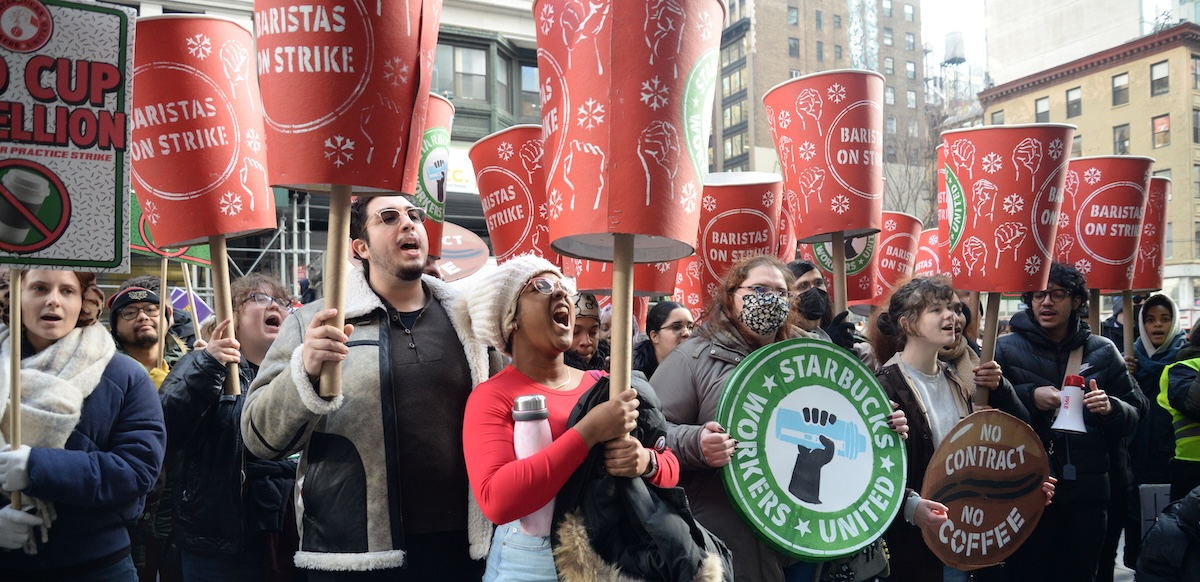
Striking Starbucks workers were joined by members of other unions in front of the Empire State Building in Manhattan on December 4. Photo: Jenny Brown
Several hundred more Starbucks baristas walked out Thursday, the 22nd day of their growing unfair labor practice strike. It is now the longest strike the coffee giant has faced, spreading to 145 stores in more than 100 cities.
Kingston, New York, baristas joined the strike early Thursday, and management didn’t even bother trying to open the store. So the workers, joined by supporters, picketed a nearby store in Lake Katrine, piercing the crisp winter air with chants of “What’s disgusting? Union-busting!” and “I want to eat food and pay rent at the same time!”
Starbucks Workers United, the union representing 12,000 baristas, is asking customers to shun all Starbucks stores for the duration of the strike. They had not previously called for a boycott. The company is big, and the 550 unionized stores account for only 5 percent of the company’s 10,000 U.S. outlets. Starbucks is the second-largest fast food company in the world.
In Lake Katrine, several would-be customers turned away at the drive-through, and others who had pre-paid mobile orders pledged not to return for the duration of the strike. After a morning out on the picket line, some workers drove to New York City to join a rally at the Empire State Building, where there is both a flagship Reserve store (serving espresso martinis) and corporate offices.
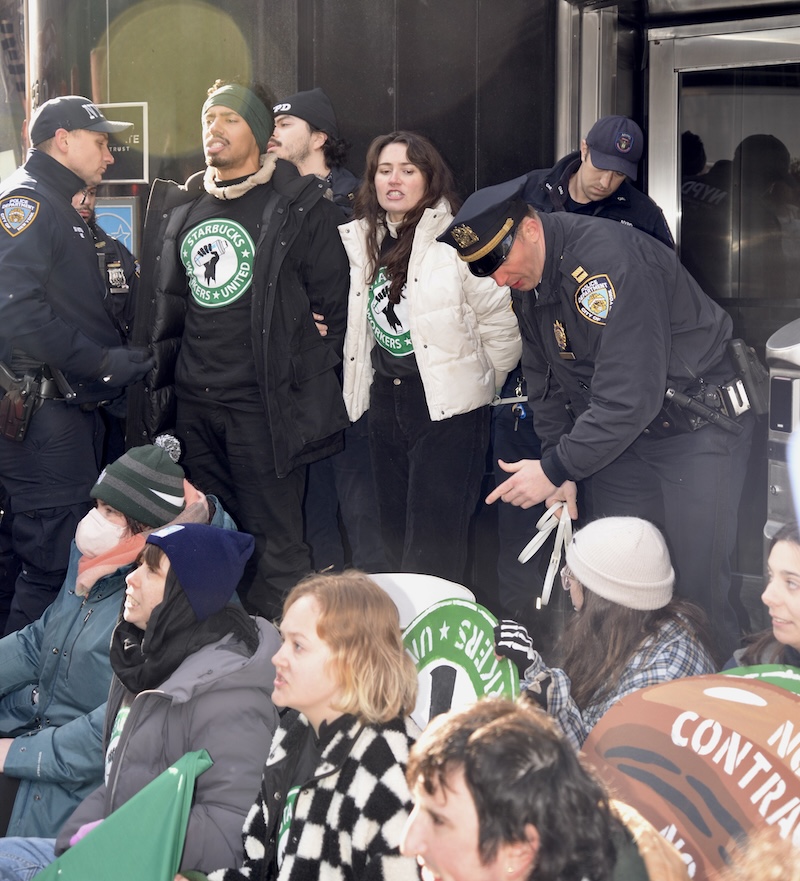
In Manhattan, 500 rallied with giant red cups saying “Baristas on Strike,” and signs comparing CEO Brian Niccol to The Grinch. Twelve workers and supporters sat down to block the iconic building’s office entrance. They had asked for a meeting with executives in the offices above, but were met with silence. The police immediately warned that they would be arrested if they didn’t move, then arrested all 12, while a press scrum snapped photos and the crowd chanted “Shame!”
The strike started with 65 stores on November 13, then escalated with 30 more a week later, while five more stores—in Maryland, Virginia, and Arkansas—filed for union elections. Workers turned away trucks delivering to Starbucks’ largest distribution center in York, Pennsylvania on November 20.
New York Mayor-elect Zohran Mamdani and Vermont Senator Bernie Sanders joined a Brooklyn Starbucks picket line on December 1. They blasted CEO Niccol, whose pay is 6,000 times that of the average barista.
‘UNDERSTAFFING, LOUSY PAY’
After four years of organizing, Starbucks workers are still trying to get a first contract. Negotiations progressed for eight months, then stalled last year. The company has racked up a record number of labor law violations since 2021, with an additional 125 charges filed by the union since January.
Baristas said the main issues are pay and scheduling. The average store worker makes $15.25 an hour and works 19 hours a week, said Rami Saied, who works at the 325 Lafayette store in Brooklyn. “That is not a livable wage,” Saied said.
In bargaining last year, the union proposed minimum pay of $20 an hour, with 5 percent raises each year, while the company proposed no immediate increase and 1.5 percent raises in future years.

“We've been consistently clear on what we need,” said Rey Shao, a barista at the 2 Broadway store, at the NYC rally. “We need more take-home pay, we need better hours… Bring us new proposals that actually address these issues so we can finalize a contract.”
Saied said that the raise they’re asking for would cost “less than they spent to send all store managers to Las Vegas to have this huge retreat [in June]… It shows how little they care about us that they are not willing to negotiate over that amount.” The managerial shindig cost $80 million.
At a practice picket in October, baristas chanted, “Understaffing, lousy pay! This is how your coffee’s made!” Mima, a barista at the 155 Water Street store in downtown Manhattan, said she regularly stays until 2 a.m. to finish closing the store. She said that on the previous Sunday there had been only two workers on the floor between 5 a.m. and noon, “which made it difficult for us to keep up with customer demand, and to take our legally mandated breaks.”
Long waits in some stores lead to frazzled customers. Mima said it’s management policy. “Even when understaffing isn't so egregious on the weekends, it is still difficult to keep up with volume as is.”
HAD TO PAY UP
Scheduling practices are so grueling that Starbucks has been breaking New York City law. On Monday, the company agreed to shell out $38.9 million for violating the city’s Fair Workweek statute. Management “arbitrarily cut workers’ hours, involuntarily kept them in part-time work, and failed to provide predictable schedules,” according to the city’s Department of Consumer and Worker Protection.
Workers report that the company keeps many of them below 20 hours a week, the threshold where it starts providing benefits, and denies requests for more hours, preferring to hire more hours-starved workers. That’s been illegal in New York City since 2017, when retail workers won the Fair Workweek law after enduring years of scheduling that created chaos for workers trying to go to school or raise a family or even go on dates.
Many retail outlets had introduced software that predicted store traffic based on weather and other factors, and forced workers to conform to just-in-time schedules—calling them in for surprise shifts, short shifts, or dismissing them early. Under the law, workers are entitled to know their schedules two weeks in advance and managers have to offer current workers more hours rather than hiring.
The law has provided some relief, and the Starbucks settlement is the largest to date. As many as 15,000 workers from 300 stores will get $50 for each month they worked under illegal conditions between July 2021 and July 2024.
To be updated on pickets near you, sign the Starbucks workers’ No Contract, No Coffee pledge here.
Natascha Elena Uhlmann contributed reporting.





You must log in or register to post a comment.