UFCW Members Protect Local Election After Sham Merger Attempt
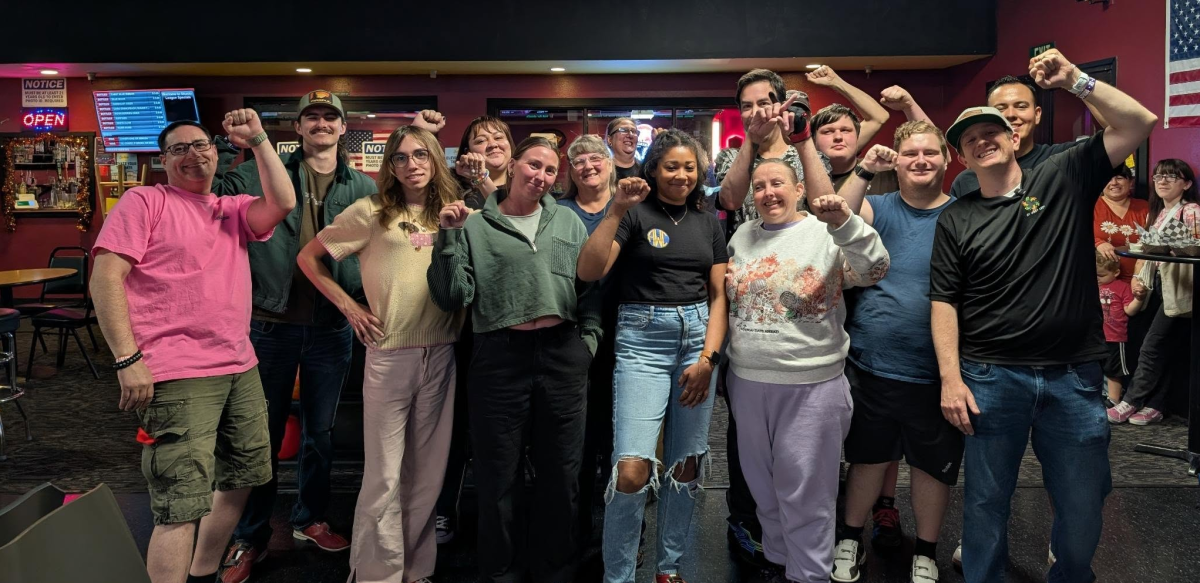
UFCW Local 8 represents 23,000 workers in grocery, meatpacking, health care, and cannabis across northern California and the Central Valley. The insurgent At What Cost slate is seeking to get on the ballot and challenge the incumbent leadership for the first time in at least 40 years.
An insurgent slate is challenging the longtime incumbents in Local 8-Golden State, one of the largest locals in the United Food and Commercial Workers (UFCW), in what may be the local’s first competitive election in decades. And now, after protecting the election from a sham merger attempt that would have canceled the election, the battle is on.
Ballots are set to be mailed on November 21. But when members first saw the election notice in the local’s newsletter, they discovered a big “but.” The notice stated that the election would not proceed if Local 8 merged with another union, the Staffing Agencies Federated Employees (SAFE), before the end of the year.
Members said they had never heard about this possible merger, or SAFE, before reading about it in the final sentence of the election notice, mailed to members on October 16.
What is SAFE? Publicly available information about the organization, which has multiple ties to Local 8 President Jacques Loveall, raised more questions than answers. Neither Local 8, the UFCW International union, nor SAFE has responded to inquiries about the merger.
With the help of Essential Workers for Democracy, a UFCW reform organization focused on member education and union democracy, the insurgent slate urged the Department of Labor to investigate SAFE and the merger. After a federal investigator began to probe, the local told them the merger had been “postponed indefinitely.”
A FAMILY AFFAIR
Local 8 represents 23,000 workers in grocery, meatpacking, health care, and cannabis across northern California and the Central Valley. End to end, it would take 10 hours to drive the length of the local’s jurisdiction.
The reform slate At What Cost is running on opening up negotiations to members and training stewards in every workplace. Wages for grocery workers have stagnated across California. A 2025 study sponsored by several other UFCW locals on understaffing at Kroger and Albertsons found a high degree of financial insecurity among their workers.
“Grocery careers, once dignified, have been reduced to second jobs for most,” said Eric Marcuz, a veteran Safeway worker who is running for president on the At What Cost slate. The local has not had a competitive election in at least 40 years.
Marcuz’s slate created a page to try to provide members more information about the merger, and sent a letter of complaint to Local 8, UFCW International, and the Department of Labor over what they saw as an effort to avoid a democratic election.
The At What Cost slate is running against a slate of incumbents—the Solidarity Works Team— headed by Loveall, who has been president of Local 8 and its predecessor union, Local 588, since 2004. He took over the position from his father, Jack Loveall, who became president of Local 588 in 1984, after working in high-level positions for the UFCW International and one of its predecessor unions, the Retail Clerks, for many years.
When the elder Loveall retired, he was one of the highest-paid union officers in the country, earning more than $567,000 in compensation a year, equivalent to over a million dollars today.
“The Loveall family has led our union for decades,” said Marcuz. “Over that time they have consolidated power at the top and completely distanced themselves from the workers they claim to represent. While their wealth and wages have ballooned, the members have been left behind.”
On his LinkedIn page, the younger Loveall describes himself as “Chief Executive Officer of trade organization (UFCW8.org).” He received $306,000 in total compensation from the local last year, plus another $20,000 salary as an International Vice President and $34,752 from his role as a trustee of the UFCW Vacation Compensation Trusts. Loveall is also the director and co-founder of Solidaritus, a for-profit health care company that Local 8 has purchased millions of dollars of shares in, as have other unions.
‘THAT’S THEIR MODE OF OPERATING’
Leaders of the local have used a merger to avoid a competitive election before. In 2006, a slate of reformers planned a challenge to the leadership of then-Local 588, including Loveall. But prior to the scheduled election, Local 588 merged with Local 1288 to form Local 8-Golden State, and elections were put off until 2008.
Meanwhile, Doug Slaydon, a 25-year meat cutter and the reform slate’s candidate for union president, was fired from Safeway on the pretext of a customer complaint in 2006. The firing occurred a day after a 20-store campaign blitz by his slate, 588 Members for a Democratic Union.
“That's their mode of operating,” Slaydon said, referring to the mergers. “That's how they got around my attempt at an election.”
“Federal law is clear: local unions must hold officer elections at least every three years,” said Will Bloom, a professor at the CUNY School of Law and a board member of the Association for Union Democracy. “Any attempt to forestall an election through a sham merger, in an effort to quash dissent and make member participation more difficult, goes against the basic principles of union democracy law.”
A REAL UNION?
The proposed merger with SAFE immediately raised the eyebrows of members and the Department of Labor.
It is not clear who SAFE represents, or whether it is even a union. On its website, SAFE calls itself a “labor-driven initiative committed to securing union inclusion and equitable treatment for workers employed through staffing agencies.”
However, there are no union election filings by SAFE with the National Labor Relations Board, nor any other public documentation of where members are being organized. The organization’s website is filled with stock photos, rather than photos of actual members.

An initial LM-1 form for SAFE was filed on February 9, 2026 by Patricia Schreiter, who appears to be a relative of Loveall, and has no other public connection to the labor movement. Schreiter was not listed on SAFE’s website as an officer, although the LM-1 form lists her as president. After members and a federal investigator from the Department of Labor began asking questions, the page listing SAFE’s officers and staff was removed from its site.
As of early last week, the SAFE homepage stated the organization was “9,800 Strong and Growing,” but this figure has since been removed. A legislative update on the SAFE site from September 30 included a reference to union mergers as a strategy “to build a larger, stronger, more unified organization,” as “bigger unions win bigger protections”, but this language has also been removed.
The SAFE website features dozens of articles about the SAFE Act, or SB 1032, a California state senate bill sponsored by Senator Eloise Reyes that would tighten regulatory standards for temporary staffing agencies and require them to buy workers’ compensation insurance. Loveall has been a vocal supporter of the bill via the UFCW Western States Council, the bill’s co-sponsor.
However, an aide for Senator Reyes told Labor Notes that the SAFE union was not registered as a group in support of the bill, or one that they had personally interacted with.
WEB OF CONNECTIONS
There are a number of suggestive ties between SAFE and an organization called The PACT, which claims to be a 501(c)5 labor organization for temp workers. Until early last week SAFE’s organizing director was listed as Fernando Cisneros, whose LinkedIn profile states that he is also a full-time “Growth Leader” at The PACT. (Cisneros’s name disappeared when SAFE removed that section of its website.)
The PACT has an arrangement with a company called Samuel Hale, which provides workers’ compensation insurance to the employers of temp workers and acts as a co-employer of those workers.
“In addition to passing along savings to our customers, Samuel Hale also reinvests a percentage of every payroll dollar worked into a benefits fund managed by The PACT, a 501c5, exclusively focused on developing and administering new benefits to our growing 10,000+ member population,” Samuel Hale writes on its website. These workers appear to be mostly immigrant workers in sectors including warehouse work, food processing, and domestic services.
As of earlier this week, SAFE’s website had a section called “Health Care & Retirement Benefits,” which stated that SAFE members will receive a defined benefit pension plan, as well as comprehensive medical coverage. These are both benefits which The PACT claims to offer to its employees. This section on the SAFE website, too, has since been removed.
Samuel Hale and Local 8 appear to have a collective bargaining agreement, and seem to be utilizing California’s Alternative Dispute Resolution (ADR) carve-out, a state law that allows for workers’ compensation claims to be directly arbitrated between a union and employer, bypassing the state’s worker compensation board. A collective bargaining agreement must be in place in order to qualify for the carve-out.
Loveall of Local 8 (then Local 588) appears to have signed a collective bargaining agreement in 2005 with Samuel Hale on behalf of The Professional and Commercial Trades Association (PACT), according to a video posted on the company’s Facebook page. In a 2025 workers’ comp appeal case, a Samuel Hale spokesperson said that the Samuel Hale employees are covered by a UFCW CBA and that The PACT is “a wing of the UFCW.” However, the details of this agreement are unclear and cannot be found online. The worker who filed the appeal also said that Local 8 was unable to provide “any information regarding alleged union membership,” even as Samuel Hale affirmed that union dues were being deducted from employee paychecks.
Samuel Hale says that it can help employers cut workers’ comp claim costs by up to 50 percent, and boasts that it is the only entity covered by the California ADR carve-out that can extend the carve-out’s protection to other employers, thanks to its CBA with Local 8.
In addition to the web of connections between SAFE, The PACT, Samuel Hale, and Local 8, SAFE’s articles of incorporation were filed July 17, 2025 by Ellen Anreder. Anreder is the CEO of Bleiweiss Communications, a major vendor for Local 8. Website metadata indicates that SAFE’s website was also created by Bleiweiss.
Anreder and Loveall together serve on several non-profit boards that Local 8 has financial ties to, including CORPaTH, the Food and Drug Conference, the Loveall Foundation for Children, and All Trusts Cooperative (of which Anreder and Loveall are the only two board members), with a collective net assets of over $10 million.
FUTURES AT STAKE
In the UFCW, local union bylaws typically allow for elections to be called at any point in a six-month window preceding the end of a term, giving incumbents a powerful advantage, since challengers can't be sure when exactly they might need to take time off to collect nomination signatures or campaign to turn out the vote. What’s more, Local 8 has scheduled ballots to be mailed during the week of Thanksgiving, a universal blackout period for time off in the grocery retail sector. That’s exactly the week when candidates could most effectively campaign at worksites.
The At What Cost slate notified the local union of their intent to run in August 2025, although reformers have been publicly agitating in the local since late 2024.
But even talking about doing more to engage members has had repercussions. After Marcuz read Jane McAlevey’s organizing guide No Shortcuts, he brought up the possibility of opening up bargaining to his union rep. A few days later, he was removed from his position as steward, and was told that more “loyalty” was expected from him.
Marcuz and his co-workers encountered similar resistance when they collected 300 petition signatures for Zoom access to union meetings, which are only held in-person at the union office in Roseville—a several-hour drive for many members of the local, which is spread out across 40 counties. The same happened when they organized bowling socials.
During their campaign, union staff representatives have allegedly told members that it’s illegal to wear At What Cost buttons or to provide contact information to the slate. At a Safeway store in Turlock, a rep physically pulled a member away from speaking to Marcuz.
“Workers face exploitation through contract violations, wage theft, and unsafe staffing and working conditions,” Marcuz said. “We could organize against these issues, but our leadership seems more interested in collaborating with the corporations creating these conditions than with the members who pay their salaries.”
In early November, members of the slate will be working to collect 443 petition signatures—2 percent of active members—to get on the ballot and force the first competitive election in memory.