Book Review: Courage or Complicity? How Veterans are Responding to the Assault on Democracy
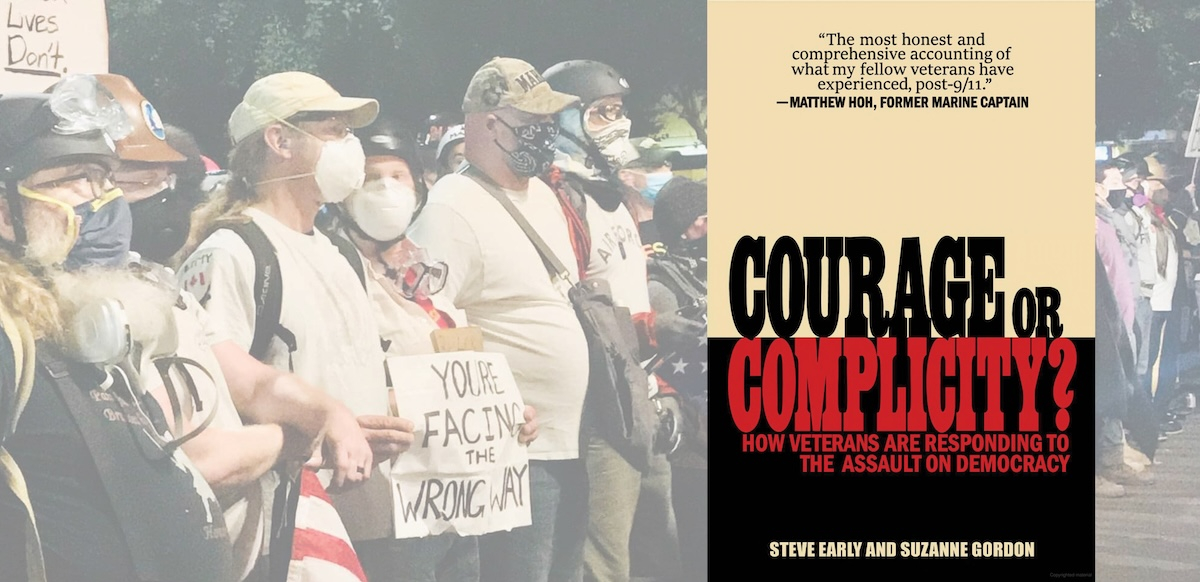
Courage or Complicity: How Veterans are Responding to the Assault on Democracy, by Steve Early and Suzanne Gordon, is published by PM Press (2026).
U.S. military veterans are drilled by their commanders to obey their superior officers. Many still believe it is their duty to support the commander-in-chief even after their tour of duty.
But at a time when Donald Trump is undermining the Veterans Administration, attacking unions and other democratic institutions, and instigating illegal wars, could the nation’s 17 million military veterans become key allies in the fight for workers’ rights, democracy, and peace?
In their recent book Courage or Complicity? How Veterans are Responding to the Assault on Democracy, Steve Early and Suzanne Gordon provide a wealth of examples showing how veterans and labor can form a powerful alliance for change.
The authors cite veterans like Richard Ojeda, a 25-year Army vet who voted for Bernie Sanders in the 2016 primary, and for Trump in the general election. But now, says Ojeda, people “are realizing that they were pawns in the oldest con game in the book—blame immigrants, blame workers, blame anyone who doesn’t look or pray… the way you do.”
Many vets feel bitter about the wars our leaders are sending them to, and wary of Trump’s war-mongering. Vietnam vet Jerry Lembcke observes that a lot of veterans “came back [from overseas] deflated and disappointed.” Another veteran concluded, “We were not guests, but invaders… we were occupiers.”
Veteran Daniel Sjursen decided that the war in Iraq was “built on lies, ill-advised, illegal, and immoral.” He now wants to find more “socially conscious veterans of these endless, fruitless wars who are willing to step up… for revitalized patriotic dissent.”
FIGHTING FOR THE VA
Instead of more wars, what many vets want from both the government and employers is support for their mental and physical needs.
As the authors note, veterans are at higher risk for post-traumatic stress disorder, substance abuse, and suicide. Even “joystick warriors” who carried out targeted assassinations via Hellfire missiless from the other side of the world have experienced PTSD. One U.S. Air Force vet involved in drone operations suffered from “depression, sleep disorders, and anxiety.” Two of her former colleagues committed suicide.
Many vets are angry about Trump’s cuts and outsourcing at the Veterans Administration, which have led to staffing shortages and compromised treatment for vets in need. The Trump regime has cancelled nearly 600 federal contracts and proposed a $12 billion cut in funding for VA caregivers.
Early and Gordon write that close to one-third of the VA’s healthcare workforce—about 100,000 people—are veterans. “So at VA hospitals around the country, vets are taking care of other vets—as doctors, nurses, therapists, and support staff.” This, they write, “creates a real community of care which is not reproducible in a ‘fee for service’ world of privatized care that siphons off billions of dollars every year away from the VA budget.”
And yet the Trump administration is doing everything it can to privatize VA services and demolish federal unions representing staff at the VA and elsewhere.
In response to Trump’s efforts to partially privatize the VA, thousands of members of American Federation of Government Employees, National Nurses Union, and Veterans For Peace organized protests on a national “Day to Save the VA.”

Vets employed by the Department of Veterans Affairs have been campaigning to “Save Our VA,” with active support from Veterans for Peace and the veterans group Common Defense. Vets in the U.S. Postal Service (one of the nation’s largest employers of veterans) are also rank-and-file leaders in the fight against privatization.
Labor Notes has helped bring together VA patients and their caregivers to fight VA privatization. They’ve linked this to the fight for universal healthcare, noting that the VA can be a model of not-for-profit healthcare. The Federal Unionists Network is organizing to fight cutbacks at all of the federal agencies.
VETERANS AS ORGANIZERS
Men and women in military service learn that they have to count on each other for survival. As Early and Gordon put it, “Their past experience with collective action can be put to good use in a strike situation or in a non-union workplace where organizers must be resourceful and brave to stand up to anti-union employers like Amazon or Walmart.”
And since many blue-collar communities hold veterans in high respect, vets can be an important asset for unions trying to generate popular support for their organizing and contract fights.
Today about 1.3 million former military personnel work in union jobs. These workers are in a perfect position to expose the hypocrisy of so-called “veteran-friendly” firms like Amazon and Walmart.
That hypocrisy is glaring. The U.S. Chamber of Commerce Foundation, no friend of workers, solicited Amazon and other major corporations to hire veterans and employ “best practices for strengthening mental wellness and preventing suicide.”
But Amazon’s treatment of its employees is known for causing physical and emotional stress. Navy vet Seth King said “it was exhausting just thinking about having to come in and start another 10 hour shift” at Amazon. “I didn’t want to be alive any more if that was the future that I had to look forward to. I was in the Navy for 8 years, and there wasn’t a single day that I felt as miserable or as isolated as I did at Amazon.”
UNIONS AND COMMUNITY ALLIES
The Communications Workers has a program called Veterans for Social Change, which organizes a broad base of union activists who are veterans to engage with community allies.
CWA partnered with the veterans’ group Common Defense to send younger veterans to week-end sessions on how to fight big money on behalf of poor and working-class people.
Common Defense has stood up against Trump’s use of the National Guard to intimidate or attack protesters. “We’ve seen peaceful protests met with riot gear and we’ve heard the threats to deploy active duty marines against American citizens,” member David Marshall told a rally crowd. “Let me be clear: Using the military to silence dissent is not strength, it’s tyranny. And no one knows that better than those who have worn the uniform.”
Meanwhile, in CWA Local 7250, president Kjeran Knudson learned that one unit of the National Guard, with 50 soldiers and 15 armored vehicles, was operating out of the St. Paul labor center during Black Lives Matter protests. He and others pushed for them to be expelled. “Our union hall should have no place in those militarized efforts against the Black community, activists, and working people,” he said.
Knudson expressed hope that unionization efforts in the Guard might lead to “more potential solidarity between the Guard and people on the street or on strike.”
Together, union members and veterans can fight attacks on working people. Unions can organize members who are veterans to battle corporate bosses. And shop floor activists can push their unions to join with anti-war veterans to oppose the endless overseas wars that hurt the working class while enriching corporate stockholders.
Early and Gordon’s book is fuel for this growing labor-veteran alliance.
John Braxton has been a labor activist for 48 years and a leader in the Teamsters and the American Federation of Teachers.