Canadian Walmart Workers Make History: A Union Contract
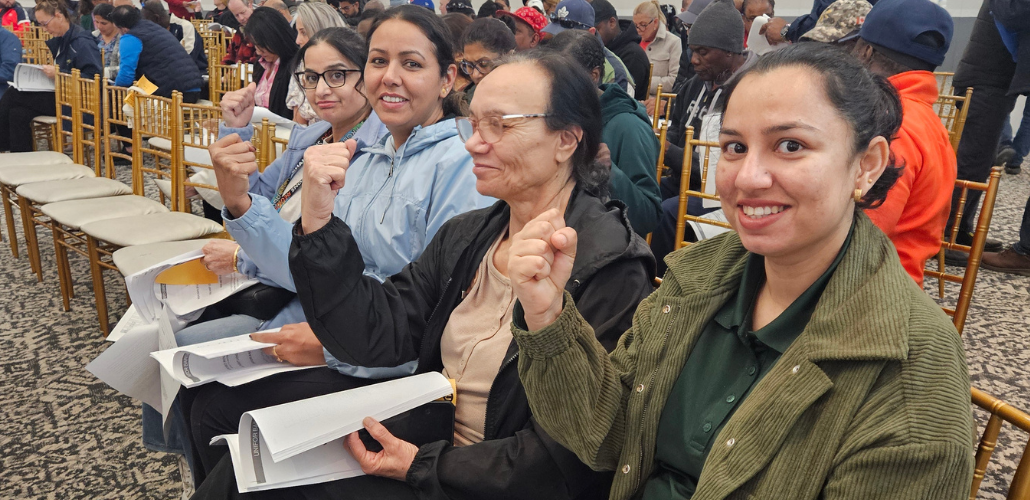
They organized at one warehouse... and scored a raise for every Walmart warehouse worker in Canada, as the company tried to quash further organizing. Photo: Angela Drew Kimelman
Eight hundred workers at a Walmart distribution center in Mississauga, Ontario, succeeded where others have not: they are now working under a two-year contract with North America’s largest logistics giant.
The landmark collective bargaining agreement went into effect on July 1, nearly two years after workers won union representation, joining Unifor Local 252, motivated by low wages and unsafe working conditions.
As punishment two years ago, Walmart bumped the pay of every logistics worker in Canada—except those who unionized. This was an effective maneuver to halt further union drives.
“Walmart gave all the wage increases to all the non-union folks, and everything fell apart,” said Angela Drew Kimelman, a Unifor organizer who worked on organizing campaigns at multiple warehouses, including one in Cornwall, near Montreal.
But now, the new contract prevents Walmart from raising wages at other warehouses without doing the same at this one. The unionized workers have received a matching raise, and back pay for the months when other warehouse workers received raises that they didn’t.
Unifor has restarted its organizing efforts at other Ontario warehouses.
‘QUITE THE EYE-OPENER’
In past union drives, Walmart has closed facilities rather than deal with a union. So far, no such threat has emerged for this warehouse.
Instead, two months into the contract, members are moving forward with contract education and implementation, for both workers and the boss.
For the first time, the workers have the protections of a contractual disciplinary procedure. “If you’re at another distribution center and they walk you out, you’re pretty much on your own, at the mercy of the employer,” said Rodolfo Pilozo, a 30-year Walmart worker and member of Unifor’s organizing and negotiations committees.
Kathryn Cespite, an eight-year worker at the warehouse, acted as an interim steward with a co-worker in the contract’s first week. “That was quite the eye-opener,” she said. A manager tried to discipline a worker without letting him tell his side of the story.
STALLING TACTICS

It took 18 months of negotiations to reach a deal. Walmart used stalling tactics, like offering very few dates for negotiations.
“I believe they were intentionally trying to drag out the process, and frustrate the membership into decertifying us,” said Shayne Fields, Unifor’s lead negotiator. There was a decertification petition, he said, and workers reported that Walmart was covertly supporting it, but it never got much traction.
The company also brought in temp workers, implying a threat to replace union workers.
“Walmart was feeding people a lot of misinformation,” Cespite said. “I let the union representatives know what was being said in meetings, and then the union was able to counter it.
“They were taking advantage of people’s lack of knowledge about what unions are,” she said. “One of the challenges we’re running into is that a lot of the people don’t have any experience with unions and don’t know what it’s all about.”
Now that the contract is in place, “we have two years to educate ourselves and others,” said Pilozo. “It’s not just the president of Local 252, or of the national union. It’s us, collectively; we can make changes.”
WHY WALMART GAVE IN
Ontario’s labor laws helped. The law includes a conciliation process for first contracts. First there’s mediation, and then disputes can move to settlement through arbitration. Unifor’s lead negotiator, Fields, filed the paperwork to move that process forward, which started an external clock that pressured Walmart to settle.
Geography also helped. Labor scholar Benjamin Fong argues it would be “a huge pain for Walmart” to relocate this regional distribution center, which serves most of Ontario and Quebec, because the area is hemmed in by the Great Lakes and the layout of Toronto. Walmart already closed its distribution centers in Quebec, which has even stronger labor laws.
Walmart worker Simon Hayford thinks the company settled because executives were worried about more warehouses joining the union, and they didn’t want to draw more attention to the unionized one. He and Pilozo have been participating in Unifor’s efforts to organize other Walmart warehouses.
“I’ve talked with some of the other warehouse guys, and they say ‘We’re making the same money so why would we do it?’” Hayford said. But he anticipates the other benefits the contract provides, like an improved safety committee and protection against unfair terminations, will show the value of the union over time.