UAW Members Voting for International Officers
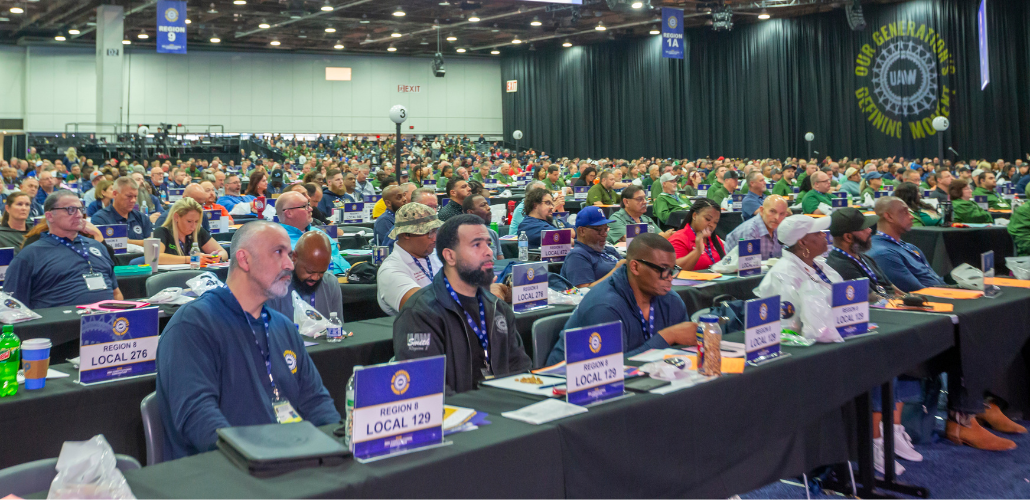
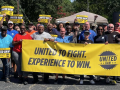
Delegates to the UAW Convention in June heard candidates for top offices. Any active member could run; there was no signature-gathering requirement as in some other unions. Photo: Jim West | jimwestphoto.com
United Auto Workers members are voting by mail ballot for their top officers, for the second time in the union’s 91 years. Ballots went out August 21 and are due back by October 5.
The contest will decide whether President Shawn Fain, who became famous for leading 2023’s Stand-Up Strike against the Big 3 automakers, will be able to continue the union’s about-face from its previous employer-friendly ways.
William Hughes, a member of UAW Local 249 at Ford Kansas City, said the election is about maintaining the union’s momentum in winning gains for the membership.
“During my 27 years in the union, I’ve never seen anything even close to the amount of gains that we’ve been getting in all these contracts—not just in the Big 3,” said Hughes. “I built seats before I came to Ford, and under no circumstances that I can recall would the parts sector ever strike these plants and try to really push for bigger contracts.”
Fain was first elected in 2023 on a platform of “no corruption, no tiers, no concessions.” He is running on a record of successful contract fights at the Big 3 and elsewhere, and a pledge to keep organizing parts suppliers and nonunion auto plants in the South.
His opponents have downplayed the gains made in the last three years, asserting that any president could have won them. Instead, they have focused on strife at union headquarters and unflattering reports issued by the federal monitor, Neil Barofsky, who was appointed in 2021 to oversee the union after massive corruption was uncovered and a dozen officers went to jail.
NEW SMILES
Fain’s strongest base of support is in locals where members have experienced the new willingness to fight management.
JoAnna McClenathan is a senior designer at General Dynamics Electric Boat in Connecticut and a steering committee member of the reform network UAW Member Action, which is backing Fain. She credits Fain for opening up bargaining and creating a new Department of Bargaining Strategies that helped her local score a “record contract” with 30 percent raises.
Fain set up that department to research employers and involve members in escalating campaigns. “During our contract fight last year, he came down and met with us, and he was a big reason we had the resources we did,” she said.
“We had essentially been bargaining behind closed doors since the 1980s. For so long, a lot of us in our local felt powerless: this is what they’ve given us, so we’re just going to vote for this. Last year, the rank and file was able to use our voice and become more engaged, and that’s due to the new strategy.”
Similarly at American Axle, an auto parts supplier in Three Rivers, Michigan, members are happy with the results of a two-week strike in June. They will be making $30 an hour by 2030, up from a top pay of $22.
“We’re starting to see a change in the parking lot,” said bargaining committee member Jon Krause. “People are now able to buy cars that can get them to work. Some are looking to buy their first homes. We’ve seen a few people smiling that we haven’t seen smile in years.”
Krause predicts Three Rivers members will vote for Fain’s United UAW slate.
Legal services worker Brian Sullivan, a member of UAW Local 2325, said workers in his industry have set their sights on bargaining sector-wide. They were inspired by Fain’s industry-wide strategy with the automakers, he said: “We want a UAW leadership that’s going to back us as we take similarly big swings.”
FIVE CHALLENGERS
Fain’s five challengers spent most of the union’s presidential debate July 30 attacking him. They are Rich Boyer, vice president for the Stellantis Department; Tricia Geiger, an international servicing rep; Stellantis worker Brian Keller; Mack Truck worker Will Lehman; and Greg Mooney, recording secretary from Local 2147.
Of the challengers, Boyer and Keller have the most name recognition. Keller won 14 percent of the vote in 2022 and spearheaded failed efforts to recall Fain last year. He finished fourth out of five candidates in his local union’s (Local 1248) delegate election this spring.
Boyer and Fain ran on the same slate in the last election, as did Vice President Mike Booth and Secretary-Treasurer Margaret Mock, also now opposing Fain’s slate on their own slate, Integrity. Their differences have been the subject of long reports by the monitor.
Fain accused Boyer of failing to enforce the contract at Stellantis and of responsibility for a new attendance program that members hated, as well as trying to secure union jobs for family members—standard practice in the old UAW.

Boyer has consistently maintained that it’s the union’s job to enforce company attendance policies. In a video message to members about the 2023 contract ratification, he bemoaned the overuse of medical leave (FMLA) by people who “don’t want to do the work” and implied that plants would close if the union didn’t help fix attendance.
The union’s executive board voted to relieve Boyer and Mock (who had also tried to put a family member on the payroll) of some of their assignments. Fain and other board members said Mock was using her office to block projects and retaliate against staffers she disliked.
The monitor agreed with Boyer and Mock that their removal was “retaliation,” and they were reinstated. Earlier, the monitor had called Fain to lobby against the executive board’s December 2023 call for a ceasefire in Gaza. Fain angrily refused to back down, and he charges the monitor with having it in for him ever since. Barofsky accuses Fain of seeking favors for his fiancee and her sister.
“The truth when it comes to Boyer is that I didn’t want him running the Stellantis Department because he wasn’t doing a good job for our members,” Fain told The Nation magazine. “I wouldn’t let him hire family members into UAW positions, and I wouldn’t stand by while he bargained concessions with Stellantis and failed to enforce our contract.”
Boyer’s supporters say he is outspoken and a fighter. His main pledges in his campaign statement in the UAW magazine were to lower union dues to two hours a month, reduce the staff and salaries at union headquarters, and hire only from within the membership. Delegates at this summer’s convention voted to keep dues at 2.5 hours to build up the strike fund and provide resources for aggressive organizing and bargaining campaigns.
The dueling ugly accusations have fed member cynicism, the prevailing attitude before 2023. Fain’s opponents are largely focused on the “infighting” among the leadership. “I don’t like the way [Fain] treats people,” said Jennifer Miller, recording secretary at Local 1700 near Detroit, who backs Boyer. “I don’t like the arrogance of him. I don’t think he deserves credit for everything he says he’s done.”
In the last election, Fain, who was running against then-President Ray Curry, benefited from a powerful anti-incumbent sentiment, stemming from years of frustration with concessions, plant closures, and corruption at the union’s top levels. This time, he won’t have that advantage.
JJ Barbosa, a millwright at Stellantis’s Jeep plant in Toledo, has backed Keller, a prolific Facebook presence, in all three of his runs. He sees Keller as tenacious and consistent, and he is “disgusted that there are still tiers.” He says all the incumbents are guilty of “cronyism and nepotism.”
MOMENTUM
In interviews with members across the union, it was common to hear that they were impressed that Fain showed up at locals to talk with members and supported their contract fights.
Carlos Gonzalez-Rios, a 27-year worker at the General Motors engine plant in Buffalo, New York, said he met Fain twice. He rattled off a few of the gains he’s seen, including a pay increase of 25 percent. “We got COLA back,” he said. “We don’t have endless temporary workers for five or six years.”
He also cited the union’s win at Volkswagen in Tennessee, where workers voted to join the UAW and won a first contract earlier this year—becoming the first unionized foreign-owned auto assembly plant in the South.
What’s at stake in the election, Gonzalez-Rios argues, is whether this momentum will continue. “I’d rather go with the guy that’s been proven and has the leadership skills that brought us what we have right now,” he said. “And we still have issues that we are working towards—we want health care for all at GM after retirement.”
“I’ve held people accountable and that pisses some people off, I understand that,” said Fain during the presidential debate. “But running on a platform of ‘the monitor said this or that,’ that’s not going to deliver for the membership.”
CHANGING ALLIANCES
The union’s 400,000 active members and nearly 600,000 retirees will be electing all 14 positions on the union’s International Executive Board.
Fain’s United UAW slate, which is contesting 13 of the seats, includes candidates who ran against him in the last election as members of the “Administration Caucus” that had run the union since the 1940s and overseen multiple waves of concessions in recent decades. Some have been won over by the impressive contract results that Fain’s bold approach has achieved; others may be inclined to go with the one in power.
In early August, three ex-UAW presidents, Ray Curry, Rory Gamble, and Ron Gettelfinger, attempted to resurrect the old ruling caucus by releasing a letter backing Geiger, Mock, and other Fain opponents. Fain shot back, reminding members of Gettelfinger’s “sellout deal” in 2007 that cut wages in half for new-hires and created the two-tier system.
Four regional directors on Fain’s slate are running unopposed: Mark DePaoli in Region 1A, Mike Miller in Region 6, Tim Smith in Region 8, and Brandon Mancilla in Region 9A. The other five director seats and three vice president seats are all contested, as is the secretary-treasurer slot.
Candidates need a majority to avoid a run-off, and votes will be tabulated October 6.