They Didn’t Wait: California Teachers Strike and Win
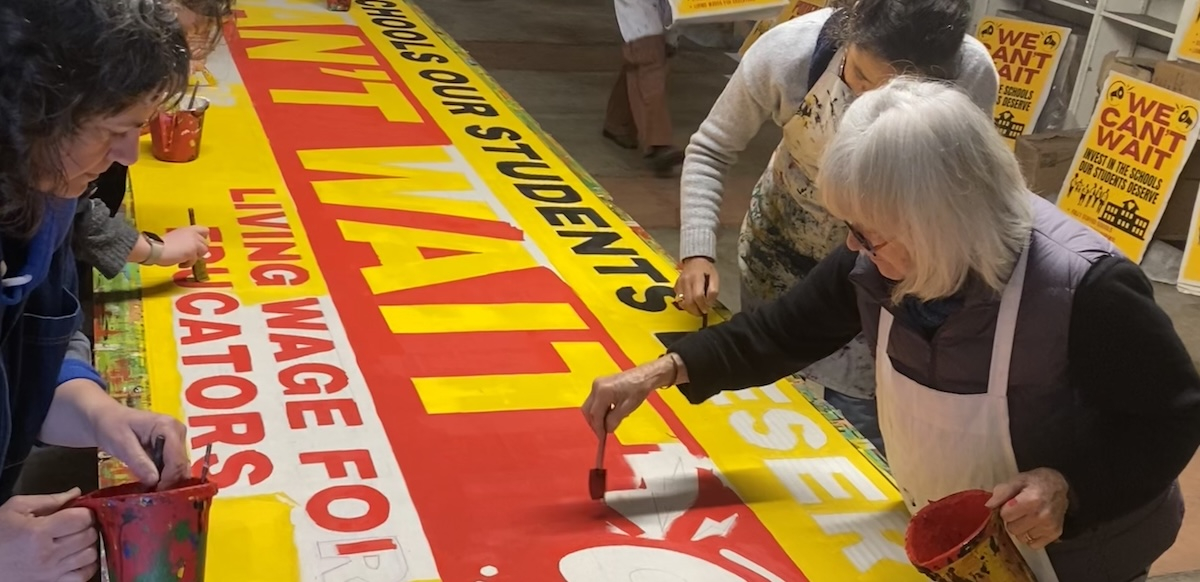
Oakland Education Association members made a banner for the 'We Can't Wait' campaign. Photo: David Solnit
Tens of thousands of California educators joined forces statewide, wagering that they could win more by working together. The result was a wave of strikes this school year that defied narratives of austerity and won better funding.
“Our districts are different, but our stories are the same,” said Gina Gray, a Los Angeles high school English teacher who served on her union’s extended bargaining committee. “It’s exciting to see how up and down the state, locals are really standing up. Educators everywhere are saying: Enough is enough. Invest in public education the way it deserves to be.”
The We Can’t Wait Campaign started with 11 California Teachers Association locals, and expanded to 32. They ratified a shared platform of fighting for smaller class sizes, more school resources, and competitive compensation. They also committed to organize and escalate on a common timeline, build up member power at their schools, and work with families, students, the community, and other unions.
In the course of the campaign, six locals struck—San Francisco, Richmond, Natomas, Twin Rivers, Dublin, and Little Lake. Others, including Oakland and Los Angeles, took strike votes but settled before walking out.
RECORD-SETTING STRIKES
The campaign started with the locals doing coordinated actions, but it became clear as bargaining reached full swing that their negotiations were moving at different paces, said Denisha Jordan, a Los Angeles teacher who is organizing for the campaign statewide.
Richmond was the first to strike, going out for four days in December. Next was San Francisco for four days in February.
In March, Notomas and Twin Rivers, two locals in Sacramento, went out just days apart. At 12 days, Twin Rivers set a record for the longest teachers strike in Sacramento County history. Dublin, near the Bay Area, also struck in March for four days.
Little Lake, outside Los Angeles, went out for 10, starting on April 16, which was also the United Teachers Los Angeles strike deadline.
San Francisco hadn’t been on strike in nearly 50 years; Richmond, Notomas, Twin Rivers, Dublin, and Little Lake never had.
Brittoni Ward, the president of Twin Rivers United Educators, said they suspected their strike would be longer than others’ when they walked out demanding fully paid family health care, better wages, and reduced class sizes and caseloads. But they didn’t anticipate setting a record.
At one point during the strike, management refused to bargain over anything unless the union agreed to the district’s health care proposal, Ward said. The district also signaled its willingness to wait the strikers out, soliciting scabs all the way up to spring break.
But the strikers were united.
“This district thought they were going to break us, and all they did was empower us,” Ward said. “On the eleventh day, we had the highest [picket line] attendance... Our members knew the financial strain that they were taking, they knew the risks, but they knew this is the only way we were going to change the direction of this district.”
The strike didn’t end until California Assemblywoman Maggy Krell stepped in to mediate. The 1,500-member union won fully paid health care, retroactive to July 2025.
They also won wage increases of 4 percent for 2026 and 3 percent for 2027, and put speech language pathologists on a new salary schedule. But they weren’t able to achieve their demands on caseloads and class sizes, instead getting an agreement to form a committee to discuss those issues.
GAME-CHANGING SOLIDARITY
As educators across California were gearing up to fight, district administrations across the state united around their own common message—that the money simply wasn’t there. But when educators walked off the job, the districts found the funds.
In Richmond, the union was told repeatedly that the district didn’t have the money. But United Teachers of Richmond President Francisco Ortiz said that their school district, West Contra Costa Unified, was subject to the same funding formula as other school districts that were managing to avoid vacancy crises.
Richmond was spending a quarter of its budget on outside contracts, Ortiz argued, and it needed to reprioritize the workers who show up for students in the classroom.

Getting ahead of the district’s austerity narratives emboldened other school unions. Teamsters Local 856 represents custodians and paraprofessionals in the Richmond schools. In December they voted down a tentative agreement recommended by their bargaining committee, opting to strike with the educators instead.
“That was the game changer,” Ortiz said, “when we were able to work alongside our Teamster siblings.”
The educators won 8 percent raises over two years, fully paid family health care by June 2027, and more support for international teachers, a significant part of their workforce. Teamsters Local 856 won a 3 percent raise, retroactive to last July, and a 4 percent raise for 2026—much improved from the offer they had voted down.
EXPANDING COALITIONS
In Los Angeles there was no question the money was there—the district was sitting on $5 billion in reserves. “Spend today’s dollars on today’s kids” was the educators’ refrain, Jordan said.
L.A. educators felt that their district was spending too much on tech contracts and subcontracting—$10 billion on private contracts from 2022-2025. And the district wasted the better part of the year not engaging seriously with their proposals, making the educators feel they had to strike.
The contrast between the district’s austerity narrative and the flashy social-media lifestyle of Superintendent Albert Carvalho generated common disgust in the schools and with parents, said Maya Suzuki Daniels, a teacher on the expanded bargaining committee. Carvalho is currently on paid leave after the FBI raided his house in February.
It was like the district was divided into two social classes, Suzuki Daniels said: teachers and support staff versus the “Beaudry class,” a reference to LAUSD’s luxury office downtown, where administrators make two or three times the salaries in the schools.
SEIU Local 99, with 30,000 members in the district, was prepared to walk out the same day as United Teachers Los Angeles. So were the principals and administrators, who unionized with Teamsters Local 2010 in 2024. All the unions settled before the strike deadline.
The educators won a raise in the starting salary to $77,000, an average increase of nearly 14 percent, paid parental leave—a first for the union—and improvements to planning time for special education.
UTLA members had been building a strong relationship with their SEIU co-workers for years, and went on a sympathy strike with them in 2023. Having principals and administration prepared to strike, on the other hand, was something new.
“It’s different, but we’re coming to see why we need to stand together,” Gray said. “At my school site, it’s not a hierarchy. When we’re preparing for this action, we’re standing together as ‘union strong.’”
In San Francisco, too, unionized principals and administrators voted to strike with educators and joined them on picket lines. Jordan was in San Francisco and spoke with administrators out on the line. It was both “really cool” and “a little weird” she said, but the members embraced it.
TAX THE RICH NEXT
Now that the locals in the We Can’t Wait Campaign have won stronger contracts, they’re setting their sights on the larger funding issues in the state, including fighting in the legislature to tax billionaires. The campaign’s next phase also looks to shorten the three year budget cycle for school districts. The long cycle allows districts to grossly overestimate how much they’ll spend in future years and avoid putting those dollars into classrooms now, Jordan said.
Ortiz said that one of the biggest strike wins in Richmond was increased organizing capacity and new relationships with other unions and the community. The statewide campaign helped bring attention to the fight for better-funded public education, and also restored members’ hope and solidarity, he said..
“We can talk about it at rep council, we can talk about it at e-board meetings, but it’s still abstract,” he said. “But when they saw everyone coming together, it made it real.”
Twin Rivers United Educators formed such strong relationships, Ward said, that at some schools they’re still holding “morning huddles” like they did during the strike.
“This is a district that has disinvested in our students and educators over the years, and that’s not going to happen anymore,” Ward said. “We made a big change in that.”